Facts
The Plaintiff, S Shalu Constructions, filed a suit seeking specific performance of a Collaboration Agreement dated February 1, 2013, concerning property A-72, New Friends Colony, New Delhi
Source reference: p.1In January 2013, the Defendants represented themselves as joint owners of the property, disclosing two pending litigations: a partition suit (CS(OS) No. 649/2010, Ashok Kaura & Ors. v. Shashi Kaura & Ors.) and a specific performance suit (CS(OS) No. 1448/2010, by Mr. Ajit Pal Singh against Defendant Nos. 2 and 3)
Source reference: p.2The Defendants allegedly sought funds to settle the specific performance suit, promising a favorable collaboration agreement once resolved
Source reference: p.2Relying on this, the Collaboration Agreement was executed on February 1, 2013, where the Plaintiff agreed to demolish and construct a new building, paying ₹7.5 crores.
Source reference: p.2The Plaintiff paid ₹2 crores in cash to Defendant Nos. 2 and 3 immediately, acknowledged in the agreement
Source reference: p.2The agreement stipulated division of the constructed property, with the Plaintiff receiving the first and second floors, servant quarters, and 50% stilt parking, while the Defendants received other portions
Source reference: p.3The Plaintiff was to undertake redevelopment, apply for sanction plans, and make payments, while the Defendants were to settle litigations, obtain mutation, convert the property from leasehold to freehold, and hand over vacant possession
Source reference: p.3The Plaintiff applied for sanction plans and paid municipal charges of approximately ₹12.38 lakhs, and further paid ₹20 lakhs on March 16, 2013, and ₹12 lakhs on November 1, 2013, to the Defendants to facilitate litigation disposal
Source reference: p.3-4The specific performance suit (CS(OS) No. 1448/2010) was withdrawn on July 11, 2013
Source reference: p.4The partition suit (CS(OS) No. 649/2010) continued and was disposed of on July 14, 2022, with directions for decree sheet preparation
Source reference: p.4The Plaintiff alleges repeated assurances from Defendants regarding possession after formalities like mutation and conversion, which were pending until the final decree
Source reference: p.4, p.13, p.16Despite the disposal of earlier proceedings in July 2022, the Defendants allegedly failed to hand over possession or perform obligations
Source reference: p.4In October 2023, Defendants stopped responding, leading the Plaintiff to suspect an intent to sell the property to a third party
Source reference: p.4The Plaintiff issued a public notice on November 4, 2023, and a legal notice on November 8, 2023, demanding performance
Source reference: p.4The Defendants filed an application under Order VII Rule 11 CPC, contending the suit is barred by limitation under Article 54 of the Limitation Act, 1963, and that it is a commercial dispute requiring mandatory pre-institution mediation under Section 12A of the Commercial Courts Act, 2015
Source reference: p.8, p.12-13Issues
1. Whether the Plaintiff's suit for specific performance is barred by limitation under Article 54 of the Limitation Act, 1963
Source reference: p.82. Whether the dispute arising from the Collaboration Agreement is a "commercial dispute" of specified value, thus requiring mandatory pre-institution mediation under Section 12A of the Commercial Courts Act, 2015
Source reference: p.12-13Law Applied
The court applied Article 54 of the Limitation Act, 1963, which states that a suit for specific performance must be filed within three years from the "date fixed for the performance, or, if no such date is fixed, when the plaintiff has notice that performance is refused"
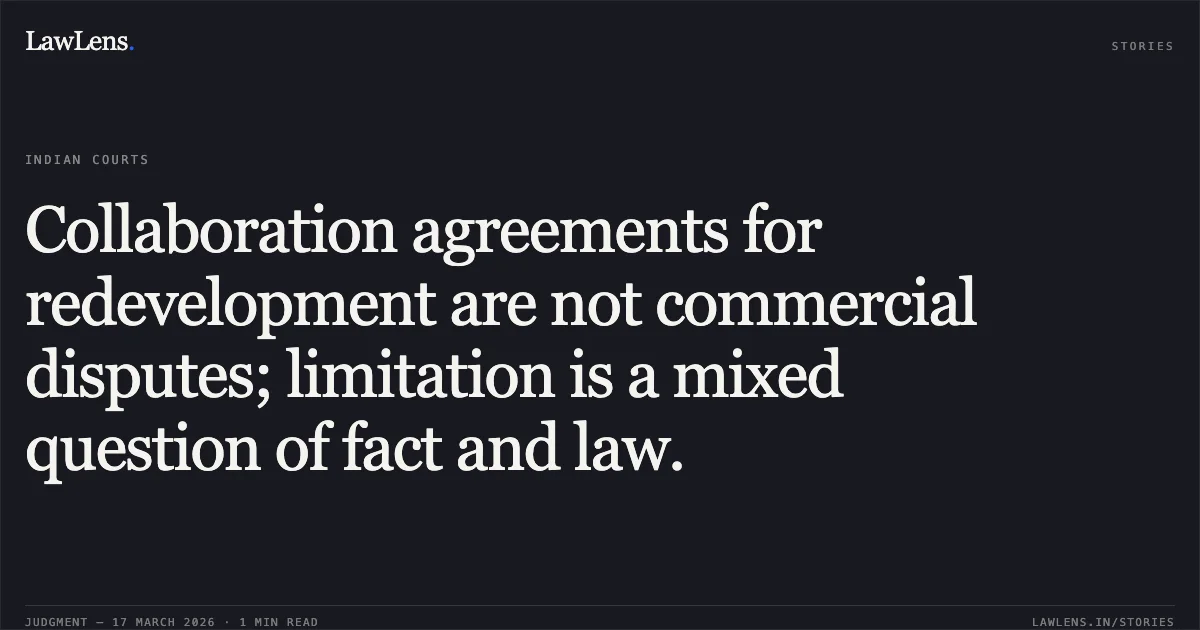
Source reference: p.8, p.11It also considered the principle that limitation is a mixed question of fact and law, and a plain can typically only be rejected on this ground if it is clearly demonstrated that the suit is barred by limitation
Source reference: p.17, p.18, p.22Furthermore, the court referred to Section 2(1)(c)(vi) of the Commercial Courts Act, 2015, which defines "commercial disputes" to include "construction and infrastructure contracts", and Section 12A of the same Act, requiring mandatory pre-institution mediation for commercial disputes
Source reference: p.13The court also relied on Panchanan Dhara v. Monmatha Nath Maity for the proposition that extension of time for contract performance can be implied by conduct, and limitation starts running only after notice of refusal when performance depends on obtaining statutory permissions
Source reference: p.17-18It cited Urvashiben v. Krishnakant Manuprasad Trivedi to affirm that in Order VII Rule 11 applications, only the plaint's averments are considered, and the issue of notice of refusal in cases where no date is fixed for performance typically requires evidence
Source reference: p.19-22Precedent from Asif Ali Khan v. Manoj Kumar was applied to determine whether a collaboration agreement concerning allocation of developed property portions constitutes a "commercial dispute"
Source reference: p.14, p.23-24Reasoning
The Court analyzed the limitation argument by considering the reciprocal obligations in the Collaboration Agreement, noting that the Defendants had the duty to get the property mutated, which could only occur after the final decree in the partition suit passed in 2022
Source reference: p.13, p.16Since the Plaintiff's obligation could only be carried out once the Defendants fulfilled their reciprocal obligations, and the final decree was only passed in 2022, the court determined it could not definitively conclude that the suit was time-barred ab initio
Source reference: p.16Citing Panchanan Dhara v. Monmatha Nath Maity, the court highlighted that performance might be dependent on obtaining statutory permissions and a vendor cannot take advantage of their own wrong in not complying with such provisions to plead limitation
Source reference: p.17-18The court further referenced Urvashiben v. Krishnakant Manuprasad Trivedi, stating that limitation is a mixed question of fact and law and for an Order VII Rule 11 application, only plaint averments are considered, and the issue of when the plaintiff had notice of refusal (for specific performance where no performance date is fixed) often requires evidence
Source reference: p.19-22Therefore, without a clear demonstration that the suit is barred, rejection of the plaint on this ground is inappropriate
Source reference: p.17Regarding the "commercial dispute" argument, the court applied Asif Ali Khan v. Manoj Kumar, which held that a collaboration agreement primarily involving the transfer or allocation of immovable property portions, even with a redevelopment component, does not ipso facto become a "construction and infrastructure contract" under the Commercial Courts Act, 2015
Source reference: p.14, p.23-24The court found that this Collaboration Agreement, where the Plaintiff (developer) was paying a monetary consideration and receiving built-up portions in return for construction, was essentially an "Agreement to Sell" portions of the property, with the cost of purchase being the construction itself
Source reference: p.25This is distinct from an owner employing a contractor to construct
Source reference: p.25Consequently, the dispute fundamentally concerns "enforcement of rights in immovable property and reciprocal contractual obligations," not a commercial infrastructure project
Source reference: p.25-26Thus, it falls outside the ambit of a commercial dispute requiring mandatory pre-institution mediation
Source reference: p.26Holding
The Court held that the Plaintiff's suit is not demonstrably barred by limitation under Article 54 of the Limitation Act, 1963, as the reciprocal obligations of the Defendants, such as mutation, were pending until 2022, making the date of performance unascertainable until then
Further, the Court concluded that the dispute arising from the Collaboration Agreement is not a "commercial dispute" under the Commercial Courts Act, 2015, as its substance pertains to the transfer of immovable property and not a construction contract per se
Source reference: p.25-26Therefore, the application filed by the Defendants under Order VII Rule 11 of the CPC was dismissed
Source reference: p.22, p.26The case was listed for further proceedings on August 10, 2026
Source reference: p.26Acts & Sections Cited
5 provisions across 3 statutes referred to in this judgment. Each provision opens on LawLens.
Code of Civil Procedure, 19081
Limitation Act, 19633
Commercial Courts Act, 20151
Original Court PDF
S Shalu ConstructionsvsAshok Kaura And Ors.
Click to open original judgment
Original judgment, available to read, download and summarize on LawLens.in