Facts
The Appellant (Collaborator) provided technical design and equipment to the 2nd Respondent (Contractor) to enable the Contractor to meet the eligibility criteria for a Coal Handling Plant project awarded by the 1st Respondent (Employer)
Source reference: p. 2-3As required by the bid, the Collaborator and Contractor executed a ‘Deed of Joint Undertaking’ (DJU) in favor of the Employer, establishing joint and several liability
Source reference: p. 4-5When the Contractor entered liquidation in 2020, a tripartite agreement was signed in 2016 to facilitate direct payments to the Collaborator
Source reference: p. 6Disputes arose regarding project delays and the encashment of the Collaborator's bank guarantee
Source reference: p. 5-6The Collaborator invoked arbitration under Section 21 of the Arbitration and Conciliation Act, 1996, but the Employer refused, citing a lack of privity of contract
Source reference: p. 7The High Court dismissed the Section 11(6) petition, finding the Collaborator was not a signatory to the main arbitration agreement
Source reference: p. 2Issues
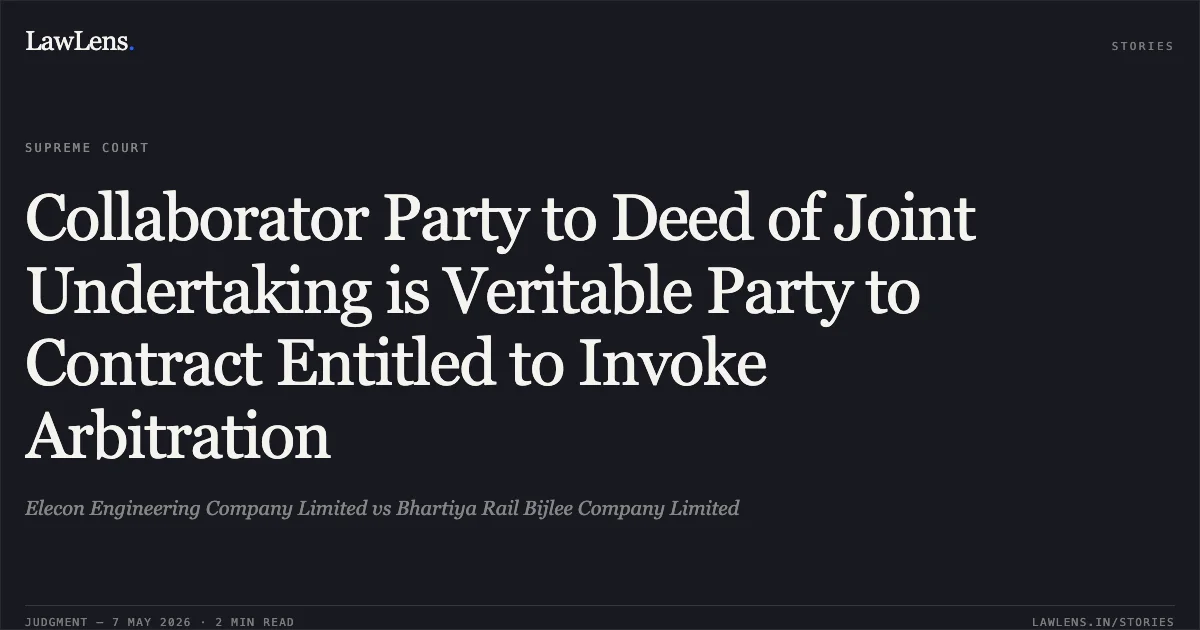
1. Whether a non-signatory collaborator, who executed a Deed of Joint Undertaking (DJU) essential to the main contract, can be considered a "veritable party" to the arbitration agreement
Source reference: p. 5 / para. 72. Whether the lack of an explicit arbitration clause in a subsequent tripartite agreement eclipses the arbitration clause in the original contract to which the collaborator is inextricably linked
Source reference: p. 7 / para. 9Law Applied
The Court applied Section 11(6) and Section 21 of the Arbitration and Conciliation Act, 1996 regarding the appointment of arbitrators
Source reference: p. 1-2It relied on the "Group of Companies" or "Veritable Party" doctrine, which stipulates that non-signatories to an agreement may invoke an arbitration clause if they are inextricably connected to the performance of the contract and the underlying transaction
Source reference: p. 2, 5The Court also emphasized the principle of "joint and several liability" arising from composite commercial transactions where a Deed of Joint Undertaking (DJU) forms an integral part of the main contract
Source reference: p. 7-8Reasoning
The Court reasoned that the Collaborator was an "inseparable part" of the contract because the Contractor would not have qualified for the bid without the Collaborator's technical expertise and the submission of the DJU
Source reference: p. 2-3, 5The DJU established "joint and several" responsibility, which the Employer itself invoked when threatening the Collaborator with risk-and-cost execution after the Contractor’s default
Source reference: p. 6, 8The Court found the High Court erred in focusing on the Collaborator’s request for "consent" in the Section 21 notice; this was interpreted not as an admission of the absence of an arbitration clause, but as a procedural suggestion for a specific forum
Source reference: p. 7Since the tripartite agreement merely facilitated direct payment and did not "wipe out" the original contractual framework, the arbitration clause in the main contract extended to the Collaborator as a "veritable party"
Source reference: p. 7, 9Holding
The Supreme Court allowed the appeal and set aside the High Court judgment. It held that the Collaborator is a veritable party to the contract and is entitled to invoke the arbitration clause
The Court appointed Justice (Retd.) Chakradhari Sharan Singh as the sole Arbitrator to adjudicate the disputes. The Arbitrator was directed to file a disclosure under Section 12 and proceed in accordance with the Fourth Schedule of the Act
Source reference: p. 9, 10Acts & Sections Cited
4 provisions across 1 statute referred to in this judgment. Each provision opens on LawLens.
Arbitration and Conciliation Act, 19964
Original Court PDF
Elecon Engineering Company LimitedvsBhartiya Rail Bijlee Company Limited
Click to open original judgment
Original judgment, available to read, download and summarize on LawLens.in