Facts
The complainant, proprietor of an automobile-accessories business, had a commercial relationship with the petitioner company from 2017.
Source reference: para. 3–4He alleged that products supplied during 2018–2019 were defective or commercially non-viable, that an advance of ₹60,000 for further supplies was neither adjusted nor refunded, and that another product valued at ₹5,70,825 was not repaired or replaced
Source reference: para. 3–4He filed a complaint under Section 200 CrPC alleging offences under Sections 406, 420 and 506 IPC.
Source reference: para. 5–6Following the complainant’s examination and an inquiry under Section 202 CrPC, the Magistrate issued process against the company and its officers
Source reference: para. 5–6The petitioners sought quashing under Section 482 CrPC, contending that the dispute was contractual, the complaint disclosed no dishonest intention at inception or specific criminal acts by the officers, and the Section 202 inquiry and issuance of process were inadequate
Source reference: para. 7–9Issues
1. Whether the complaint disclosed the essential ingredients of offences under Sections 420, 406 and 506 IPC, or instead concerned a civil contractual dispute
Source reference: para. 112. Whether the company’s officers could be prosecuted under the IPC without specific allegations of their individual participation or a statutory basis for vicarious liability
Source reference: para. 113. Whether the Magistrate issued process mechanically, without adequate inquiry or application of mind under Section 202 CrPC
Source reference: para. 11Law Applied
Section 420 IPC requires fraudulent or dishonest inducement from the inception of the transaction; subsequent failure to perform a promise, without such initial intent, does not by itself constitute cheating.
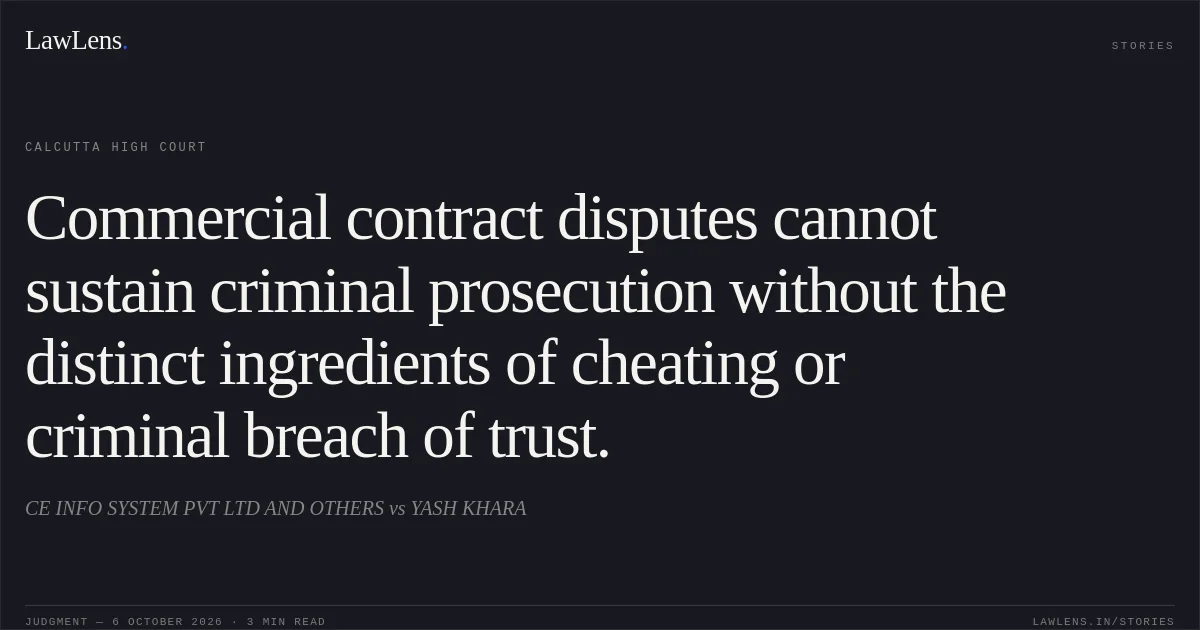
Source reference: para. 12The Court relied on *V.Y. Jose v. State of Gujarat*, (2009) 3 SCC 78, for the principle that a contractual dispute cannot be converted into a criminal prosecution unless the necessary criminal ingredients are distinctly made out
Source reference: para. 12The Court further applied the principle that the IPC does not generally impose vicarious criminal liability on corporate officers: absent an applicable statutory provision, an officer’s position alone is insufficient, and specific allegations of personal participation are required
Source reference: para. 14Under Section 202 CrPC, an inquiry is intended to assist the Magistrate in deciding whether sufficient grounds exist to issue process; the Magistrate must apply judicial mind to the material before doing so.
Source reference: para. 15The petition was brought under the High Court’s inherent jurisdiction in Section 482 CrPC to prevent abuse of process
Source reference: para. 2, 16Reasoning
The allegations concerned defective products, warranty or replacement issues, and an unfulfilled advance-payment transaction within an ongoing commercial relationship.
Source reference: para. 13The complaint did not allege that the petitioners had a dishonest or fraudulent design when the transactions began; the Court therefore found no sufficient basis for cheating under Section 420 IPC and treated the dispute as essentially civil
Source reference: para. 13It also found that the complaint made generalized allegations against the company’s officers without identifying their individual criminal acts, making their prosecution unsustainable under the IPC
Source reference: para. 14Finally, the Section 202 report was described as limited to verifying territorial jurisdiction, without examining witnesses or gathering substantive material, while the complaint contained no factual foundation for criminal intimidation under Section 506 IPC.
Source reference: para. 15The Court held that issuing process in those circumstances reflected inadequate judicial scrutiny
Source reference: para. 15Holding
The Court answered the issues in favour of the petitioners and held that continuation of the prosecution would be an abuse of process because the complaint did not prima facie disclose the ingredients of Sections 406, 420 or 506 IPC
It allowed the revision and quashed C. Case No. 666 of 2021, including the orders issuing process against the petitioners; connected applications were disposed of, any interim order was vacated, and no order as to costs was made
Source reference: para. 18–22Acts & Sections Cited
6 provisions across 2 statutes referred to in this judgment. Each provision opens on LawLens.
Code of Criminal Procedure, 19733
Indian Penal Code, 18603
Original Court PDF
CE INFO SYSTEM PVT LTD AND OTHERSvsYASH KHARA
Click to open original judgment
Original judgment, available to read, download and summarize on LawLens.in