Facts
The Appellant (LMT) entered into a Professional Services Agreement with Respondent (SCB) on February 19, 2013, to develop a mobile application
Source reference: p. 1-2Following a dispute regarding revenue sharing and the subsequent removal of the app, LMT filed a civil suit in 2015
Source reference: p. 2The suit was renumbered as a commercial suit (CS(Comm.) 169 of 2018) in January 2018, at which time LMT was granted leave to file additional documents
Source reference: p. 2, 13After the completion of the cross-examination of Plaintiff’s Witness (PW-1) in May 2023, LMT filed a second application (IA No. 24359 of 2023) to introduce further additional documents—including emails and backend data—and to recall PW-1
Source reference: p. 2The High Court rejected this application, finding no "reasonable cause" for the delay
Source reference: p. 2-3Issues
1. Whether the Appellant established "reasonable cause" under Order XI of the CPC (as amended by the Commercial Courts Act) to justify the filing of additional documents eight years after the suit's institution and after the completion of witness evidence
Source reference: p. 3 / para. 4, 12Law Applied
The court applied the Commercial Courts Act, 2015 (CCA), specifically Section 15(3), which mandates that the procedures of the CCA apply to pending suits transferred to Commercial Divisions
Source reference: p. 12It primarily relied on Order XI Rule 1(4) and (5) of the CPC (as amended by the CCA), which requires a plaintiff to show "reasonable cause" for the non-disclosure of documents at the time of filing the suit
Source reference: p. 7, 13The court also applied the principles from Sudhir Kumar v. Vinay Kumar G.B. regarding the strict necessity of established justification
Source reference: p. 7State of Maharashtra v. Borse Bros. Engineers Contractors (P) Ltd., which emphasizes that "sufficient cause" (or reasonable cause) cannot be used to condone negligence or a lack of diligence in commercial matters meant for speedy resolution
Source reference: p. 8-10Reasoning
The Court observed that the primary objective of the CCA is the "expeditious culmination of proceedings" to enhance the ease of doing business
Source reference: p. 6-7It rejected LMT’s justification that the documents were voluminous or that new facts emerged during cross-examination, noting that a plaintiff is expected to anticipate the opponent's case and produce all documents in their possession at the earliest instance
Source reference: p. 10-11The Court found it significant that LMT had already been allowed one round of additional evidence in 2018 based on substantially similar grounds
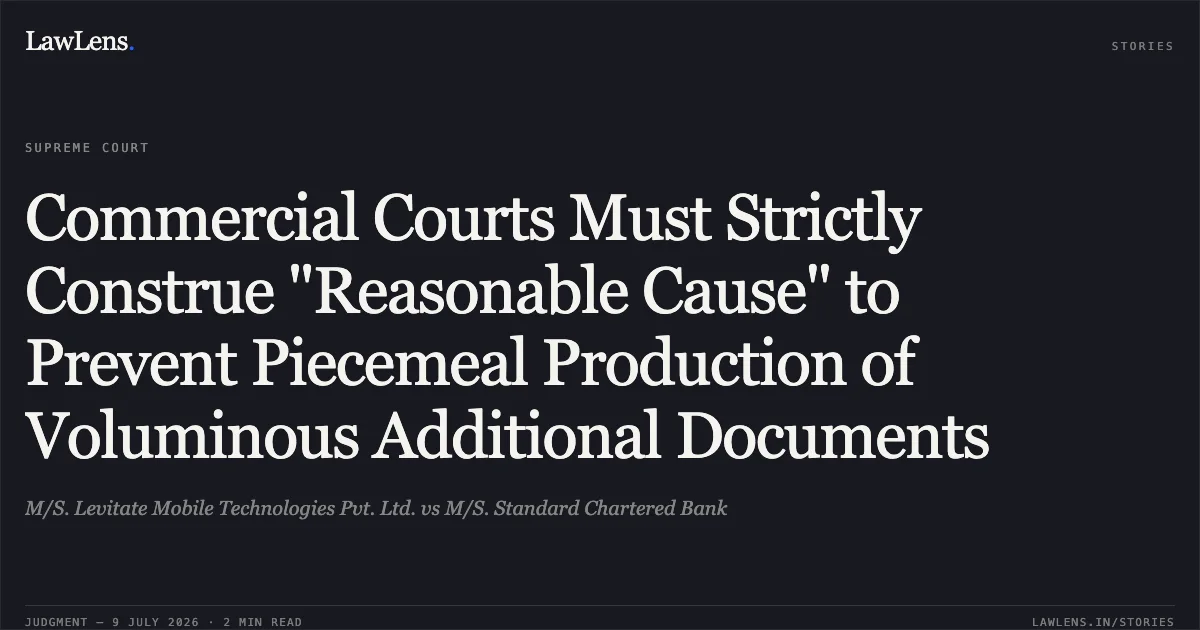
Source reference: p. 11-12Because the documents were in LMT's possession since the suit's inception, the Court determined that allowing a "piecemeal approach" after five years of the suit being designated as "commercial" would subvert the statutory intent of the CCA
Source reference: p. 11-13Holding
The Court held that LMT failed to provide a reasonable cause or justifiable explanation for the delay, and that the rigors of the Commercial Courts Act apply to all pending high-stakes commercial disputes to prevent "stop and go" litigation
The Supreme Court dismissed the appeal, affirming the High Court's order and directed the trial court to decide the suit as expeditiously as possible
Source reference: p. 14Acts & Sections Cited
14 provisions across 2 statutes referred to in this judgment. Each provision opens on LawLens.
Commercial Courts Act, 2015
Code of Civil Procedure, 19081
Original Court PDF
M/S. Levitate Mobile Technologies Pvt. Ltd.vsM/S. Standard Chartered Bank
Click to open original judgment
Original judgment, available to read, download and summarize on LawLens.in


