Facts
The respondent sued to recover ₹37,45,109 for services rendered under the parties’ contractual arrangement.
Source reference: pp. 3–6The appellant was served with summons on 2 April 2026 but did not file its written statement within 120 days. After its right to file the written statement was recorded as forfeited, the Commercial Court permitted it to participate in the proceedings and cross-examine the respondent’s witnesses. The appellant then applied under Section 8 of the Arbitration and Conciliation Act, 1996, relying on an arbitration clause in the parties’ agreement. The Commercial Court dismissed the application, and the appellant appealed.
Source reference: pp. 3–6Issues
1. Whether a defendant in a commercial suit may seek reference to arbitration under Section 8 after its right to file a written statement has been forfeited.
Source reference: p. 6, para. 92. Whether permission to participate in the proceedings and cross-examine witnesses allows the defendant to seek a Section 8 reference after that forfeiture.
Source reference: p. 14, para. 24Law Applied
Section 8(1) of the Arbitration and Conciliation Act, 1996 requires an application for reference to be made “not later than when submitting” the applicant’s first statement on the substance of the dispute; the Court construed this as requiring an application no later than the stage at which a written statement may be filed.
Source reference: pp. 9–10, para. 16For commercial suits, the amended Order V Rule 1, Order VIII Rule 1 and Order VIII Rule 10 of the Code of Civil Procedure, introduced by the Commercial Courts Act, 2015, impose a 120-day outer limit for filing a written statement, after which the defendant forfeits that right and the Court cannot accept the statement. The Court relied on SCG Contracts India Pvt. Ltd. v. K.S. Chamankar Infrastructure Pvt. Ltd., (2019) 12 SCC 210, on the mandatory nature of that limit, and on SPML Infra Ltd. v. Trisquare Switchgears Pvt. Ltd., 2022 SCC OnLine Del 1914, which held that the Section 8 application stage closes when the opportunity to submit the first statement has passed.
Source reference: pp. 7–8, paras. 10–12; pp. 8, 10–12, paras. 13, 17–18Reasoning
The Court treated the time for seeking a Section 8 reference as tied to the stage for filing the first statement on the substance of the dispute. Because the appellant had allowed the 120-day period to expire, its right to file a written statement—and, in the Court’s view, its corresponding opportunity to seek a reference—had closed.
Source reference: pp. 9–14, paras. 16–18, 24Allowing the appellant to participate in cross-examination did not reopen that stage. A later Section 8 application would, the Court held, circumvent the mandatory timelines governing commercial suits.
Source reference: pp. 9–14, paras. 16–18, 24Holding
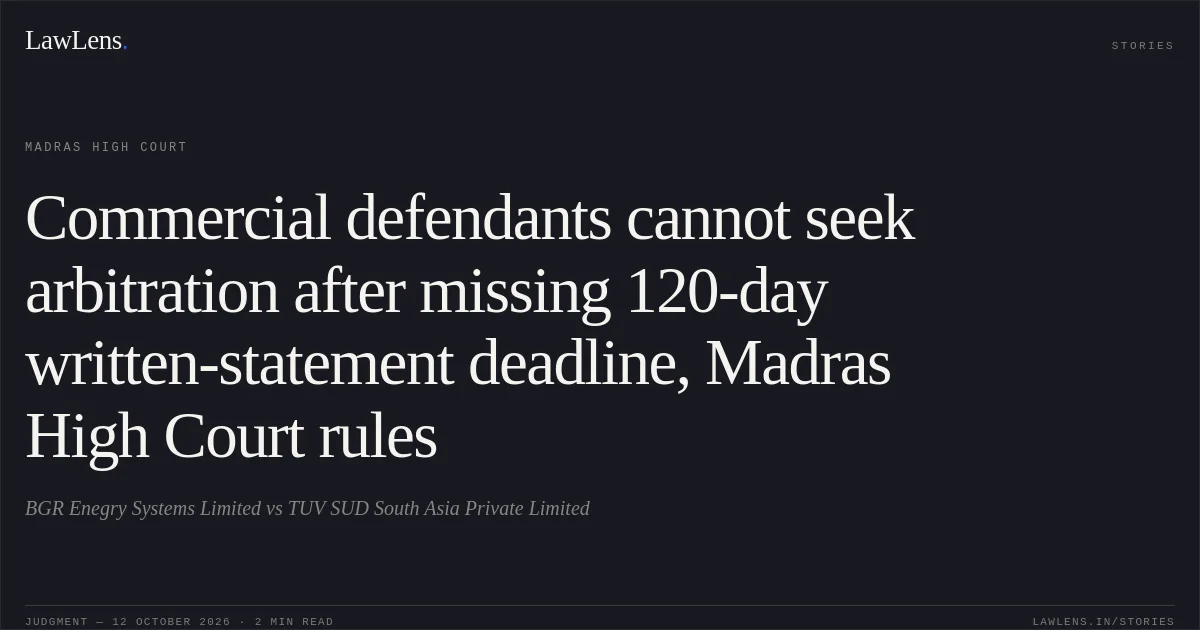
The Court held that a defendant whose right to file a written statement in a commercial suit has been forfeited cannot thereafter seek reference to arbitration under Section 8.
It dismissed the appeal, confirmed the Commercial Court’s order, made no order as to costs, and closed the connected miscellaneous petition.
Source reference: p. 14, para. 25Acts & Sections Cited
4 provisions across 2 statutes referred to in this judgment. Each provision opens on LawLens.
Arbitration and Conciliation Act, 19962
Commercial Courts Act, 20152
Original Court PDF
BGR Enegry Systems LimitedvsTUV SUD South Asia Private Limited
Click to open original judgment
Original judgment, available to read, download and summarize on LawLens.in