Facts
The complainant, Amarsing Mansing Rathva, entered into an oral agreement to sell watermelons to the respondents (accused) in 2008.
Source reference: p. 7While the total transaction was valued at ₹5,79,031, only ₹92,000 was paid.
Source reference: p. 7On May 20, 2008, when the complainant demanded the balance, the accused allegedly provoked him, used caste-related derogatory slurs in public view, and threatened him.
Source reference: p. 2A private complaint was filed, leading to an FIR for offences under Sections 406, 418, 420, 504, 506(2), and 114 of the IPC, and Section 3(1)(10) of the Atrocities Act.
Source reference: p. 2The Trial Court (Special Atrocity Court, Vadodara) acquitted the accused on March 30, 2012, prompting this appeal by the State.
Source reference: p. 1-4Issues
1. Whether the failure to pay the balance amount under a sale agreement constitutes criminal breach of trust or cheating under Sections 406 and 420 of the IPC.
Source reference: p. 7 / para 112. Whether the alleged derogatory remarks met the statutory requirements of "public place" and "public view" under Section 3(1)(10) of the Atrocities Act.
Source reference: p. 7 / para 113. Whether there was any manifest illegality or perversity in the Trial Court’s judgment of acquittal justifying interference by the Appellate Court.
Source reference: p. 7 / para 11Law Applied
The Court applied Section 405 (Criminal Breach of Trust) and Section 415 (Cheating) of the IPC, emphasizing the necessity of proving dishonest intention at the inception of the transaction, as established in Satishchandra Ratanlal Shah v. State of Gujarat [(2019) 9 SCC 148] and Dr. Lakshman v. State of Karnataka [(2019) 9 SCC 677].
Source reference: p. 8-9Regarding the SC/ST Act, the Court relied on Shajan Skaria v. State of Kerala [AIR 2024 SC 4557] and Gunjan @ Girija Kumari v. State (NCT of Delhi) [2026 (0) INSC 468], which require that insults must occur in a "public place within public view" specifically targeting the victim’s community.
Source reference: p. 10The power of Appellate Courts to review acquittals is governed by the "double presumption of innocence" principle from Chandrappa v. State of Karnataka [(2007) 4 SCC 415].
Source reference: p. 10-12Reasoning
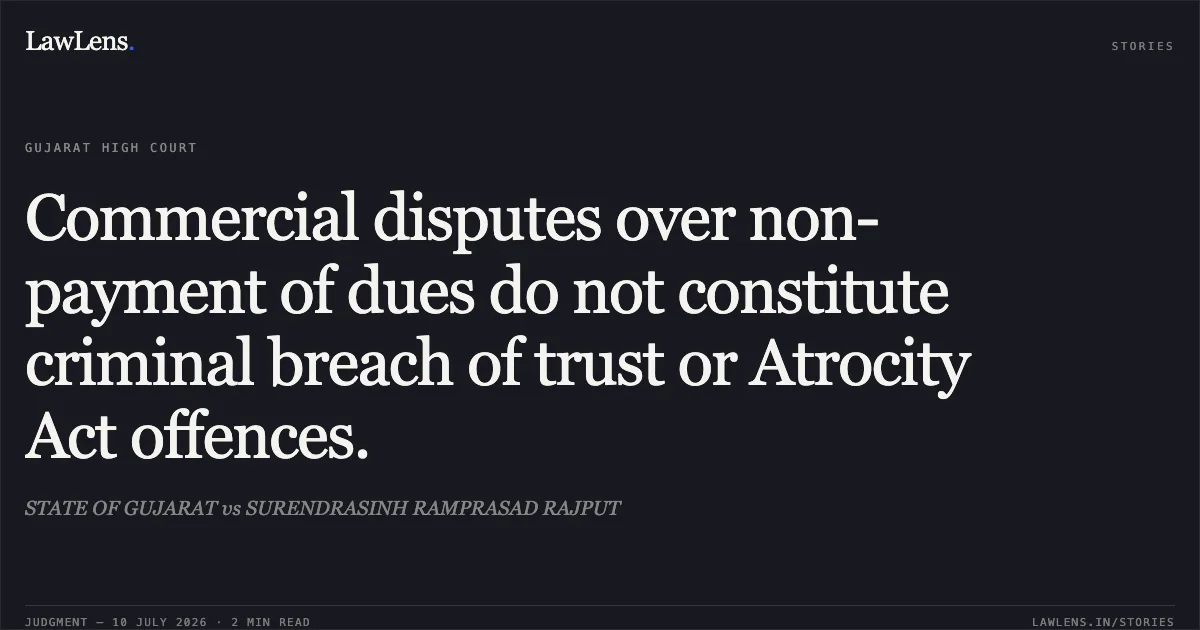
The Court found that the dispute was essentially civil, arising from a breach of contract regarding the sale of watermelons. It reasoned that the prosecution failed to prove "mens rea" or fraudulent inducement at the starting point of the transaction; mere refusal to pay a balance amount does not automatically constitute a criminal offence.
Source reference: p. 9Regarding the Atrocity Act charge, the Court observed that the prosecution failed to produce independent witnesses or evidence to prove the alleged slurs were uttered in a public place within public view.
Source reference: p. 10Applying the Chandrappa doctrine, the Court held that since the Trial Court's view was a "reasonable conclusion" based on the evidence, the Appellate Court should not disturb the acquittal simply because a different view is possible.
Source reference: p. 11-14Holding
The Court held that the prosecution miserably failed to prove the ingredients of cheating, criminal breach of trust, or the Atrocity Act charges beyond a reasonable doubt.
The Court dismissed the appeal and confirmed the Trial Court’s judgment of acquittal. The bail bonds of the respondents were ordered cancelled.
Source reference: p. 14Acts & Sections Cited
11 provisions across 3 statutes referred to in this judgment. Each provision opens on LawLens.
Code of Criminal Procedure, 19732
Indian Penal Code, 18608
Scheduled Castes and the Scheduled Tribes (Prevention of Atrocities) Act, 19891
Original Court PDF
STATE OF GUJARATvsSURENDRASINH RAMPRASAD RAJPUT
Click to open original judgment
Original judgment, available to read, download and summarize on LawLens.in