Facts
Respondent Nos. 1 and 2 (claimants) filed a claim petition under the Employee’s Compensation Act, 1923, asserting that the deceased, Chandeshwar Ray, was employed as a driver on a truck (HR-55H-8581) owned by Respondent No. 3
Source reference: p. 1-2On March 26, 2011, the vehicle met with an accident during an occupational trip, leading to the deceased’s death on June 11, 2011
Source reference: p. 2The Appellant (Insurance Company) contested the award, while the owner (Respondent No. 3) denied the employment of the deceased, claiming one Pappu Singh was the driver at the time of the accident
Source reference: p. 2-3The Commissioner, Employee’s Compensation, allowed the claim, directing the Appellant to pay Rs. 8,60,664 with 12% interest
Source reference: p. 2The Appellant challenged this order before the High Court under Section 30 of the EC Act, arguing the judgment was perverse as criminal records identified Pappu Singh as the driver
Source reference: p. 3Issues
Whether the findings of the Commissioner regarding the employer-employee relationship were perverse or lacked evidence under Section 30 of the EC Act
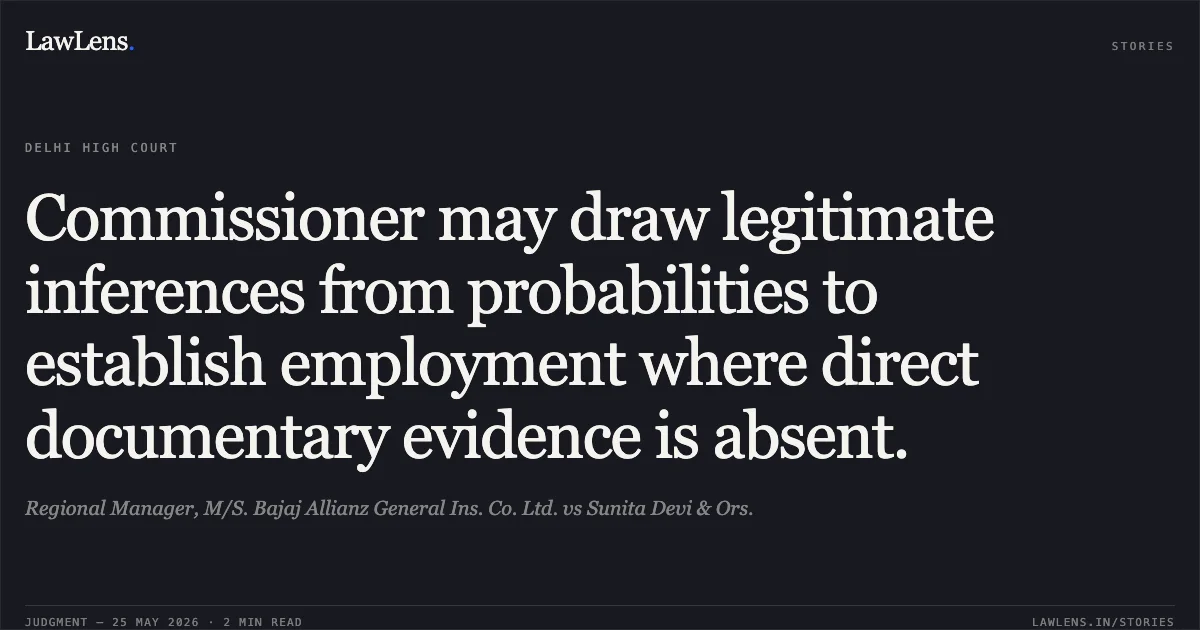
Source reference: p. 3 / para. 7Whether the Commissioner was justified in relying on the preponderance of probabilities to establish employment in the absence of direct documentary evidence
Source reference: p. 3-4 / para. 10Law Applied
The Court primarily applied Section 30 of the Employee’s Compensation Act, 1923, which limits appeals to "substantial questions of law"
Source reference: p. 3It relied on the principle that the EC Act is beneficial legislation where strict rules of evidence do not apply as rigorously as in criminal trials
Source reference: p. 4The Court followed the precedent in Macainnon Mackenzie and Co. (P) Ltd. v. Ibrahim Mahmmed Issak, which held that a workman need not prove a case by direct evidence and the Commissioner may draw legitimate inferences from proved facts
Source reference: p. 4-5Additionally, it cited North East Karnataka Road Transport Corporation v. Sujatha, affirming that findings of fact by a Commissioner should not be lightly interfered with unless perverse
Source reference: p. 5-6Reasoning
The Court observed that while the owner denied the deceased's employment, neither party produced conclusive documentary evidence of engagement for either the deceased or Pappu Singh
Source reference: para. 9The Court noted that in the criminal proceedings against Pappu Singh, eye-witnesses failed to support the prosecution, and none claimed to have seen him at the spot
Source reference: para. 11Consequently, the Commissioner had to weigh competing versions—the claimants’ medical and mechanical reports versus the owner’s criminal case records
Source reference: para. 9Applying the "touchstone of preponderance of probabilities," the Court found the Commissioner's inference legitimate, as the accident was undisputed and the criminal trial against the alternative driver had collapsed
Source reference: para. 10-13The Court held that since the Commissioner is the final authority on facts, and the inferences drawn were reasonable based on the surrounding circumstances, there was no ground for interference
Source reference: para. 12-15Holding
The High Court dismissed the appeal, holding that there was no infirmity or perversity in the Commissioner’s order
The Court affirmed the award of Rs. 8,60,664 with interest @ 12% per annum, concluding that the Commissioner is entitled to draw reasonable inferences in beneficial legislation proceedings when facts are not equally consistent
Source reference: para. 13-16Acts & Sections Cited
1 provisions across 1 statute referred to in this judgment. Linked provisions open on LawLens.
Employee1
Original Court PDF
Regional Manager, M/S. Bajaj Allianz General Ins. Co. Ltd.vsSunita Devi & Ors.
Click to open original judgment
Original judgment, available to read, download and summarize on LawLens.in