Facts
The Applicant and Respondent No. 1 are siblings disputing their deceased father’s estate.
Source reference: no citationThe Applicant’s partition suit, originally filed in the Bombay High Court, was transferred to the Bombay City Civil Court following a change in pecuniary jurisdiction and renumbered as Suit No. 6934 of 2024.
Source reference: no citationBoth siblings also pursued testamentary proceedings in the High Court concerning the father’s Will; the proceedings became contested.
Source reference: no citationThe partition suit and testamentary proceedings concerned substantially overlapping properties, although the parties disputed the identity or ownership of one flat.
Source reference: no citationNo issues had been framed and evidence had not commenced in any of the three proceedings.
Source reference: paras. 1–3, 7–8, 17; pp. 2–6, 15Issues
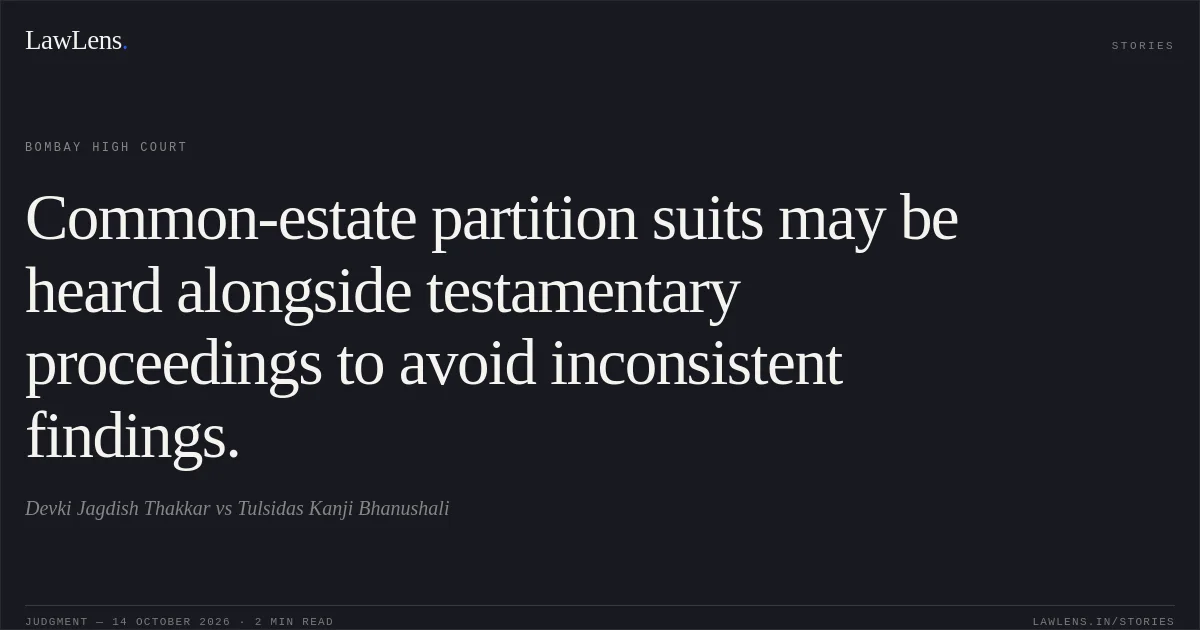
1. Whether the partition suit should be transferred from the Bombay City Civil Court to the High Court under Section 24 CPC for hearing with the parties’ testamentary proceedings.
Source reference: paras. 1, 17–19; pp. 2, 15–162. Whether the overlap in the properties and issues across the proceedings made transfer appropriate to avoid duplicated evidence or inconsistent findings.
Source reference: paras. 8–9, 17–18; pp. 6–7, 15–16Law Applied
Section 24 of the Code of Civil Procedure, 1908 empowers the High Court to transfer proceedings where doing so serves the ends of justice.
Source reference: no citationIn Shamita Singha v. Rashmi Ahluwalia, (2020) 7 SCC 152, the Supreme Court recognised that where testamentary proceedings may directly affect a partition suit concerning substantially common assets, transferring the suit for coordinated hearing may be expedient to avoid inconsistent findings; the “first past the post” principle does not control such a transfer.
Source reference: para. 9; pp. 7–9The Court also considered Kulwinder Kaur v. Kandi Friends Education Trust, (2008) 3 SCC 659, in relation to the need for a reasoned exercise of transfer discretion.
Source reference: para. 12; pp. 11–12Reasoning
The Court found that three of the four properties identified across the proceedings were common, while the fourth concerned a flat whose precise identity or ownership was disputed.
Source reference: paras. 7–8; pp. 4–6The testamentary proceedings could affect which assets formed part of the estate available for partition and the parties’ respective shares.
Source reference: paras. 17–18; pp. 15–16Because all proceedings were at an early stage, coordinated adjudication could avoid duplication of evidence and the risk of inconsistent findings.
Source reference: paras. 17–18; pp. 15–16Applying Shamita Singha, the Court held that transfer would serve the interests of justice; it distinguished the authorities relied on by Respondent No. 1 as addressing different circumstances or issues.
Source reference: paras. 10–16; pp. 9–14Holding
The Court allowed the application under Section 24 CPC.
It transferred Suit No. 6934 of 2024 from the Bombay City Civil Court to the High Court and ordered it to be heard with Testamentary Petition Nos. 2647 of 2024 and 5014 of 2024.
Source reference: para. 19; p. 16Acts & Sections Cited
5 provisions across 2 statutes referred to in this judgment. Each provision opens on LawLens.
Code of Civil Procedure, 19084
Indian Succession Act, 19251
Original Court PDF
Devki Jagdish ThakkarvsTulsidas Kanji Bhanushali
Click to open original judgment
Original judgment, available to read, download and summarize on LawLens.in