Facts
On 12 July 2016, Bodial Sk was allegedly chased from Kalithan Market into a house and assaulted with a rice-grinding stick or pestle. He later died from head injuries.
Source reference: pp. 3–4, paras. 3–6The prosecution case implicated the three appellants and a juvenile.
Source reference: pp. 3–4, paras. 3–6The Trial Court convicted the appellants under Sections 341/448/302 read with Section 34 IPC and imposed sentences including life imprisonment under Section 302 IPC.
Source reference: pp. 3–4, paras. 3–6In their appeals, the appellants challenged the eyewitness evidence and identification, raised the delay in lodging the FIR and the absence of forensic examination of the alleged weapon, and relied on a plea of alibi.
Source reference: pp. 5–8, paras. 7–19Issues
1. Whether the eyewitness testimony and other evidence established beyond reasonable doubt that the appellants participated in the assault causing the victim’s death, including in furtherance of a common intention.
Source reference: pp. 14–16, paras. 33–402. Whether the alleged deficiencies in identification and investigation, and the appellants’ plea of alibi, created reasonable doubt warranting acquittal.
Source reference: pp. 15–19, paras. 36–43Law Applied
The Court applied Sections 341, 448, 302 and 34 IPC.
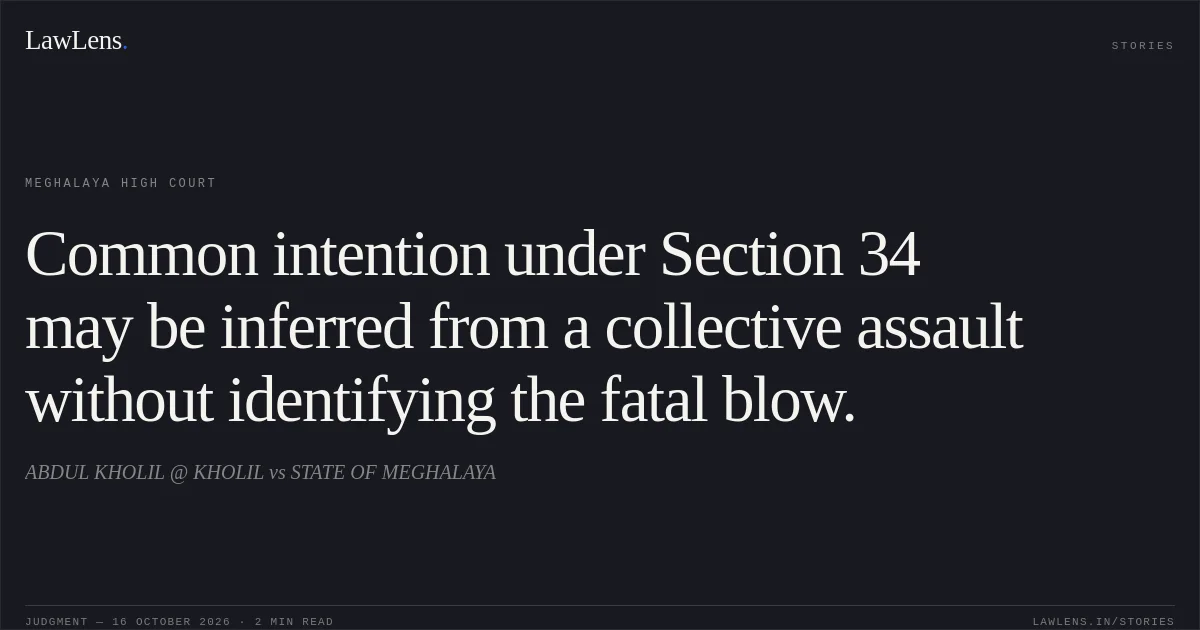
Source reference: no citationSection 34 imposes joint liability where a criminal act is committed by several persons in furtherance of their common intention; that intention may be inferred from the totality of the circumstances, including the accused’s conduct and the manner of the attack (Ramesh Singh alias Photti v. State of A.P., (2004) 11 SCC 305, as quoted at [pp. 16–17, para. 40]).
Source reference: pp. 16–17, para. 40The Court also relied on the principle that failure to send a weapon for forensic examination is not necessarily fatal where the prosecution case is supported by reliable direct evidence (Doman Murmu v. State of Jharkhand, 2024 SCC OnLine Jhar 1646, discussing State of Punjab v. Hakam Singh, (2005) 7 SCC 408 [pp. 18–19, para. 42]).
Source reference: pp. 18–19, para. 42It further treated dock identification as evidence that could be considered even if the TIP result was excluded.
Source reference: p. 16, para. 38Reasoning
The Court found that PW-2, PW-3 and PW-4 consistently described the victim being pursued into the house and assaulted there; their evidence placed the appellants at the scene, notwithstanding that no witness identified who delivered the fatal blow.
Source reference: pp. 14–16, paras. 34–38The medical evidence established death from a head injury caused by a heavy blunt object, and the collective pursuit and assault supported the inference of common intention under Section 34 IPC.
Source reference: pp. 13–16, paras. 32, 37–40The Court considered PW-1’s account hearsay but found the eyewitness evidence sufficient.
Source reference: pp. 18–19, paras. 41–43It also held that the absence of an FSL report did not defeat the direct evidence, and that the defence witnesses did not account for the appellants’ whereabouts at the time of the incident.
Source reference: pp. 18–19, paras. 41–43Holding
The Court answered the issues against the appellants, found no infirmity in the Trial Court’s judgment or sentence, and dismissed both appeals.
The convictions and sentences were left undisturbed, and the Trial Court records were directed to be returned.
Source reference: p. 19, para. 44Acts & Sections Cited
6 provisions across 2 statutes referred to in this judgment. Each provision opens on LawLens.
Indian Penal Code, 18604
Code of Criminal Procedure, 19732
Original Court PDF
ABDUL KHOLIL @ KHOLILvsSTATE OF MEGHALAYA
Click to open original judgment
Original judgment, available to read, download and summarize on LawLens.in