Facts
Rajshree Talkies, a partnership firm engaged in exhibiting films, had approximately 13 employees, or 17 if four security personnel were included.
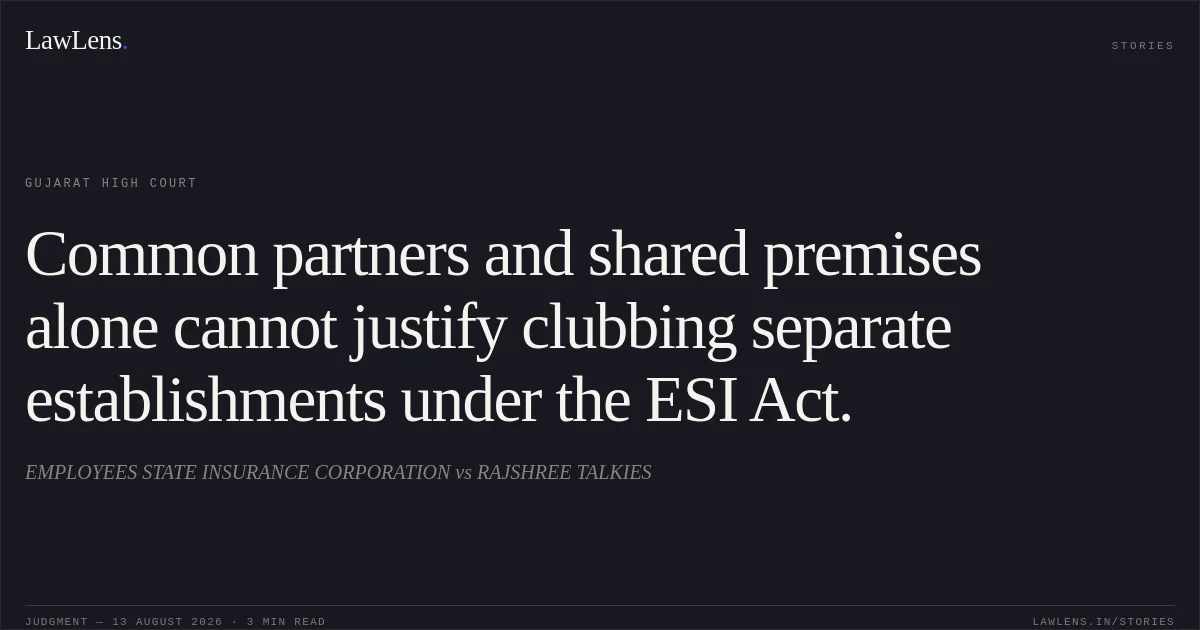
Source reference: pp.1–3The Employees’ State Insurance Corporation (“ESI Corporation”) treated Rajshree Talkies and Rajshree Enterprise as a single establishment, principally because they operated from the same premises, had some common partners, and were engaged in connected film-related activities.
Source reference: pp.1–3The Corporation subsequently issued a notice under Section 45 of the Employees’ State Insurance Act, 1948 (“ESI Act”) and demanded approximately Rs.19,574.19 towards contribution.
Source reference: pp.3, 9–16The ESI Court held that the two concerns were separate establishments, that the Corporation had failed to establish functional or managerial unity, and that Rajshree Talkies itself did not employ the requisite number of employees.
Source reference: pp.3, 9–16Issues
Whether Rajshree Talkies and Rajshree Enterprise constituted one establishment for determining applicability of the ESI Act, merely because they shared premises, had some common partners, and carried on connected businesses?
Source reference: pp.6–8, 16–18Whether the ESI Corporation established unity of ownership, management and control, functional integrity, and unity of employment between the two concerns?
Source reference: pp.6–8, 18–19Whether the employee strength of Rajshree Talkies independently satisfied the applicable statutory threshold for ESI coverage?
Source reference: pp.14–16, 18Whether the recovery order issued under Section 45 of the ESI Act, without adequate reasons and supporting evidence, was legally sustainable?
Source reference: pp.5–6, 18–20Law Applied
The Court applied the ESI Act, particularly Sections 45, 75, 76 and 77 concerning determination and recovery of contributions and adjudication of disputes.
Source reference: pp.1–3, 18–20For deciding whether ostensibly separate concerns constitute one establishment, it applied the three-fold test stated in Dhoraji Engineering Works, Rajkot v. Regional Provident Fund Commissioner, Ahmedabad, 1980 (2) GLR 461, and followed in Regional Director v. HI Life Manufacturing Co.: (i) unity of ownership, management and control; (ii) functional integrity; and (iii) unity of employment.
Source reference: pp.6–8The Court also relied on Regional Provident Fund Commissioner v. Dharamsi Morarji Chemical Co. Ltd., (1998) 2 SCC 446, for the principle that common ownership or common directors/partners alone is insufficient; clear evidence of common supervisory, financial or managerial control and interconnection is necessary.
Source reference: pp.16–18Further, an order determining liability under Section 45 must disclose reasons and demonstrate application of mind; a merely printed or mechanically completed order is vulnerable as arbitrary and unsustainable.
Source reference: pp.18–20Reasoning
The ESI Corporation relied substantially on the Insurance Inspector’s visit note and produced no independent documentary or oral evidence establishing common management, financial control, unified employment, or functional dependence between Rajshree Talkies and Rajshree Enterprise.
Source reference: p.18The Court held that common partners and occupation of the same premises did not, by themselves, satisfy the applicable tests.
Source reference: p.18Rajshree Talkies exhibited films, whereas Rajshree Enterprise distributed films in the Saurashtra region; either business could continue by dealing with other exhibitors or distributors, showing an absence of functional dependency.
Source reference: p.18The Corporation also failed to inspect or produce records of Rajshree Enterprise and did not identify the alleged employees or substantiate the additional personnel shown in the inspection report.
Source reference: pp.14–16, 18On the available evidence, Rajshree Talkies had only 13 employees, or 17 including the security personnel, and the Corporation failed to prove the requisite employee strength independently.
Source reference: pp.14–16Finally, the Section 45 order was a substantially pre-printed format containing no adequate reasons for clubbing the concerns or determining the contribution, reflecting non-application of mind.
Source reference: pp.18–20Holding
The High Court held that Rajshree Talkies and Rajshree Enterprise were separate establishments and that the ESI Corporation failed to prove the requisite unity of ownership, management and control, functional integrity, or unity of employment.
Since the employee strength of Rajshree Talkies independently did not satisfy the applicable threshold, ESI coverage and the consequent contribution demand could not be sustained.
Source reference: pp.14–16, 18The Section 45 recovery order was also found inadequately reasoned and arbitrary.
Source reference: pp.18–20The appeal was therefore dismissed, the decision of the ESI Court was upheld, and the record was directed to be returned to the concerned court.
Source reference: p.20Acts & Sections Cited
6 provisions across 2 statutes referred to in this judgment. Linked provisions open on LawLens.
Employees4
Employees’ Provident Funds And Miscellaneous Provisions Act, 19522
Original Court PDF
EMPLOYEES STATE INSURANCE CORPORATIONvsRAJSHREE TALKIES
Click to open original judgment
Original judgment, available to read, download and summarize on LawLens.in