Facts
The appellant challenged the order of the learned Single Judge dated 23.04.2015, which dismissed a writ petition (WPMS No. 1574 of 2009)
Source reference: para. 5The writ petition had contested an order by the Additional Director of Education (Respondent No. 3) dated 07.09.2009, which invalidated the induction of 500 members into the general body of Nehru Rashtriya Inter College between 2002 and 2005
Source reference: para. 5-6The appellant contended that the Additional Director (Mr. N.S. Rana) was disqualified from deciding the dispute as he had previously issued an order on the same subject on 28.05.2004 in his capacity as District Education Officer
Source reference: para. 7, 9The appeal was initially dismissed as infructuous but was restored upon finding that life membership constitutes a continuing cause of action
Source reference: para. 2-3Issues
1. Whether the order passed by the Additional Director of Education was vitiated by bias or procedural impropriety on the grounds that he sat in appeal over his own previous decision.
Source reference: para. 7-92. Whether the High Court should interfere with findings regarding membership disputes involving disputed questions of fact in an intra-court appeal.
Source reference: para. 13-14Law Applied
The court applied the principles of administrative law regarding the "rule against bias," establishing that an authority cannot sit in judgment over its own prior decision
Source reference: para. 12Furthermore, it relied on the provisions of the Intermediate Education Act, 1921 (specifically Section 16-A/paragraphs 5-7 regarding the scheme of administration) concerning the management of educational institutions
Source reference: para. 10The court also applied the principle that writ jurisdiction is generally not the appropriate forum for resolving "disputed questions of fact" where "summary" administrative decisions can be challenged via "civil remedies"
Source reference: para. 13Reasoning
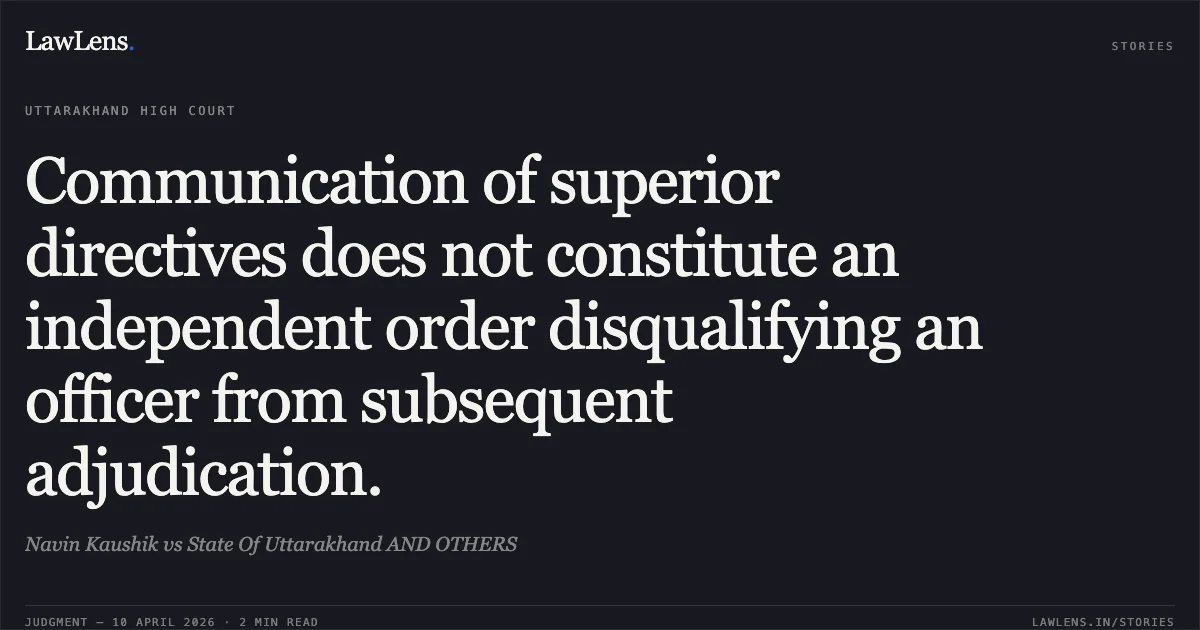
The Court examined the communication dated 28.05.2004 issued by the respondent in his capacity as District Education Officer
Source reference: para. 10It observed that this document was not an independent "order" involving the application of mind, but rather a ministerial communication intended to ensure compliance with directions already issued by the Additional Regional Joint Director of Education
Source reference: para. 8, 11Consequently, the Court held that the respondent did not sit in appeal over his own judgment when passing the impugned order in 2009
Source reference: para. 12Regarding the merits of the membership dispute, the Court noted that such matters involve complex "disputed questions of fact and appreciation of evidence"
Source reference: para. 13Since the decision by educational authorities is "summary in nature," the Court determined that the appellant’s proper recourse lies in seeking "civil remedies" rather than invoking writ jurisdiction
Source reference: para. 13Holding
The High Court upheld the Single Judge’s decision, finding no grounds to interfere
The Court held that the communication of 2004 did not constitute a prior judgment by the same officer and that membership disputes are better suited for civil suits
Source reference: para. 12-13The Special Appeal was dismissed, and the restoration of the appeal was formally recorded after condoning a one-day delay
Source reference: para. 1, 15Acts & Sections Cited
1 provisions across 1 statute referred to in this judgment. Linked provisions open on LawLens.
Intermediate Education Act, 19211
Original Court PDF
Navin KaushikvsState Of Uttarakhand AND OTHERS
Click to open original judgment
Original judgment, available to read, download and summarize on LawLens.in