Facts
The deceased, Phool Singh, was assaulted on 29.04.2011 by his younger son, the appellant, over a dispute regarding harvesting crop in exchange for chaff
Source reference: p. 2The appellant used a Takora (sharp-edged agricultural tool) to inflict multiple blows on the deceased’s head, leading to his death from a coma induced by ante-mortem injuries
Source reference: p. 3-4Eye-witnesses (P.W. 1, 2, and 3), who are family members, identified the appellant as the assailant.
Source reference: no citationThe appellant had a history of mental instability, having been treated at a Mental Hospital five years prior, and had previously been acquitted in a case involving the murder of his mother
Source reference: p. 2, 14, 31The Trial Court convicted the appellant under Section 304 IPC and sentenced him to life imprisonment
Source reference: p. 1-2Issues
1. Whether the prosecution proved its case against the appellant beyond a reasonable doubt
Source reference: p. 8 / para. 192. Whether the sentence of life imprisonment awarded to the appellant is excessive given the circumstances
Source reference: p. 8 / para. 19Law Applied
The court applied Section 304 of the IPC regarding culpable homicide not amounting to murder
Source reference: p. 1For evidentiary assessment, the court relied on the principles of ocular evidence appreciation established in Balu Sudam Khalde v. State of Maharashtra (2023)
Source reference: p. 9-12Bhagwan Jagannath Markad v. State of Maharashtra (2016), which mandate that close relatives' testimony must be scrutinized but not mechanically rejected
Source reference: p. 12Regarding sentencing, the court applied the ratio from Munna Moyuddin Shaikh v. State of Gujarat (2024), which allows Constitutional Courts to modify life imprisonment to a fixed term of more than 14 years
Source reference: p. 31-32Reasoning
The court found the eye-witness testimonies of P.W. 1, 2, and 3 to be reliable, as they remained consistent regarding the date, time, and manner of the incident despite minor contradictions
Source reference: p. 22-23The medical evidence (post-mortem report Ex. Ka-17) corroborated the oral testimony, showing five head injuries caused by a heavy sharp-edged weapon
Source reference: p. 23-24The court rejected the defense theory that the deceased was hit by bricks thrown by family members, noting that the Appellant's history of mental illness and the lack of premeditation suggested the act occurred in a "fit of anger"
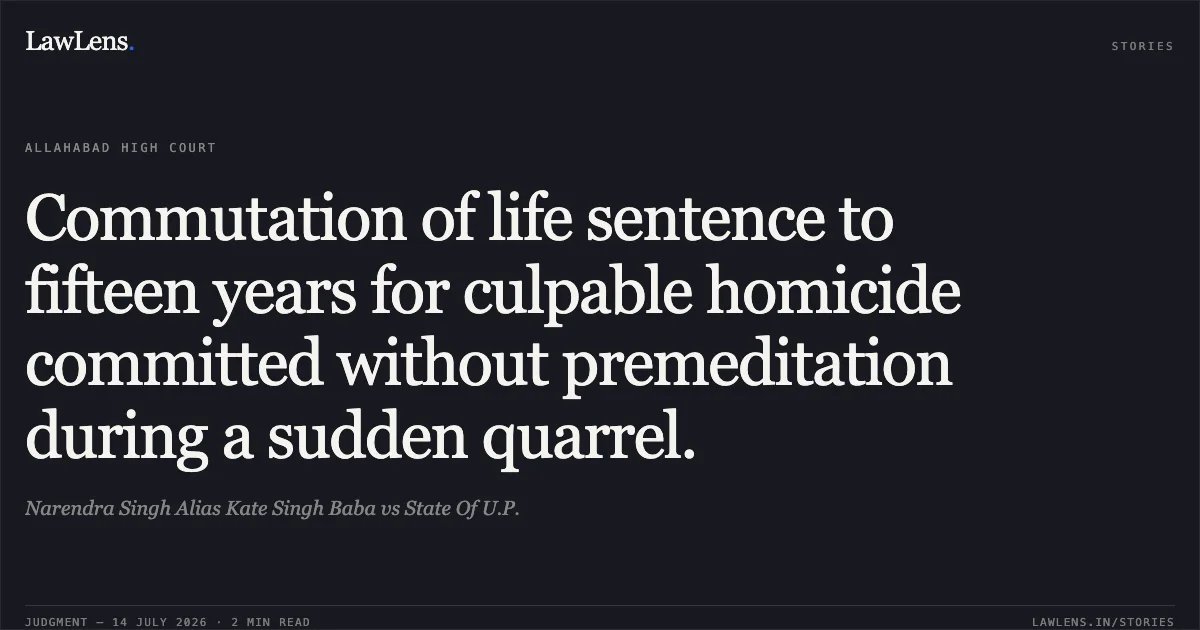
Source reference: p. 30-31While the conviction was upheld, the court determined life imprisonment was disproportionate given the appellant's history of mental illness and the fact that the assault happened during a sudden quarrel
Source reference: p. 31Holding
The court answered Issue 1 in the affirmative, upholding the conviction under Section 304 IPC
On Issue 2, it found the sentence excessive and commuted the life imprisonment to a fixed term of 15 years without remission
Source reference: p. 32The fine of Rs. 10,000 and the default sentence were maintained
Source reference: p. 32The appeal was partly allowed, and the appellant, having already served over 15 years in actual incarceration, was directed to be processed according to the modified sentence
Source reference: p. 32Acts & Sections Cited
9 provisions across 2 statutes referred to in this judgment. Each provision opens on LawLens.
Indian Penal Code, 18607
Code of Criminal Procedure, 19732
Original Court PDF
Narendra Singh Alias Kate Singh BabavsState Of U.P.
Click to open original judgment
Original judgment, available to read, download and summarize on LawLens.in