Facts
The Petitioner, a private limited company, challenged an order dated 13.04.2022 passed by the JMFC, Salipur, taking cognizance of an offence under Section 138 of the Negotiable Instruments (N.I.) Act
Source reference: p. 1-2The Complainant (Opposite Party) alleged he paid Rs. 17.0 lakhs to the Petitioner for land purchase; when the deal failed, a settlement was reached where three cheques were issued
Source reference: p. 2While two cheques were honored, a third cheque for Rs. 5.0 lakhs was dishonored
Source reference: p. 2The Petitioner contended that since the cheque was issued by an individual (Susanta Kumar Panda) in a personal capacity, the juristic entity (the company) could not be prosecuted
Source reference: p. 2-3However, the Petitioner’s reply to the statutory notice admitted the transaction was related to company business but raised a factual defense that the cheque was for security and the debt was already discharged
Source reference: p. 10-11Issues
1. Whether a company can be prosecuted under Section 138 of the N.I. Act when its Managing Director issues a cheque, and whether such liability can be determined at the stage of cognizance
Source reference: p. 6 / para. 52. Whether the Petitioner-company is absolved of liability on the grounds that the cheque was allegedly issued in an individual capacity despite the underlying commercial transaction involving the company
Source reference: p. 12 / para. 9Law Applied
The court interpreted Section 138 of the N.I. Act, which establishes liability for the drawer of a dishonored cheque issued to discharge a debt
Source reference: p. 7-8Section 141, which extends vicarious liability to companies and persons in charge of their business
Source reference: p. 8-9The court distinguished the Petitioner's reliance on Mainuddin Abdul Sattar Shaikh v. Vijay D. Salvi, which held that only the drawer is liable
Source reference: p. 3-5Aneeta Hada v. M/s Godfather Travels & Tours Pvt. Ltd., which establishes that at the cognizance stage, courts should not conduct a mid-trial analysis of whether liability is personal or corporate if evidence is yet to be led
Source reference: p. 6-7Reasoning
The Court observed that in the Petitioner’s own reply to the statutory legal notice, they did not deny the transaction or the issuance of the cheque by the Managing Director on behalf of the company
Source reference: p. 11The Petitioner raised a factual defense regarding the "security" nature of the cheque and claimed the debt was settled through bank transfers
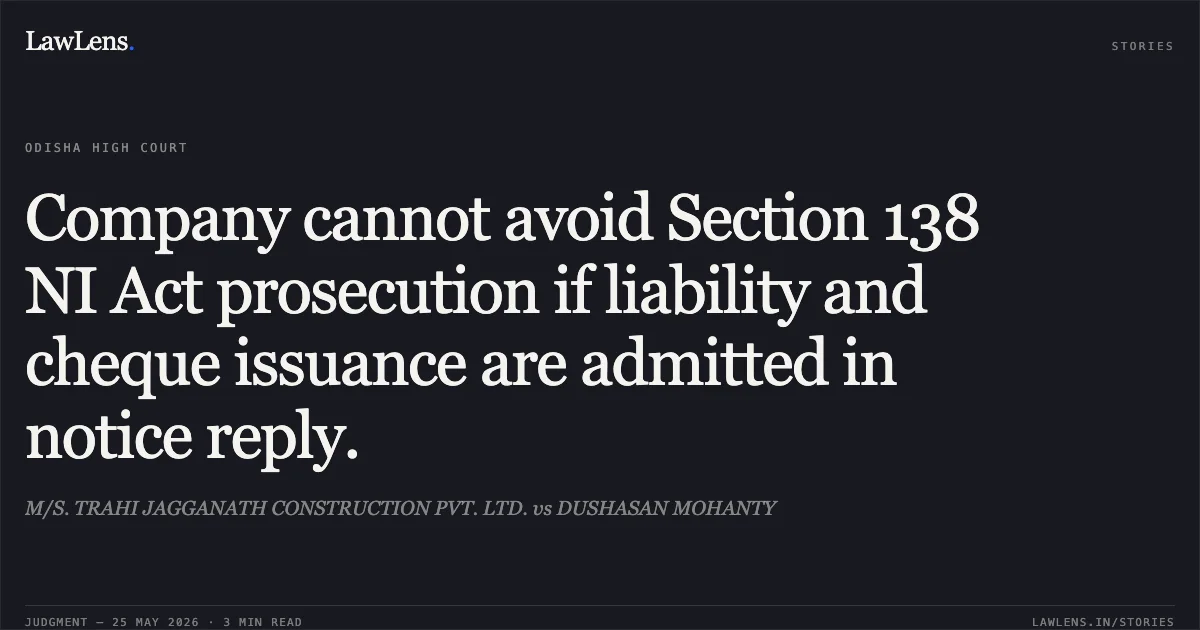
Source reference: p. 10-11The Court reasoned that once a company acknowledges a transaction and offers a factual defense in response to a Section 138(2) notice, it cannot later seek quashing by claiming it is a separate juristic person unconnected to the drawer
Source reference: p. 12Relying on Aneeta Hada, the Court found that determining whether the Managing Director misused a company cheque for personal debt or acted for the company is a matter of evidence
Source reference: p. 13Therefore, interfering at the cognizance stage would be premature as the complaint must be read in conjunction with the statutory notice and the accused's reply
Source reference: p. 12Holding
The High Court dismissed the petition, upholding the cognizance order
The Court held that at the preliminary stage of taking cognizance, the court cannot analyze the probative value of the defense or adjudicate on the specific nature of the liability (personal vs. corporate) without evidence
Source reference: p. 13The Petitioner-company was granted liberty to re-agitate these issues and lead defense evidence during the trial before the lower court
Source reference: p. 13Acts & Sections Cited
3 provisions across 2 statutes referred to in this judgment. Each provision opens on LawLens.
Code of Criminal Procedure, 19731
Negotiable Instruments Act, 18812
Original Court PDF
M/S. TRAHI JAGGANATH CONSTRUCTION PVT. LTD.vsDUSHASAN MOHANTY
Click to open original judgment
Original judgment, available to read, download and summarize on LawLens.in


