Facts
The complainant, proprietor of M/s T.K. Engineering Works, was appointed an authorised dealer of Swaraj Tractors for Nalanda district in 2007.
Source reference: p.2, para.3He alleged that the petitioners, officers of Mahindra & Mahindra Ltd., demanded ₹5,00,000 as rangdari, threatened termination of his dealership, altered the dealership area and market-share targets, and appointed another dealer without notice.
Source reference: p.2, para.3He further alleged that the petitioners caused encashment of a bank guarantee of ₹20,98,000, withheld dealership incentives, directed him to sell tractors on credit, and failed to take back spare parts valued at ₹15,00,000.
Source reference: pp.2–3, para.3The complainant instituted Complaint Case No. 849(C) of 2016, in which the Judicial Magistrate, 1st Class, Bihar Sharif, took cognizance under Section 406 IPC on 28 September 2016.
Source reference: p.1, para.2The petitioners sought quashing of the cognizance order under the High Court’s inherent jurisdiction.
Source reference: p.1, para.2Issues
Whether the cognizance order was liable to be quashed because the complaint was not supported by an affidavit, contrary to the principle stated in Priyanka Srivastava v. State of Uttar Pradesh.
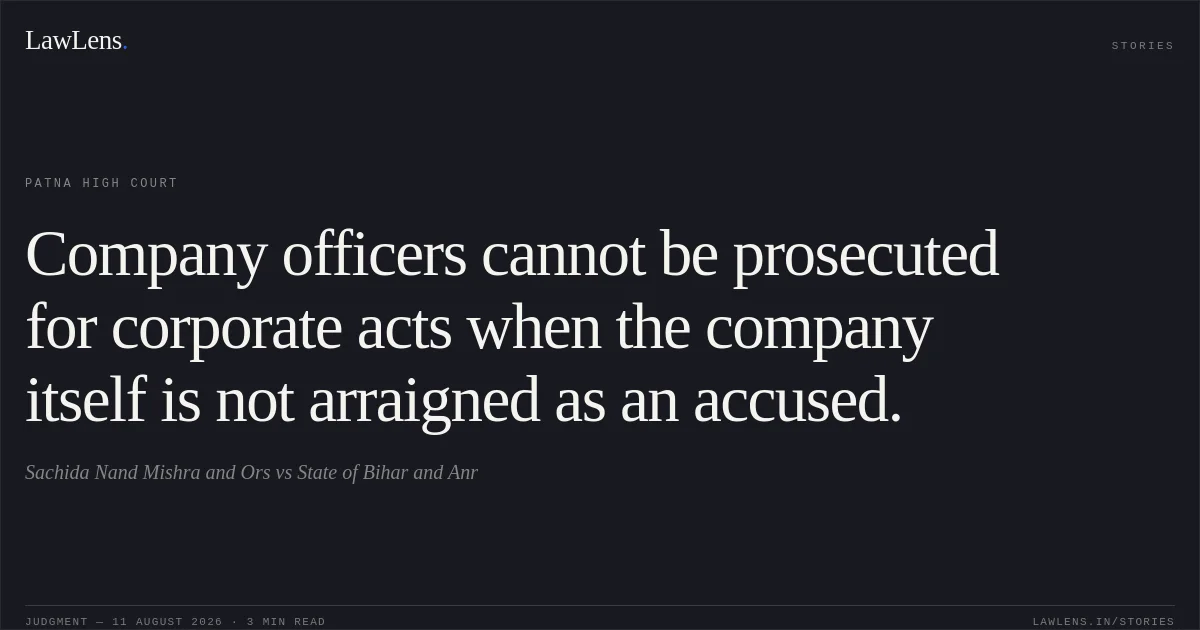
Source reference: p.4, para.4; p.5, para.8Whether the criminal proceedings against the petitioners, who were alleged to have acted on behalf of Mahindra & Mahindra Ltd., were maintainable when the company itself was not arrayed as an accused.
Source reference: pp.4–5, paras.5 and 8Whether the petitioners could be held personally liable for encashment of the bank guarantee by the company in the absence of allegations establishing their individual criminal liability.
Source reference: p.4, para.6Law Applied
The Court considered Section 406 of the Indian Penal Code, concerning criminal breach of trust.
Source reference: no citationIt relied on Priyanka Srivastava v. State of Uttar Pradesh, (2015) 6 SCC 287, for the principle that an application invoking the Magistrate’s process under Section 156(3) CrPC should be supported by an affidavit, thereby ensuring accountability in criminal proceedings.
Source reference: p.4, para.4The Court also relied on Manjula Kapoor v. State of Himachal Pradesh, 2026 LiveLaw (SC) 763, for the principle that where the alleged criminal acts are substantially attributable to a company, prosecution of its officers cannot ordinarily proceed without arraigning the company as an accused.
Source reference: pp.4–5, paras.5 and 8The Court further recognised that acts such as encashment of a company-held bank guarantee, without more, do not automatically establish personal criminal liability of the company’s officers.
Source reference: p.4, para.6Reasoning
The Court found that the complaint was not supported by the affidavit contemplated in Priyanka Srivastava, which constituted a procedural defect in the institution of the criminal process.
Source reference: p.5, para.8More importantly, the allegations concerning the dealership agreement, bank guarantee, incentives and spare parts were directed substantially against Mahindra & Mahindra Ltd., the company on whose behalf the petitioners allegedly acted.
Source reference: p.5, paras.7–8The complainant’s counsel conceded that the company had not been impleaded as an accused.
Source reference: p.5, paras.7–8Since the company had encashed the bank guarantee and the petitioners were proceeded against in their capacity as its officers, the Court held that the criminal case could not properly continue against them individually without the company being arraigned.
Source reference: p.5, para.8These defects rendered the cognizance order unsustainable.
Source reference: p.5, para.8Holding
The High Court allowed the application and quashed the cognizance order dated 28 September 2016, passed in Complaint Case No. 849(C) of 2016 under Section 406 IPC, along with all consequential proceedings, insofar as the three petitioners were concerned.
The Court clarified that the order would not affect any independent legal proceedings concerning recovery of the bank guarantee encashed by Mahindra & Mahindra Ltd.
Source reference: p.5, para.10Acts & Sections Cited
1 provisions across 1 statute referred to in this judgment. Each provision opens on LawLens.
Indian Penal Code, 18601
Original Court PDF
Sachida Nand Mishra and OrsvsState of Bihar and Anr
Click to open original judgment
Original judgment, available to read, download and summarize on LawLens.in