01Facts
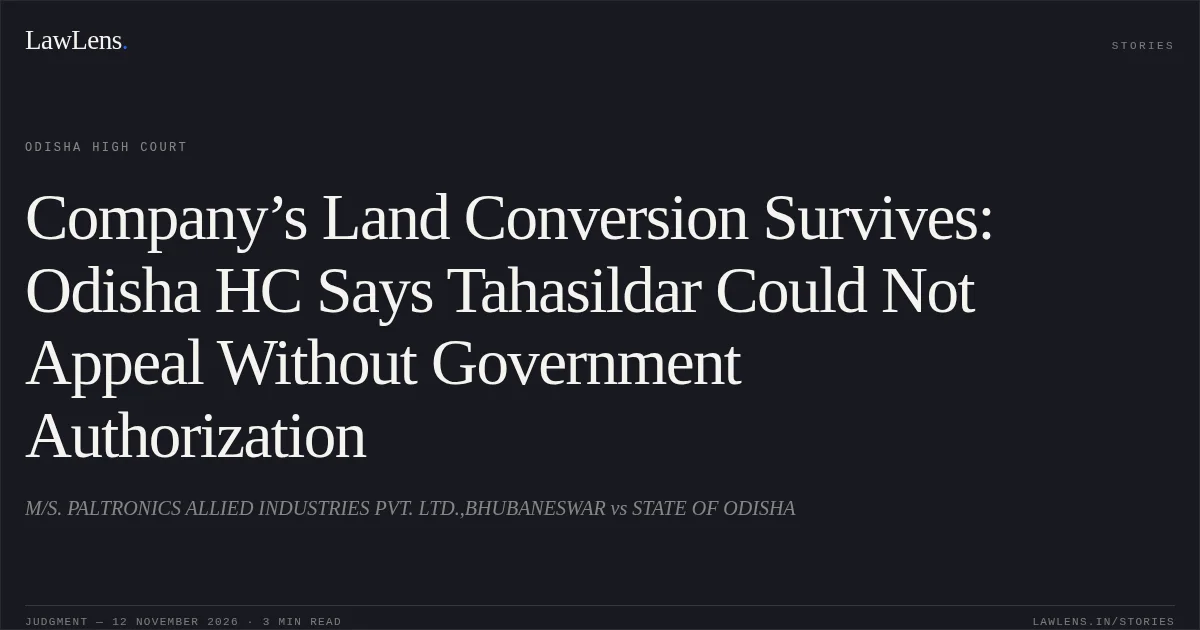
The State had leased five acres of land to Tejpal Singh, whose proprietorship was later incorporated as the appellant company. On the company’s application, the Additional Tahasildar converted the land’s classification from Patita to homestead under Section 8-A of the Odisha Land Reforms Act, 1960; the conversion was approved by the Sub-Collector and the Record of Rights was corrected accordingly.
¶ 5–6The Tahasildar appealed under Section 58 of the Act, and the Additional District Magistrate allowed the appeal, setting aside the conversion order. The Single Bench set aside that decision because the appeal had been filed without an application for condonation of delay and remitted the matter to the appellate authority.
¶ 7–802Issues
i.Whether the Tahasildar’s standing to appeal, not raised before the appellate authority or the Single Bench, could be considered for the first time in the writ appeal as a pure question of law.
¶ 3–4, 13–19ii.Whether the Tahasildar was a “person aggrieved” entitled to appeal under Section 58 of the OLR Act against an order made by the Additional Tahasildar, who is included within the statutory definition of “Tahasildar”.
¶ 20, 25, 30–3303Law Applied
Section 58 of the OLR Act confers a right of appeal on a “person aggrieved” against specified orders, including an order under Section 8-A; Rule 2(e) of the Odisha Land Reforms (General) Rules, 1965 includes an Additional Tahasildar within the definition of “Tahasildar”.
¶ 9, 20Under Section 63(2) of the OLR Act, only the specified provisions of the Limitation Act—Sections 4, 5, 12 and 14—apply to appeals or revisions under the Act.
¶ 11–12A pure question of law going to jurisdiction or standing, founded on admitted or established facts and not requiring further evidence, may be raised for the first time at a later stage, provided the other party is not unfairly prejudiced; the Court relied on Gurucharan Singh v. Kamla Singh, Greater Mohali Area Development Authority v. Manju Jain, V.L.S. Finance Ltd. v. Union of India, Ariane Orgachem Pvt. Ltd. v. Wyeth Employees Union and Shri Saurav Jain v. M/s. A.B.P. Design.
¶ 14–19A person is not “aggrieved” merely because an order disappoints them; the order must cause a legal grievance by adversely affecting a legally cognisable interest, as explained in Adi Pherozshah Gandhi v. H.M. Seervai.
¶ 26–29Provisions in the judgment · 6 · Linked ones open on LawLens
Limitation Act, 1963 Section 17
Code of Civil Procedure, 1908 Section 4Section 5Section 12Section 14Section 9
04Reasoning
The Court held that the standing objection was a pure question of law, ascertainable from the statutory provisions and the undisputed record, and could therefore be considered for the first time in the appeal.
¶ 19, 33Because Rule 2(e) includes the Additional Tahasildar within “Tahasildar,” the conversion order was, in law, an order of a Tahasildar. The Tahasildar could not be treated as a person aggrieved merely because the order had been made by the Additional Tahasildar or because he disagreed with it.
¶ 20, 31–32The Court distinguished Pabani Barik v. Tahasildar, Bhubaneswar: there, the Tahasildar’s appeal was authorised on behalf of the Government and subject to the Collector’s approval; here, the Tahasildar appealed in an individual capacity without Government authorisation or approval.
¶ 21–23, 29–30The Court did not determine the separate fraud plea mentioned at the outset.
05Holding
The Court held that the Tahasildar, acting in his individual capacity and without Government authorisation, was not a “person aggrieved” entitled to appeal under Section 58 of the OLR Act. The Tahasildar’s appeal before the Additional District Magistrate was therefore not maintainable.
¶ 30–33The High Court set aside the Single Bench’s judgment and dismissed the Tahasildar’s appeal; the writ appeal was disposed of without an order as to costs.
¶ 34–35Original Court PDF
M/S. PALTRONICS ALLIED INDUSTRIES PVT. LTD.,BHUBANESWARvsSTATE OF ODISHA
Click to open original judgment
Original judgment, available to read, download and summarize on LawLens.in