01Facts
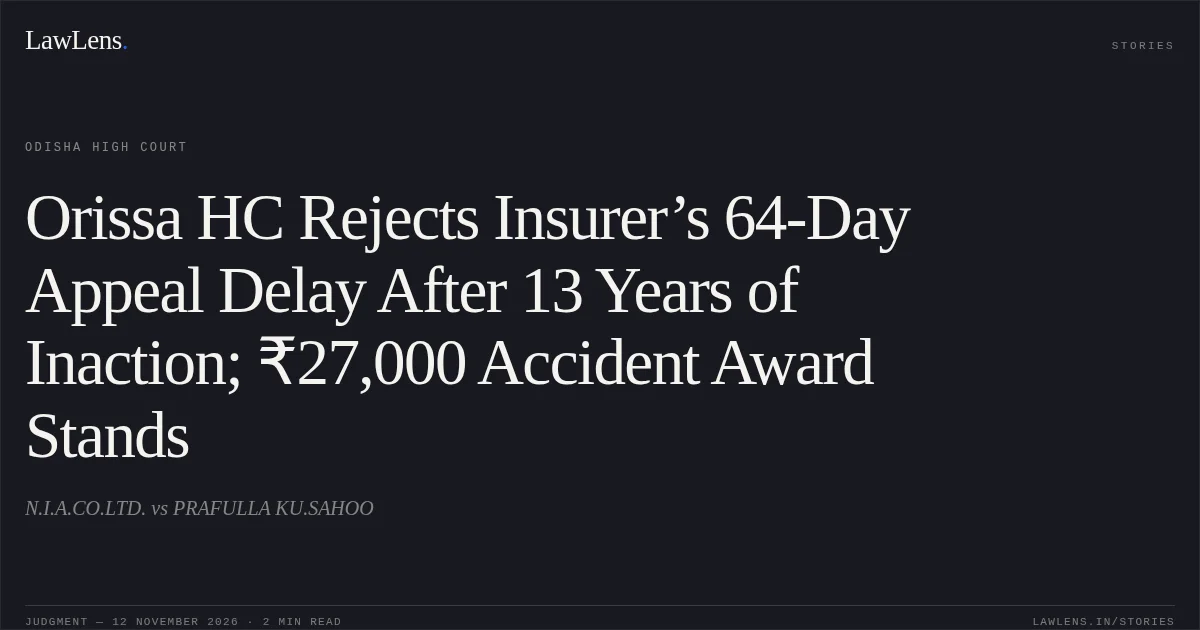
The insurer appealed the Tribunal’s 5 October 2012 award directing it to pay ₹27,000, with 6% annual interest from the date of the claim application, for an accident occurring in 1998.
pp. 1–4 · ¶ 1–5, 8The appeal was filed 64 days late, and the insurer sought condonation under Section 5 of the Limitation Act, 1963.
pp. 1–4 · ¶ 1–5, 8The appeal had also remained pending without diligent prosecution for approximately 13 years.
pp. 1–4 · ¶ 1–5, 8The insurer separately applied under Order XLI Rule 27 CPC to introduce a copy of the policy schedule as additional evidence, although it had pleaded before the Tribunal that the policy had expired before the accident.
pp. 1–4 · ¶ 1–5, 802Issues
i.1. Whether the insurer established “sufficient cause” under Section 5 of the Limitation Act to condone the 64-day delay in filing the appeal
pp. 2–7 · ¶ 2, 4–7ii.2. Whether the insurer could adduce the policy schedule as additional evidence under Order XLI Rule 27 CPC when it had not produced supporting evidence before the Tribunal
p. 8 · ¶ 803Law Applied
Section 5 of the Limitation Act permits condonation where sufficient cause for delay is established; a pragmatic approach may be taken to advance justice, but “sufficient cause” does not encompass apathy, negligence, or institutional complacency.
pp. 4–6 · ¶ 5–6In Post Master General v. Living Media India Ltd., (2012) 3 SCC 563, the Supreme Court held that routine explanations based on bureaucratic delay are insufficient without a reasonable explanation and bona fide effort.
pp. 4–6 · ¶ 5–6Order XLI Rule 27 CPC does not permit additional evidence merely to fill a party’s lacuna in its case.
p. 8 · ¶ 8Provisions in the judgment · 3 · Linked ones open on LawLens
Motor Vehicles Act, 1988 Section 173
Limitation Act, 1963 Section 5
Code of Civil Procedure, 1908 Section 41
04Reasoning
The insurer’s explanation—that the judgment was sent for legal opinion, internal approvals were obtained, and the file moved between offices—lacked precise chronological details and did not adequately explain the delay.
pp. 4–7 · ¶ 5, 7The Court considered the insurer’s lack of diligence both in filing the appeal and in prosecuting it over the ensuing years, and held that internal administrative processes did not constitute sufficient cause.
pp. 4–7 · ¶ 5, 7The policy schedule was also disallowed: the insurer had already pleaded that the policy had expired before the accident but had not produced evidence to support that position before the Tribunal; the application therefore sought to fill a lacuna.
p. 8 · ¶ 805Holding
The Court dismissed the application to adduce additional evidence and dismissed the application to condone the 64-day delay.
pp. 8–9 · ¶ 8–9Consequently, the appeal was dismissed as time-barred at the admission stage, without costs.
pp. 8–9 · ¶ 8–9The insurer was directed to satisfy the Tribunal’s award, with accrued interest; the statutory deposit of ₹13,500 and accrued interest was to be sent to the Tribunal for disbursement, and the insurer was directed to deposit the balance within eight weeks.
pp. 8–9 · ¶ 9–10The judgment refers inconsistently to the claimant as R2 and R1 in its operative directions.
pp. 8–9 · ¶ 9–10Original Court PDF
N.I.A.CO.LTD.vsPRAFULLA KU.SAHOO
Click to open original judgment
Original judgment, available to read, download and summarize on LawLens.in