01Facts
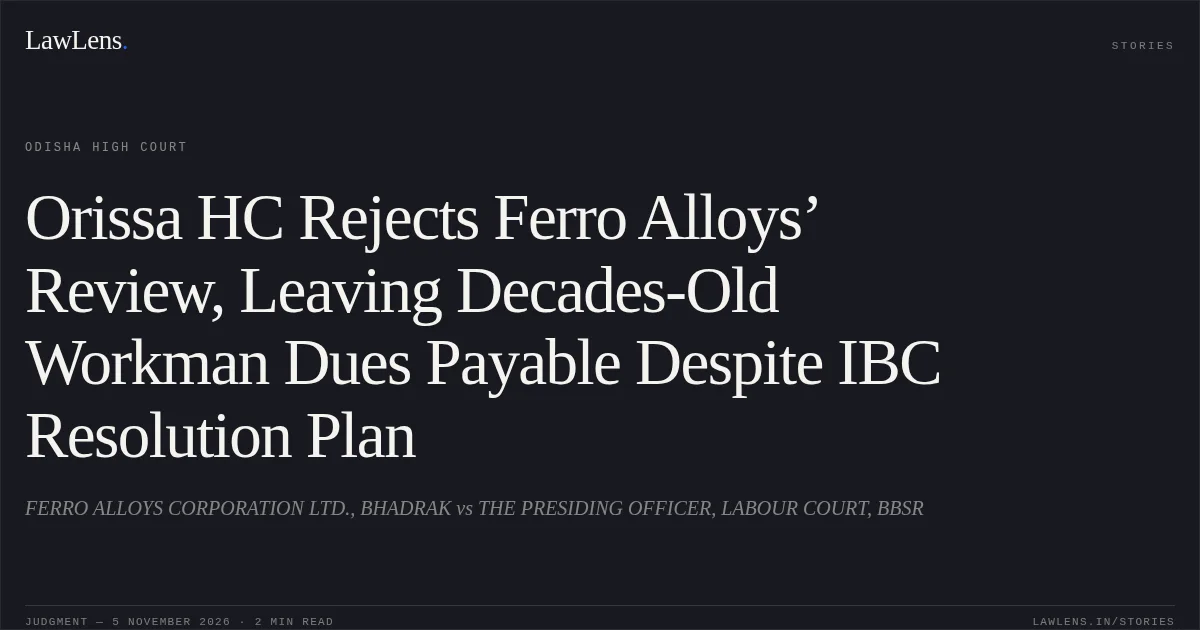
The petitioner sought review of the Division Bench judgment dated 29 August 2023 dismissing its writ petition against a Labour Court order made under Section 33-C(2) of the Industrial Disputes Act, 1947.
¶ 1, 7 · pp. 1, 5–6The underlying industrial award had directed reinstatement of the workman and payment of back wages at 50%; the award was upheld in 2019.
¶ 7–9 · pp. 5–6The employer argued that the workman’s claim was extinguished under the approved resolution plan following the employer’s corporate insolvency resolution process. The Division Bench rejected that argument and dismissed the writ petition.
¶ 10–13 · pp. 7–20In review, the employer contended, among other things, that the workman had not lodged a claim during the insolvency process and that the Division Bench had made factual and legal errors.
¶ 14–16 · pp. 20–2202Issues
i.Whether the petitioner established a ground under Order XLVII Rule 1 read with Section 114 of the Code of Civil Procedure for reviewing the judgment dismissing its writ petition.
¶ 5 · p. 3ii.Whether the alleged errors in the Division Bench’s treatment of the resolution plan and Ghanashyam Mishra were apparent errors warranting review, rather than grounds for re-arguing the merits.
¶ 23.1–23.5 · pp. 39–4003Law Applied
Order XLVII Rule 1 read with Section 114 CPC permits review on discovery of new and important matter or evidence unavailable despite due diligence, an error apparent on the face of the record, or another sufficient reason analogous to those grounds.
¶ 6 · pp. 3–5 · ¶ 21 · pp. 29–38As explained in Kamlesh Verma v. Mayawati, (2013) 8 SCC 320, review is not an appeal in disguise: an error must be self-evident, and a mere possibility of another view or repetition of rejected arguments does not justify review.
¶ 21 · pp. 29–38Parsion Devi v. Sumitri Devi, (1997) 8 SCC 715, and Thungabhadra Industries Ltd. v. Government of Andhra Pradesh, AIR 1964 SC 1372, likewise distinguish a patent error from an erroneous decision requiring reasoning to identify.
¶ 21 · pp. 29–38The Court also considered BCCI v. Netaji Cricket Club, (2005) 4 SCC 741, but treated it as fact-specific and not as displacing the limited review grounds.
¶ 15, 24–25 · pp. 21–22, 40–43Provisions in the judgment · 13 · Linked ones open on LawLens
Code of Civil Procedure, 1908 Section 114
Insolvency and Bankruptcy Code, 2016. 12 provisions
Section 7Section 9Section 10Section 13Section 14Section 15Section 16Section 30Section 31Section 33Section 74Section 23804Reasoning
The Court found that the review grounds repeated legal and factual contentions already raised and rejected in the writ petition, including the interpretation of Ghanashyam Mishra and the effect of the approved resolution plan.
¶ 23.2, 23.5 · pp. 39–40The Division Bench had considered those matters and reached a view on them; disagreement with that view, or the possibility of an alternative interpretation, did not establish a patent error.
¶ 23.2–23.3 · p. 39The factual grounds would require reconsideration of material already assessed, while the legal grounds sought a rehearing of concluded issues—neither is permissible in review absent an apparent error undermining the judgment.
¶ 23.4–23.6, 26–26.1 · p. 40, 4305Holding
The Court held that the petitioner had shown no material error apparent on the face of the judgment and no other ground warranting review.
¶ 26–27 · pp. 43–44The review application was dismissed as devoid of merit, with no order as to costs.
¶ 27 · p. 44Original Court PDF
FERRO ALLOYS CORPORATION LTD., BHADRAKvsTHE PRESIDING OFFICER, LABOUR COURT, BBSR
Click to open original judgment
Original judgment, available to read, download and summarize on LawLens.in