01Facts
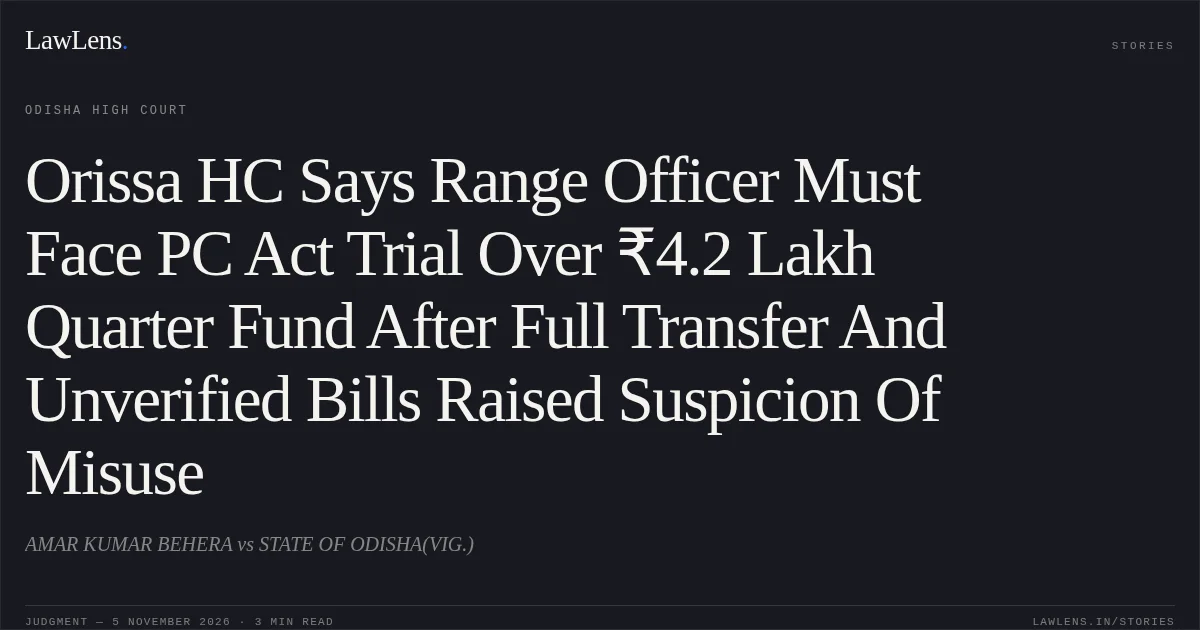
The petitioner, a Range Officer, transferred funds allocated for construction of a Forest Guard quarter to a Forester, who transferred the full amount the following day to another co-accused. The construction remained incomplete; a technical inspection assessed the completed work at approximately ₹1.27 lakh against the sanctioned ₹4.20 lakh. The prosecution alleged that the petitioner failed to ensure proper use of the funds and later passed vouchers without verifying completion of the work
pp. 3–6 · ¶ 5–6The Special Judge discharged him of the IPC offences and the charge under Section 13(1)(d) of the Prevention of Corruption Act, but declined to discharge him under Section 13(1)(c). The petitioner challenged that decision in revision
pp. 2, 6–8 · ¶ 2, 7–902Issues
i.Whether the investigation materials disclosed sufficient grounds to frame a charge against the petitioner under Section 13(1)(c) read with Section 13(2) of the Prevention of Corruption Act, despite no allegation that he personally misappropriated the funds or received a benefit
pp. 10–13, 38–40 · ¶ 11, 34–40ii.Whether the Special Judge’s decision to retain that charge, while discharging the petitioner of other offences, warranted interference in revision
pp. 21–22, 38–41 · ¶ 15–16, 38–4103Law Applied
The Court applied Section 13(1)(c), as it stood before the 2018 amendment, which covered a public servant’s dishonest or fraudulent misappropriation or conversion of property entrusted to or under the servant’s control, and also knowingly allowing another person to do so; Section 13(2) prescribed the punishment
pp. 19–20 · ¶ 13Rule 28 of the Orissa Forest Code placed duties on Range Officers to protect property in their charge, oversee works, and ensure economical and proper use of Government funds
pp. 17–19 · ¶ 13At the charge stage, the court need not determine whether the evidence will sustain a conviction; it asks whether the material, if generally accepted, provides sufficient ground to put the accused on trial
pp. 37–38 · ¶ 32–33 · Stree Atyachar Virodhi Parishad v. Dilip Nathumal ChordiaThe Court also considered the principle that negligence or failure to detect wrongdoing, without proof of knowing permission, does not by itself establish the offence of allowing misappropriation
p. 30 · ¶ 25 · Sudarsan Sahu v. StateProvisions in the judgment · 23 · Linked ones open on LawLens
Bharatiya Nagarik Suraksha Sanhita, 2023 Section 438Section 442Section 528
Prevention of Corruption Act, 1988 Section 12Section 13
Indian Penal Code, 1860 Section 109Section 406Section 409Section 468Section 471
Code of Criminal Procedure, 1973 13 provisions
Section 155Section 156Section 161Section 227Section 253Section 254Section 255Section 256Section 257Section 258Section 325Section 360Section 48204Reasoning
The Court distinguished the case from one based only on negligent supervision. The prosecution material alleged a specific sequence: the petitioner transferred the full allocation to the Forester; the full amount was transferred the next day to a person described as the Forester’s co-villager and not a contractor; the work remained incomplete; and vouchers were passed later without verification
pp. 27–28, 38–40 · ¶ 20, 22, 34–38While the material did not allege that the petitioner personally converted the money or received a benefit, the Court considered that the sequence could give rise to a strong suspicion that he knowingly permitted the co-accused to misappropriate public funds. Whether that inference could ultimately be proved was a matter for trial, not discharge
pp. 38–40 · ¶ 36, 38–3905Holding
The Court held that the materials provided sufficient grounds to frame a charge under Section 13(1)(c) read with Section 13(2) of the Prevention of Corruption Act and dismissed the revision
pp. 39–40 · ¶ 39–41It directed that, if the petitioner surrendered before the Special Judge by 12 November 2026, the non-bailable warrant would be recalled and he could continue on his previous bail; the trial court was also directed to arrange the cases for joint trial, or, if that was not possible, to list them on the same dates
pp. 40–42 · ¶ 43–46Original Court PDF
AMAR KUMAR BEHERAvsSTATE OF ODISHA(VIG.)
Click to open original judgment
Original judgment, available to read, download and summarize on LawLens.in