01Facts
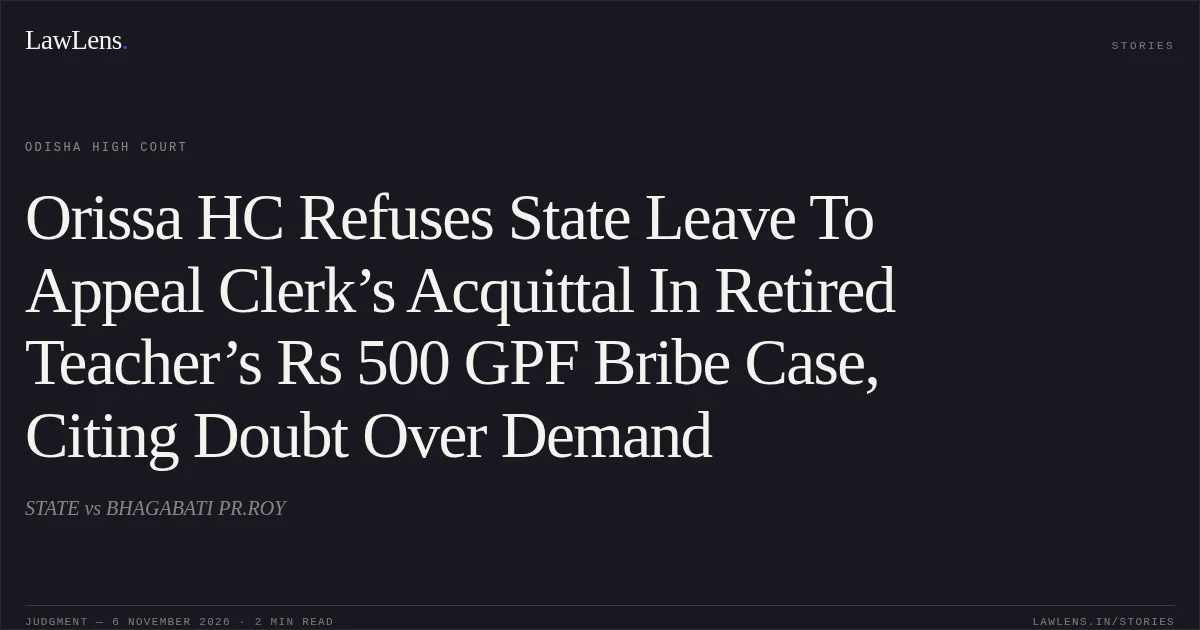
The State sought leave under Section 378 CrPC to challenge the Special Judge (Vigilance), Bhubaneswar’s judgment acquitting Bhagabati Prasad Roy of offences under Sections 7 and 13(1)(d), punishable under Section 13(2), of the Prevention of Corruption Act, 1988.
pp. 1–2The prosecution alleged that Roy, a Dealing Assistant-cum-Clerk, demanded and accepted ₹500 from a retired teacher to process his GPF withdrawal; the tainted currency was recovered, and the hand-wash and pocket-wash tests were positive.
pp. 2–3The trial court found the evidence of demand insufficient, noting inconsistencies about the trap and transaction and evidence supporting the defence account that the notes had been thrust into Roy’s pocket.
pp. 4–6The State challenged that assessment, relying on the complainant’s and trap witnesses’ evidence and the corroborative recovery and chemical tests.
pp. 6–702Issues
i.1. Whether the trial court’s acquittal was perverse, unreasonable, or based on a misreading or omission of material evidence so as to warrant appellate interference.
pp. 8–11ii.2. Whether the State had shown sufficient grounds for the High Court to grant leave under Section 378 CrPC and disturb the acquittal.
pp. 1, 11–1203Law Applied
Section 378 CrPC governs an appeal against acquittal. The court applied the principle that where two reasonable views are available, an appellate court should not disturb the trial court’s acquittal if its view is possible on the evidence; interference is warranted where the acquittal is perverse, clearly unreasonable, or rests on a misreading or omission of material evidence, or where compelling and substantial reasons exist (*Tulasareddi @ Mudakappa & Anr. v. State of Karnataka & Ors.*, 2026 INSC 67).
pp. 8–9It also applied the rule that an acquittal strengthens the presumption of innocence and requires a higher threshold for appellate reversal (*Mallappa & Ors. v. State of Karnataka*, 2024 INSC 104).
pp. 9–10The alleged offences were under Sections 7 and 13(1)(d), punishable under Section 13(2), of the Prevention of Corruption Act, 1988.
p. 2Provisions in the judgment · 4 · Linked ones open on LawLens
Code of Criminal Procedure, 1973 Section 378Section 248
Prevention of Corruption Act, 1988 Section 7Section 13
04Reasoning
The High Court considered the trial court’s assessment of the alleged demand and acceptance alongside the discrepancies concerning the trap’s time, place, and participants’ movements, the evidence about the GPF file, and the defence evidence concerning the alleged thrusting of the notes.
pp. 4–6It held that recovery of the tainted currency and positive wash tests did not, in the circumstances, make the trial court’s view perverse or wholly unreasonable. Because the trial court’s conclusion was a possible view on the record, the State had not established the compelling grounds required to overcome the reinforced presumption of innocence.
pp. 10–1205Holding
The High Court declined to grant leave to appeal, finding no legal or factual basis to unsettle the acquittal.
p. 12The criminal leave petition was dismissed.
p. 12Original Court PDF
STATEvsBHAGABATI PR.ROY
Click to open original judgment
Original judgment, available to read, download and summarize on LawLens.in