01Facts
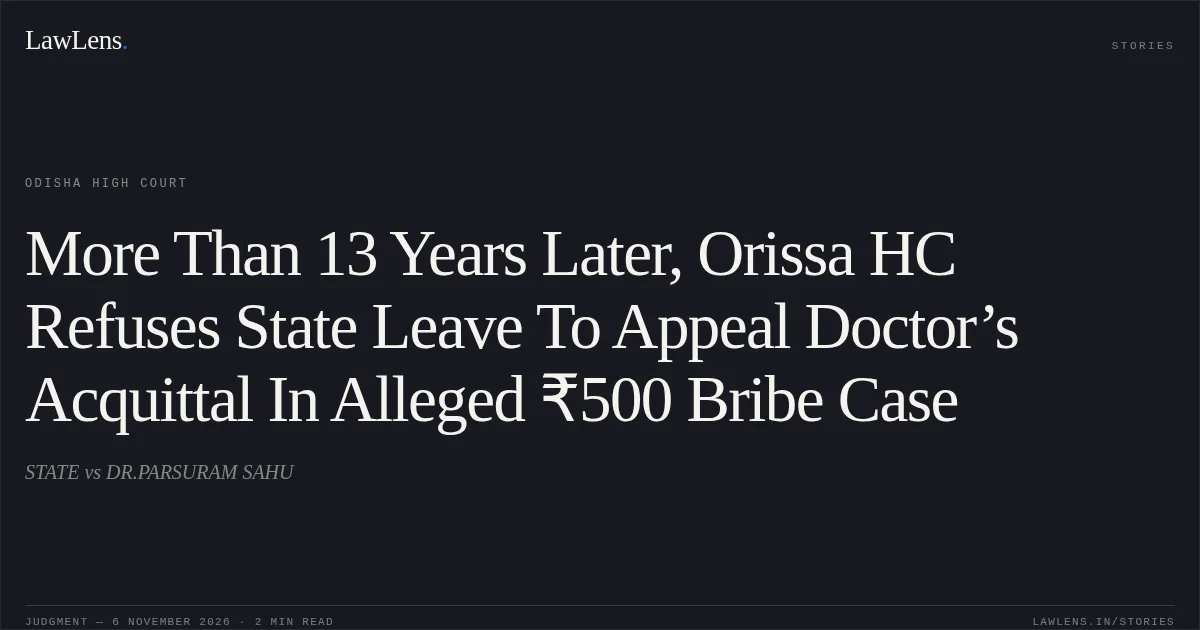
The State sought leave to appeal against the Special Judge (Vigilance), Cuttack’s judgment acquitting Dr. Parsuram Sahu, an Orthopaedic Specialist, of offences under Sections 7 and 13(1)(d), read with Section 13(2), of the Prevention of Corruption Act, 1988.
pp. 2–6The prosecution alleged that Sahu demanded and accepted Rs. 500 from the complainant for treating the complainant’s maternal grandfather.
pp. 2–6In a trap, the tainted currency was recovered from Sahu, and the hand-wash test reportedly turned pink.
pp. 2–6The complainant was not examined; the overhearing witness testified that he saw the payment but could not hear the conversation.
pp. 2–6Sahu’s defence was that the money reimbursed car expenses for an earlier visit to the patient.
pp. 2–6The trial court found demand unproved, accepted the defence explanation as sufficient to discharge the burden under Section 20, and acquitted him.
pp. 2–6The State challenged that decision, arguing that the recovery, chemical test and other evidence supported the prosecution case.
pp. 7–802Issues
i.1. Whether the trial court’s acquittal was perverse, unreasonable, or based on misreading or omission of material evidence so as to warrant appellate interference
pp. 9–12ii.2. Whether the trial court erred in finding that the prosecution had not established the demand for gratification and in accepting the accused’s explanation for receiving Rs. 500
pp. 5–8, 1203Law Applied
Under Sections 7 and 13(1)(d), read with Section 13(2), of the Prevention of Corruption Act, the prosecution must establish the ingredients of the charged offences; the trial court considered the statutory presumption under Section 20 in relation to the Section 7 charge.
pp. 2, 5–6On an appeal against acquittal, the presumption of innocence is reinforced, and where the trial court’s view is a reasonable one supported by the evidence, an appellate court should not substitute another possible view. Interference is justified where the acquittal is perverse, unreasonable, or affected by misreading or omission of material evidence, or where compelling and substantial reasons require reversal. The Court applied these principles from Tulasareddi @ Mudakappa v. State of Karnataka and Mallappa v. State of Karnataka.
pp. 9–11Provisions in the judgment · 6 · Linked ones open on LawLens
Code of Criminal Procedure, 1973 Section 378Section 313Section 248
Prevention of Corruption Act, 1988 Section 7Section 13Section 20
04Reasoning
The High Court found no basis to disturb the trial court’s assessment. The complainant, whose evidence could have addressed the alleged demand, was not examined, and the overhearing witness could not hear the conversation between the complainant and Sahu.
pp. 5–6Although the tainted money was recovered and the hand-wash test was positive, the trial court considered Sahu’s explanation that the payment was for car expenses and concluded that he had discharged the burden under Section 20.
pp. 5–6The High Court held that the trial court’s view was a possible one and was neither perverse nor wholly unreasonable; the State’s arguments did not establish compelling grounds for appellate interference.
pp. 11–1205Holding
The High Court declined to grant leave to appeal, finding no legal or factual justification to unsettle the acquittal.
p. 12The State’s criminal leave petition was dismissed.
p. 13Original Court PDF
STATEvsDR.PARSURAM SAHU
Click to open original judgment
Original judgment, available to read, download and summarize on LawLens.in