01Facts
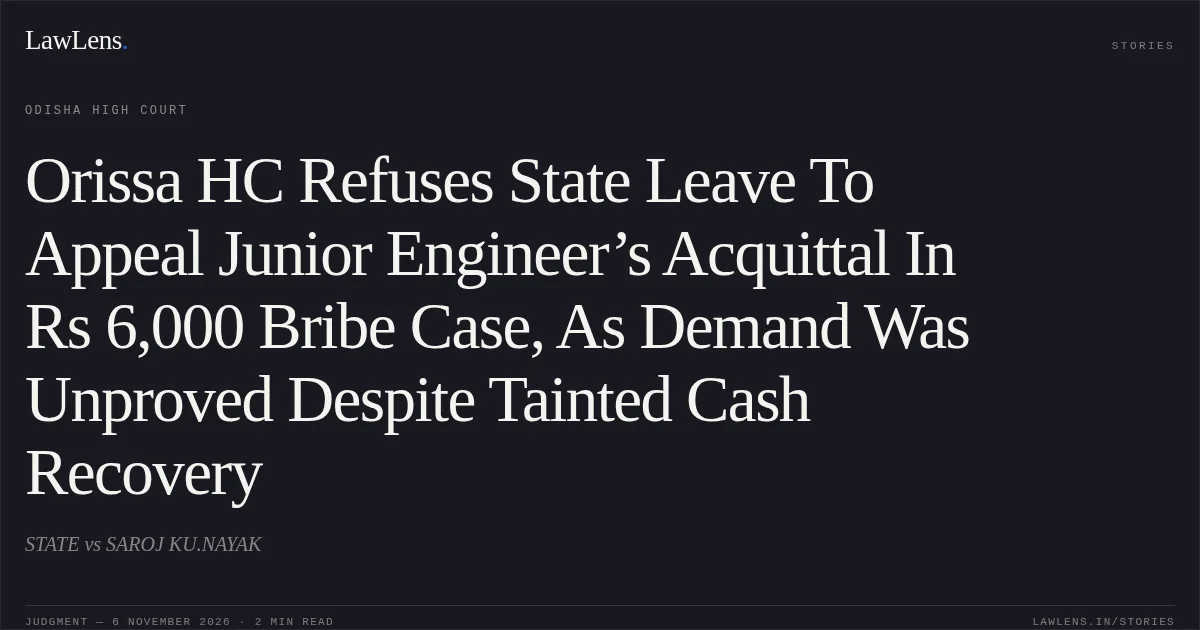
Saroj Kumar Nayak, a Junior Engineer, was accused of demanding ₹6,000 from a supplier to facilitate payment for supplied iron doors and windows.
pp. 2–8A Vigilance trap was conducted, during which tainted currency was recovered and the hand and shirt-pocket washes tested positive.
pp. 2–8The Special Judge acquitted Nayak of offences under Sections 7 and 13(2) read with Section 13(1)(d) of the Prevention of Corruption Act, 1988, finding demand and voluntary acceptance unproved.
pp. 2–8The State sought leave to challenge the acquittal, arguing that the complainant’s evidence, recovery, chemical tests and statutory presumption supported conviction.
pp. 2–802Issues
i.1. Whether the trial court’s acquittal was perverse, unreasonable, or based on misreading or omission of material evidence so as to warrant appellate interference
pp. 9–12ii.2. Whether the prosecution circumstances, including recovery of the tainted money and positive chemical tests, required the High Court to grant leave and interfere with the acquittal
pp. 7–9, 1203Law Applied
Under the principles governing appeals against acquittal, where two reasonable conclusions are possible on the evidence, the appellate court must not disturb the trial court’s view merely because another view is also available.
pp. 9–12Interference is warranted where the acquittal is perverse, clearly unreasonable, or rests on misreading or omission of material evidence; the appellate court must find that guilt was the only conclusion available on the record.
pp. 9–12The Court relied on Tulasareddi @ Mudakappa & Anr. v. State of Karnataka & Ors., 2026 INSC 67, and Mallappa & Ors. v. State of Karnataka, 2024 INSC 104, which holds that an acquittal strengthens the presumption of innocence and requires a higher threshold for appellate reversal.
pp. 9–12The charges arose under Sections 7 and 13(2) read with Section 13(1)(d) of the Prevention of Corruption Act, 1988; the State also invoked Section 20 of that Act and Section 114 of the Evidence Act in support of its challenge.
pp. 6–8Provisions in the judgment · 5 · Linked ones open on LawLens
Code of Criminal Procedure, 1973 Section 378Section 248
Prevention of Corruption Act, 1988 Section 7Section 13Section 20
04Reasoning
The trial court had identified inconsistencies in the complainant’s account of the alleged demands and relied on the accompanying witness’s evidence that the complainant thrust the money on Nayak despite his refusal, a version supported by the defence witness.
pp. 5–8It also considered office records indicating that the required certificate had been furnished and the bill processed.
pp. 5–8In that evidentiary context, the trial court treated recovery and positive chemical tests as insufficient, without reliable proof of demand and voluntary acceptance.
pp. 5–8The High Court held that this assessment was a possible view and was neither perverse nor wholly unreasonable; the State’s arguments did not establish a basis to displace the reinforced presumption of innocence.
pp. 5–8, 1205Holding
The High Court declined to grant leave to challenge the acquittal, finding no compelling or substantial reason to interfere with the trial court’s assessment.
p. 12The State’s leave application, CRLLP No. 153 of 2013, was dismissed.
p. 13Original Court PDF
STATEvsSAROJ KU.NAYAK
Click to open original judgment
Original judgment, available to read, download and summarize on LawLens.in