01Facts
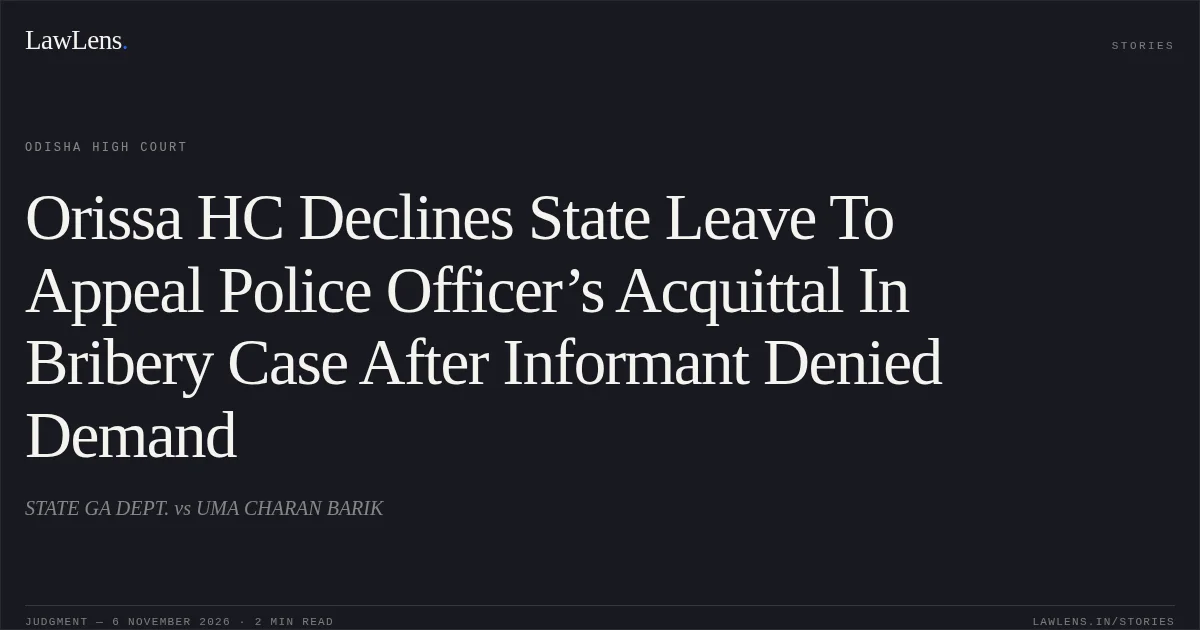
The State sought leave to appeal under Sections 378(1) and 378(3) of the Code of Criminal Procedure, 1973, against the respondent’s acquittal of offences under Sections 7 and 13(2) read with Section 13(1)(d) of the Prevention of Corruption Act, 1988.
pp. 1–2The prosecution alleged that, while serving as Officer-in-Charge of Junagada Police Station, the respondent demanded illegal gratification from the informant and accepted a payment during a vigilance trap; the trap party recovered tainted currency, and the hand and pocket washes reportedly tested positive.
pp. 2–3At trial, the informant (P.W.5) did not support the alleged demand, and the trial court found the accompanying witness’s account unreliable.
pp. 4–6It held that recovery and the chemical test results did not establish the offence without reliable proof of demand, and acquitted the respondent.
pp. 4–602Issues
i.1. Whether the evidence of demand and acceptance, including the recovery of tainted currency and positive chemical tests, justified interference with the acquittal.
pp. 6–8, 12ii.2. Whether the trial court’s acquittal was perverse, unreasonable, or otherwise met the threshold for appellate interference and grant of leave.
pp. 8–1303Law Applied
Sections 7 and 13(1)(d), punishable under Section 13(2), of the Prevention of Corruption Act, 1988, formed the basis of the charges; the trial court considered reliable proof of demand necessary and held that recovery and chemical test results alone did not establish the alleged bribery.
pp. 5–6The State also relied on the presumption under Section 20 of the Act in relation to the Section 7 charge.
pp. 7–8Under Sections 378(1) and 378(3) CrPC, the High Court considered whether leave to appeal against the acquittal was warranted.
p. 1Applying Tulasareddi @ Mudakappa v. State of Karnataka, the Court held that an acquittal should not be disturbed where the trial court’s view is reasonably possible; interference is warranted where, among other things, the acquittal is perverse, rests on misreading or omission of material evidence, or is clearly unreasonable.
pp. 8–10Relying also on Mallappa v. State of Karnataka, the Court noted that acquittal strengthens the presumption of innocence and requires a higher threshold for appellate interference.
pp. 10–11Provisions in the judgment · 5 · Linked ones open on LawLens
Code of Criminal Procedure, 1973 Section 378Section 248
Prevention of Corruption Act, 1988 Section 7Section 13Section 20
04Reasoning
The informant’s failure to support the prosecution on demand and the trial court’s doubts about the accompanying witness’s opportunity to hear and observe the alleged transaction provided a reasonable basis for finding the evidence insufficient.
pp. 4–6In that evidentiary context, recovery of the currency and positive wash tests did not render the trial court’s conclusion perverse, notwithstanding the State’s argument that those circumstances and the Section 20 presumption supported the charge.
pp. 6–8, 12Applying the reinforced presumption of innocence and the restraint required in an appeal against acquittal, the High Court found no compelling basis to substitute another possible view for the trial court’s assessment.
pp. 8–1205Holding
The High Court held that the trial court’s acquittal was neither perverse nor wholly unreasonable and that no compelling or substantial reason justified interference.
pp. 12–13It declined to grant leave to appeal and dismissed the CRLLP.
pp. 12–13Original Court PDF
STATE GA DEPT.vsUMA CHARAN BARIK
Click to open original judgment
Original judgment, available to read, download and summarize on LawLens.in