01Facts
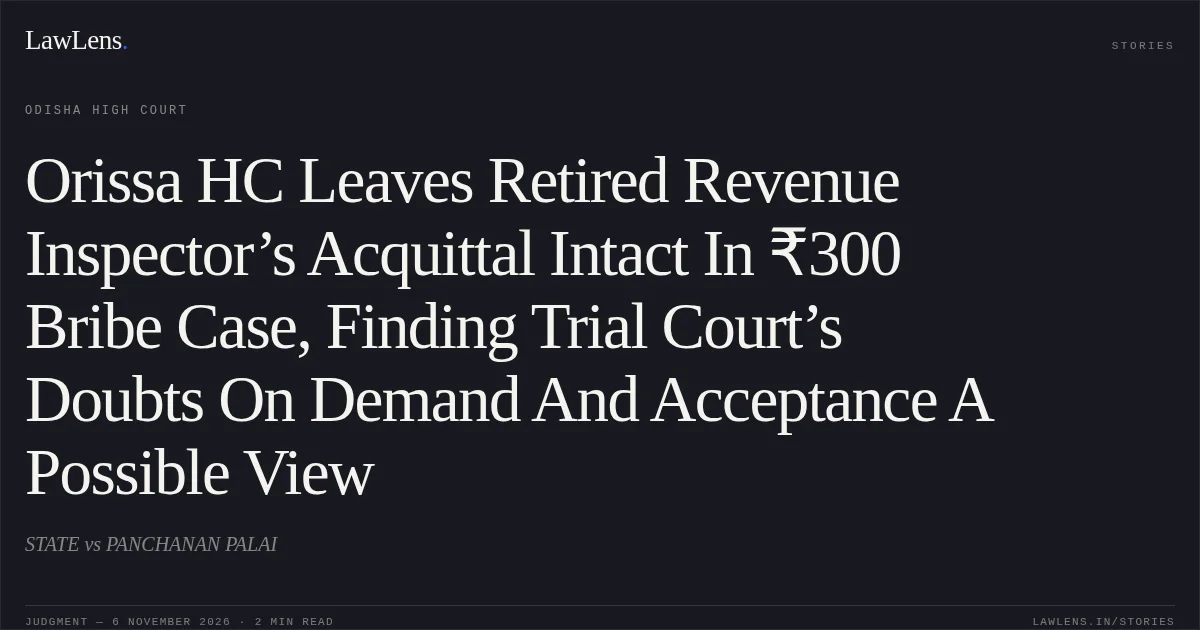
The complainant had applied for a legal heir certificate, and his application was referred to the respondent, a Revenue Inspector, for enquiry.
pp. 2–3The prosecution alleged that the respondent demanded ₹300 to submit the enquiry report and accepted the money during a Vigilance trap; the tainted currency was recovered, and the hand-wash and shirt-pocket-wash tests were positive.
pp. 2–3The trial court found inconsistencies in the evidence of demand and acceptance and acquitted the respondent under Section 248(1) CrPC, holding that recovery and chemical-test evidence did not, without reliable proof of demand and voluntary acceptance, establish the charged offences.
pp. 4–6The State sought leave to appeal, contending that the evidence and the presumption under Section 20 of the Prevention of Corruption Act supported conviction.
pp. 6–802Issues
i.1. Whether the trial court’s acquittal was perverse, unreasonable, or based on a misreading or omission of material evidence, warranting appellate interference.
pp. 8–12ii.2. Whether the evidence of recovery and positive chemical tests, considered with the witnesses’ testimony and the statutory presumption under Section 20 of the Prevention of Corruption Act, justified setting aside the acquittal.
pp. 6–8, 12–1403Law Applied
Under the principles governing appeals against acquittal, where two reasonable views are possible, the appellate court should not disturb the trial court’s acquittal if its view is a possible one; interference is warranted where the acquittal is perverse, rests on misreading or omission of material evidence, or is clearly unreasonable (Tulasareddi @ Mudakappa v. State of Karnataka, as cited at pp. 8–10).
pp. 8–10An acquittal strengthens the presumption of innocence and places a higher threshold on an appellate court seeking to overturn it (Mallappa v. State of Karnataka, as cited at pp. 10–11).
pp. 10–11The charges arose under Sections 7 and 13(2) read with Section 13(1)(d) of the Prevention of Corruption Act, 1988; the State also relied on Section 20’s presumption, citing T. Shankar Prasad v. State of Andhra Pradesh.
pp. 2, 7–8The court’s stated basis for decision, however, was the standard governing appellate review of acquittals.
pp. 11–14Provisions in the judgment · 5 · Linked ones open on LawLens
Code of Criminal Procedure, 1973 Section 378Section 248
Prevention of Corruption Act, 1988 Section 13Section 7Section 20
04Reasoning
The High Court considered the trial court’s assessment of the alleged demand and acceptance, including the inconsistencies in the complainant’s account and the lack of satisfactory corroboration from the overhearing witness.
pp. 4–6Although the recovery and chemical-test results were accepted, the trial court had found them insufficient, in the absence of reliable proof of demand and voluntary acceptance, to establish guilt.
pp. 4–6The High Court held that this assessment was neither perverse nor wholly unreasonable.
pp. 11–14Applying the reinforced presumption of innocence and the restraint required in an appeal against acquittal, it concluded that the possibility of another view did not justify interference.
pp. 11–1405Holding
The High Court declined to grant leave to appeal, finding no legal or factual basis to unsettle the trial court’s acquittal.
pp. 12–13The State’s CRLLP was dismissed.
p. 13Original Court PDF
STATEvsPANCHANAN PALAI
Click to open original judgment
Original judgment, available to read, download and summarize on LawLens.in