01Facts
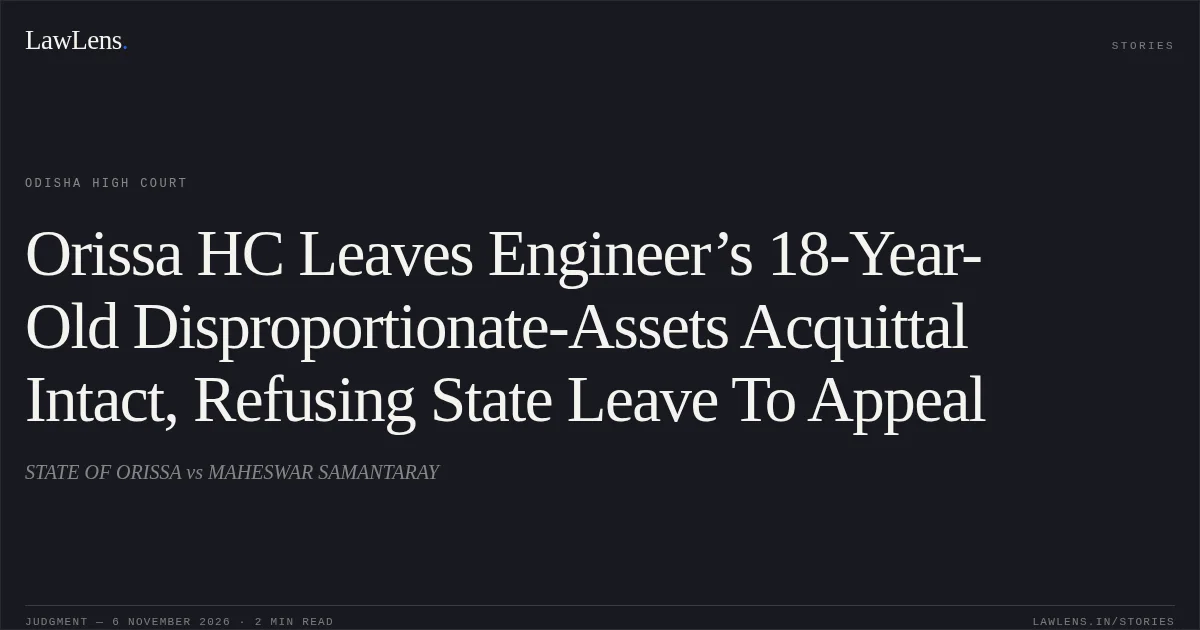
The State sought leave to appeal under Section 378(5) CrPC against the Special Judge (Vigilance), Bhubaneswar’s judgment dated 2 April 2008 acquitting Maheswar Samantaray, an Executive Engineer, of an offence under Sections 13(2) and 13(1)(e) of the Prevention of Corruption Act, 1988.
pp. 1–2 · ¶ 1The prosecution alleged that he possessed assets disproportionate to his known sources of income. The investigation assessed disproportionate assets at Rs. 15,15,870.30, while the prosecution sanction referred to Rs. 13,09,800.
pp. 2–3 · ¶ 3The trial court accepted several explanations for the assets and income, found the prosecution had not proved the charge beyond reasonable doubt, and also held the sanction invalid for want of demonstrated application of mind.
pp. 3–5 · ¶ 5 and quoted trial judgmentThe State challenged the trial court’s assessment of the evidence and its acceptance of the accused’s explanations.
pp. 6–7 · ¶ 6–702Issues
i.1. Whether the trial court’s acquittal was perverse, unreasonable, or otherwise warranted interference on appeal.
pp. 8–11 · ¶ 8–10ii.2. Whether the State had established compelling and substantial grounds for leave to appeal against the acquittal.
pp. 10–12 · ¶ 10–1203Law Applied
Section 378(5) CrPC governs the State’s application for leave to appeal against an acquittal.
p. 1The charge arose under Sections 13(2) and 13(1)(e) of the Prevention of Corruption Act, 1988.
p. 2 · ¶ 1Under Tulasareddi @ Mudakappa & Anr. v. State of Karnataka & Ors., 2026 INSC 67, an appellate court should not disturb an acquittal where the trial court’s view is reasonably possible; interference is justified where the acquittal is perverse, rests on misreading or omission of material evidence, is clearly unreasonable, or where guilt is the only conclusion possible on the evidence.
pp. 8–9 · ¶ 9Under Mallappa & Ors. v. State of Karnataka, 2024 INSC 104, acquittal strengthens the presumption of innocence and requires a higher threshold before an appellate court may reverse it.
pp. 9–10 · ¶ 9Provisions in the judgment · 3 · Linked ones open on LawLens
Code of Criminal Procedure, 1973 Section 378Section 248
Prevention of Corruption Act, 1988 Section 13
04Reasoning
The High Court considered the trial court’s treatment of the accused’s explanations and the State’s challenge to the evidentiary assessment, but concluded that the acquittal was neither perverse nor wholly unreasonable.
pp. 6–8 · ¶ 6–8 · p. 11 · ¶ 10Applying the principles in Tulasareddi and Mallappa, it held that the possibility of another view did not justify substituting the appellate court’s assessment for the trial court’s, and that the State had not shown compelling grounds to overcome the strengthened presumption of innocence.
pp. 8–11 · ¶ 9–1105Holding
The Court declined to grant leave to appeal, finding no legal or factual basis to disturb the acquittal.
p. 12 · ¶ 12The State’s application, CRLLP No. 64 of 2009, was dismissed.
p. 12 · ¶ 12Original Court PDF
STATE OF ORISSAvsMAHESWAR SAMANTARAY
Click to open original judgment
Original judgment, available to read, download and summarize on LawLens.in