01Facts
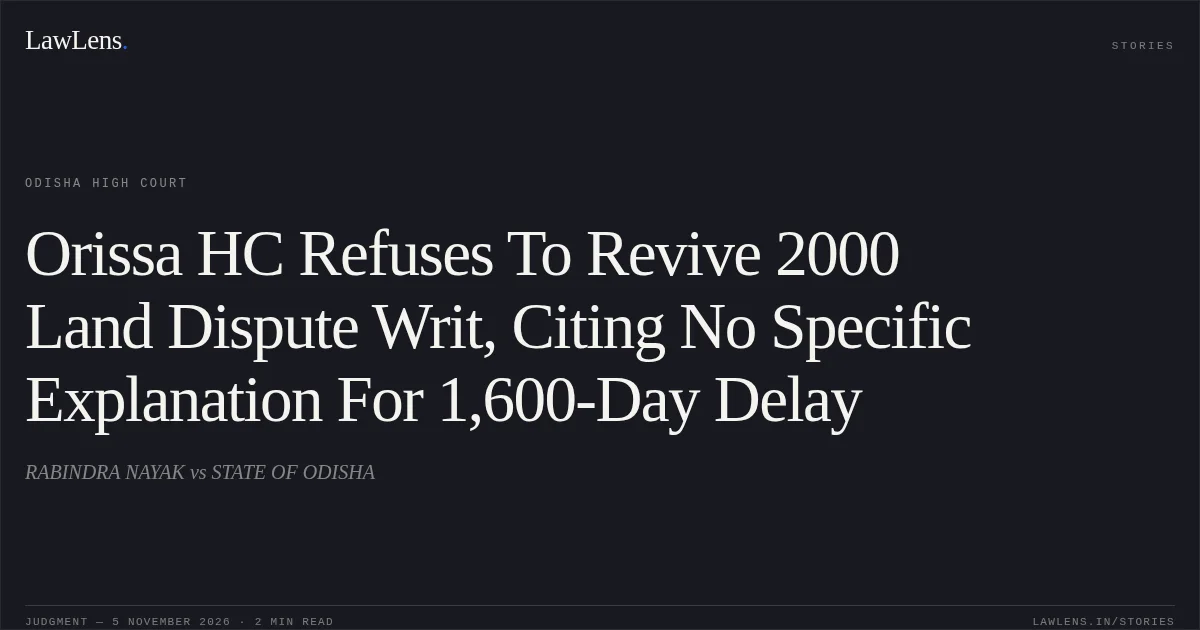
The petitioners sought restoration of OJC No. 12994 of 2000, which had been dismissed for non-prosecution on 3 March 2022 when neither the petitioners nor their counsel appeared; the interim order was also vacated.
pp. 1–2They filed the restoration application, CMAPL No. 123 of 2026, with IA No. 209 of 2026 under Section 5 of the Limitation Act, 1963, seeking condonation of a 1,600-day delay.
p. 1They stated that they were unaware of the dismissal until opposite parties began construction on the disputed land, and that they applied for and obtained a certified copy before filing the restoration application.
pp. 2–302Issues
i.1. Whether the petitioners established sufficient cause under Section 5 of the Limitation Act, 1963 to condone the 1,600-day delay in seeking restoration.
pp. 1, 3–4ii.2. Whether the restoration application could proceed once the delay was not condoned.
p. 403Law Applied
Section 5 of the Limitation Act, 1963 permits a court to condone delay where the applicant establishes “sufficient cause” for not acting within the prescribed period.
pp. 1, 3–4The Court observed that this expression does not extend to absolute apathy or utter negligence, and that limitation law serves the public policy of bringing litigation to an end.
p. 3The discretion to condone delay is judicial and may be declined in light of factors including inordinate delay, negligence, and want of due diligence; the merits of the underlying case are not required to be considered when deciding condonation.
p. 4No judicial precedent was cited.
Provisions in the judgment · 1 · Linked ones open on LawLens
Limitation Act, 1963 Section 5
04Reasoning
The petitioners’ assertions that they lacked knowledge of the dismissal and later obtained a certified copy did not explain, with sufficient particularity, the prolonged delay.
pp. 3–4The application identified no precise dates or circumstances showing why the petitioners were prevented from approaching the Court in time, or explaining the time taken to prepare and file the restoration application.
pp. 3–4Given the length of the delay and the absence of a specific explanation establishing sufficient cause, the Court declined to exercise its discretion to condone it.
p. 405Holding
The Court answered the first issue in the negative: the petitioners had not established sufficient cause for the 1,600-day delay.
p. 4It dismissed IA No. 209 of 2026 and, consequently, dismissed CMAPL No. 123 of 2026 as barred by limitation at the admission stage.
p. 4Original Court PDF
RABINDRA NAYAKvsSTATE OF ODISHA
Click to open original judgment
Original judgment, available to read, download and summarize on LawLens.in