01Facts
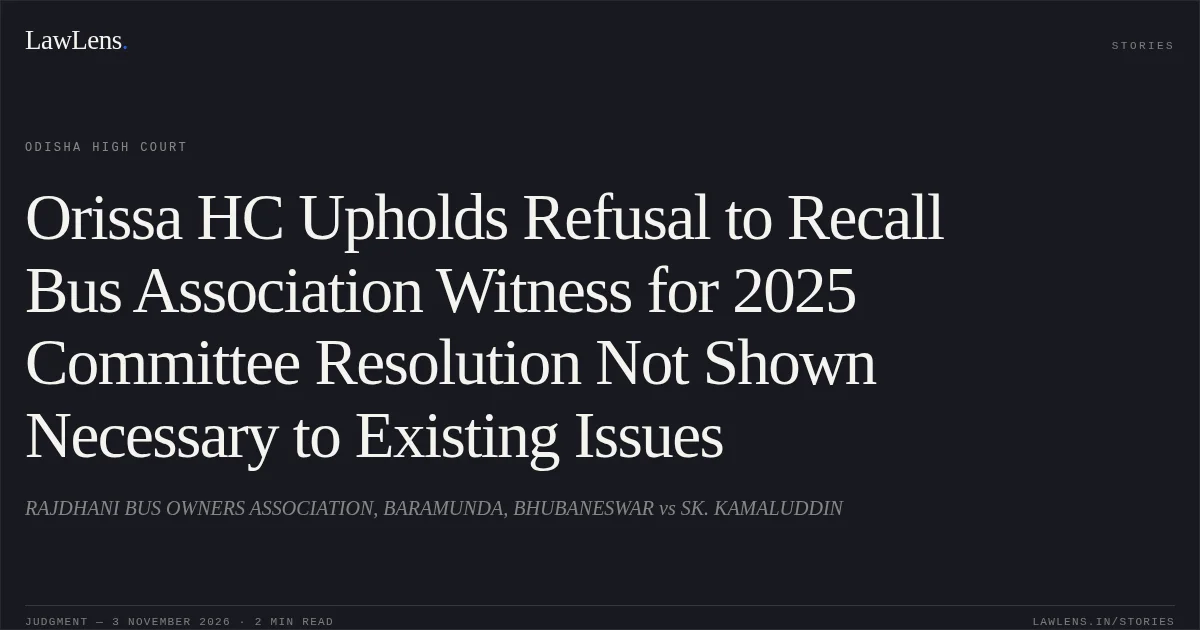
The Association, plaintiff in a suit concerning the constitution and functioning of its Executive Committee, sought to recall P.W.2 after the plaintiff’s evidence had closed.
¶ 1It intended to have P.W.2 prove a resolution dated 10 November 2025 concerning a later Executive Committee.
¶ 3(vii)–(xi), 7–8The Trial Court rejected the recall application on 23 April 2026; an earlier application concerning the same subject had also been rejected.
¶ 3(vii)–(xi), 7–8, 20The Association challenged the order under Article 227 of the Constitution.
¶ 1, 3(vii)–(xi), 7–8, 2002Issues
i.Whether the Trial Court was justified in rejecting the application under Order XVIII Rule 17 CPC to recall P.W.2 to prove the subsequent resolution.
¶ 7ii.Whether the Trial Court’s refusal disclosed an error warranting interference under Article 227 of the Constitution.
¶ 23–2503Law Applied
Order XVIII Rule 17 CPC gives the Court discretionary power to recall a witness for clarification or another legitimate judicial purpose; it does not confer an unrestricted right on a party to reopen evidence or fill omissions.
¶ 9–10, 21Evidence must ordinarily be confined to the pleadings and issues, and a subsequent document must be shown to be legally receivable and materially necessary to decide the existing controversy.
¶ 12, 16, 19Article 227 supervisory jurisdiction is not appellate; interference is warranted where the subordinate court acts without jurisdiction, fails to exercise jurisdiction, or commits a patent error resulting in manifest injustice.
¶ 23–2404Reasoning
The Court accepted that the resolution was created after the plaintiff’s evidence had closed, but held that its later date alone did not establish relevance or necessity.
¶ 12–17, 19The resolution related to a subsequent Executive Committee and had not been shown to be indispensable to deciding the issues already framed; receiving it risked enlarging the controversy beyond the pleadings.
¶ 12–17, 19The application was also made after evidence had concluded and the suit had reached arguments, and a similar application had previously been rejected.
¶ 18, 20The Trial Court had considered the application within its jurisdiction, and its refusal was neither arbitrary nor perverse.
¶ 18, 20, 2505Holding
The Court held that the petitioner had not established grounds for recalling P.W.2 or for supervisory interference.
¶ 26It dismissed the CMP, vacated any interim order, and clarified that its observations did not determine the merits of the underlying suit.
¶ 26–30Original Court PDF
RAJDHANI BUS OWNERS ASSOCIATION, BARAMUNDA, BHUBANESWARvsSK. KAMALUDDIN
Click to open original judgment
Original judgment, available to read, download and summarize on LawLens.in