Facts
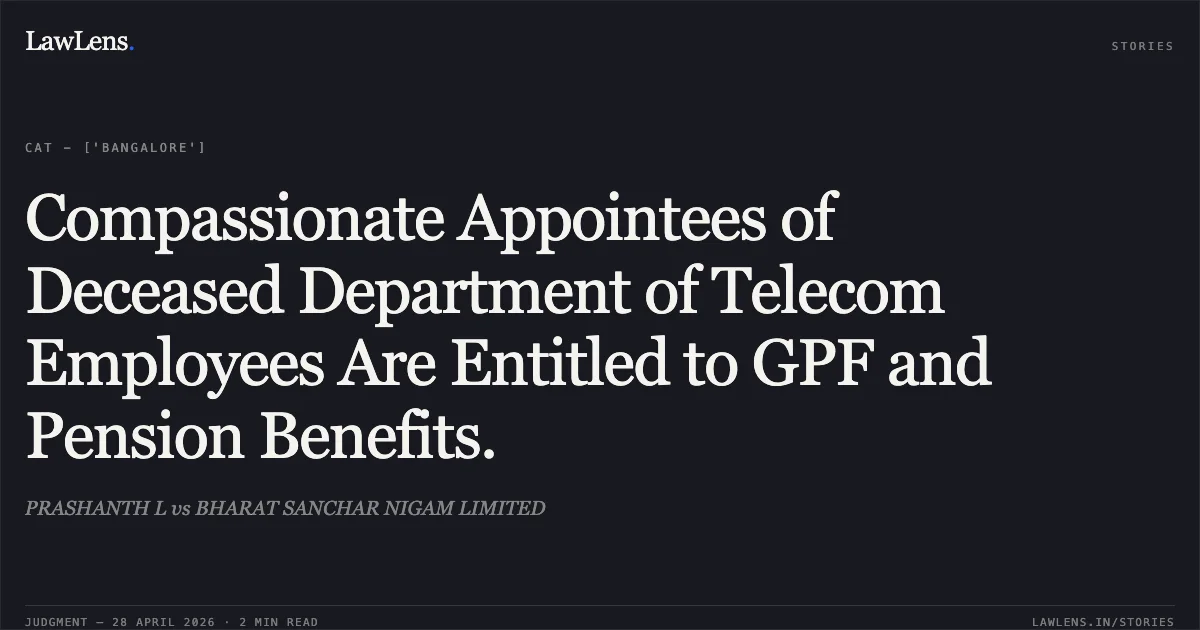
The applicants were appointed on compassionate grounds by Bharat Sanchar Nigam Limited (BSNL) as nominees of employees who died in harness while serving in the Department of Telecommunications (DoT) prior to BSNL's formation.
Source reference: p. 11Although initially placed under the General Provident Fund (GPF) scheme, BSNL shifted them to the Employees Provident Fund (EPF) scheme in 2007.
Source reference: p. 11The applicants submitted representations seeking restoration of the GPF scheme and coverage under the CCS (Pension) Rules, 1972, citing a circular dated 02.01.2001 and favorable rulings from other judicial forums.
Source reference: p. 11-13The respondents contested this, arguing that BSNL is a separate corporate entity and the previous rulings were not judgments in rem.
Source reference: p. 15-16Issues
1. Whether appointees on compassionate grounds, whose predecessors died in harness prior to 01.10.2000 (pre-BSNL formation), are entitled to the GPF scheme and CCS (Pension) Rules instead of the EPF scheme.
Source reference: p. 12-132. Whether the judicial precedents set in the Raj Kumar case and subsequent matters are applicable to the current applicants.
Source reference: p. 16/20Law Applied
The court primarily applied BSNL's internal policy clarification dated 16.01.2003, which stipulated that persons appointed on compassionate grounds on or after 01.10.2000 as nominees of DoT employees who died in harness up to 30.09.2000 would be covered under the GPF Scheme.
Source reference: p. 16-17The precedent established by the CAT Chandigarh Bench in Raj Kumar Anr v. Union of India (TA No. 35-PB of 2009), confirmed by the Punjab and Haryana High Court and the Supreme Court in Civil Appeal No. 1971/2012, which held that such appointees constitute a distinct class entitled to GPF benefits.
Source reference: p. 13/17-18Rule 37-A of the CCS (Pension) Rules regarding the protection of service conditions during permanent absorption in BSNL.
Source reference: p. 12Reasoning
The Tribunal found that the issue was no longer res integra as it had been resolved by multiple High Courts and the Supreme Court.
Source reference: p. 16The court reasoned that the clarification issued by BSNL on 16.01.2003—which explicitly placed nominees of employees who died before 30.09.2000 under the GPF scheme—had never been officially withdrawn.
Source reference: p. 17-18The Tribunal rejected the respondents' argument that the Supreme Court's dismissal of previous appeals "kept the question of law open," noting that the respondents had previously committed in other High Courts (Guwahati and Chandigarh) to abide by the Supreme Court’s decision in the Raj Kumar case.
Source reference: p. 14-16Consequently, since the applicants' predecessors died before the cut-off date of 30.09.2000, they were held to be part of the "class" entitled to the GPF scheme.
Source reference: p. 17/20Holding
The Tribunal allowed the OAs, holding that the applicants are squarely covered by the precedents in Raj Kumar, Nivedita Pathak, and Amarti Devi.
The respondents were directed to restore the GPF benefits to the applicants as per the Rules. This relief is specifically subject to the final outcome of the Review Petition (Diary No. 21201/2026) currently pending before the Hon’ble Supreme Court in the Amarti Devi case.
Source reference: p. 20-21Acts & Sections Cited
1 provisions across 1 statute referred to in this judgment. Each provision opens on LawLens.
Administrative Tribunals Act, 19851
Original Court PDF
PRASHANTH LvsBHARAT SANCHAR NIGAM LIMITED
Click to open original judgment
Original judgment, available to read, download and summarize on LawLens.in