Facts
The petitioner’s mother, an Assistant Teacher, died in harness on 05.11.2008.
Source reference: para. 3At the time of her death, the petitioner’s father was employed as an Accountant in the Public Works Department; he retired in 2009 and died in 2024.
Source reference: para. 3Upon attaining majority, the petitioner applied for compassionate appointment in 2011. Despite the Block Education Officer (Respondent No. 6) explicitly informing the District Basic Education Officer (Respondent No. 4) that the petitioner's father was a retired government employee, the petitioner was appointed as a Junior Clerk in 2013 and later promoted to Senior Clerk in 2019.
Source reference: para. 3Following a third-party complaint in 2022 alleging concealment of facts regarding the father’s employment, the respondent No. 4 issued show-cause notices and subsequently terminated the petitioner’s services on 11.08.2025 without conducting a formal inquiry or providing a charge-sheet.
Source reference: paras. 4–6Issues
1. Whether the termination of a compassionate appointee is legally sustainable when the employment status of a family member was disclosed to the authorities at the time of appointment.
Source reference: para. 92. Whether the state can terminate services after a significant lapse of time without following the prescribed procedure for departmental inquiry or proving fraud/misrepresentation by the employee.
Source reference: paras. 9, 12, 15Law Applied
U.P. Recruitment of Dependents of Government Servants Dying in Harness Rules, 1974.
Source reference: para. 3The State cannot take advantage of its own mistake to terminate an employee after a long duration if there was no fraud or suppression of facts (Md. Zamil Ahmed v. State of Bihar (2016)).
Source reference: para. 12The ratio from Shiv Kumar v. State of U.P. (2025) and Sugandha Upadhyay v. State of U.P. (2024), establishing that if the authorities failed to exercise due diligence during the verification process despite having the material facts, the appointment cannot be cancelled later.
Source reference: paras. 10, 13, 15Reasoning
The court found that the petitioner did not suppress any material facts; the recommendation letter dated 29.03.2012 clearly stated his father’s retired status, proving the respondents had full knowledge of the family's financial/employment background prior to the 2013 appointment.
Source reference: para. 9The court reasoned that under the 1974 Rules, the onus of verification lies with the respondent authorities, and once they extend an appointment after due scrutiny, they cannot later cite their own lapse as a ground for termination.
Source reference: paras. 10, 15The court noted a gross procedural illegality as no formal inquiry was conducted, no charge-sheet was served, and no witnesses were examined before the termination.
Source reference: paras. 6, 9Following the precedent in Vishwaroop v. State of U.P., the court held that a 12-year lapse in "waking up" to a self-inflicted infirmity in the appointment is unjustifiable.
Source reference: para. 15Holding
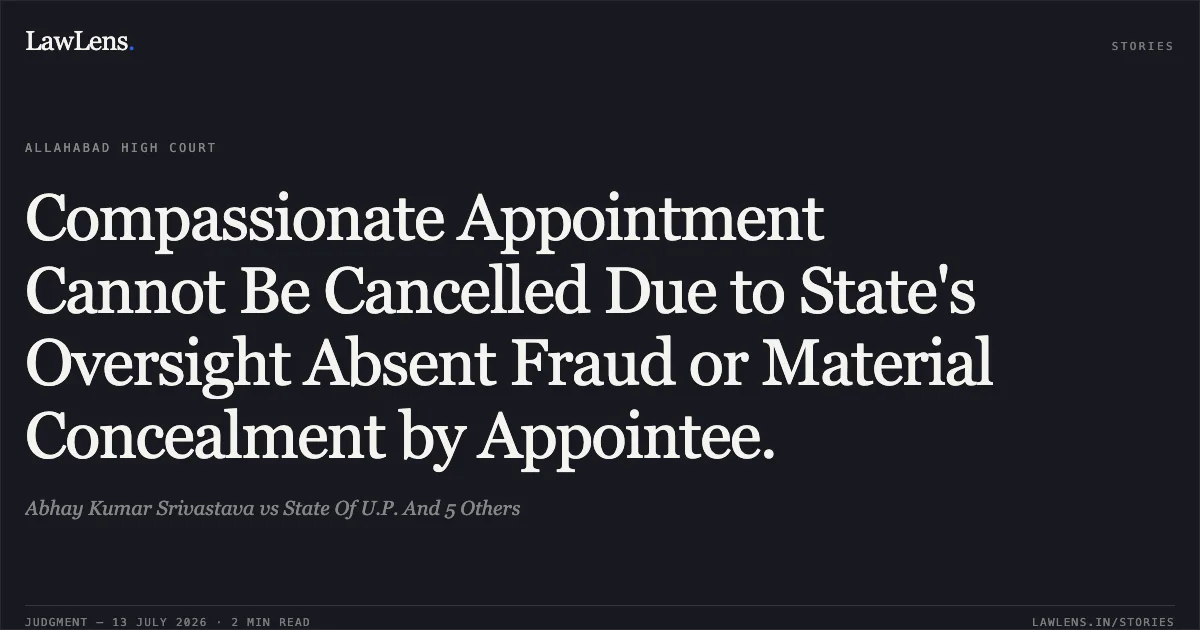
The court answered both issues in the negative, holding that the termination was arbitrary, illegal, and violated principles of natural justice.
The Court quashed the termination order dated 11.08.2025. A mandamus was issued directing the respondents to reinstate the petitioner as a Senior Clerk with all consequential benefits, including full back wages and month-to-month salary, to be settled within two months.
Source reference: paras. 18–19Original Court PDF
Abhay Kumar SrivastavavsState Of U.P. And 5 Others
Click to open original judgment
Original judgment, available to read, download and summarize on LawLens.in