Facts
The petitioner’s father, a Havildar in Bihar Military Police-2, died in harness on 25 September 2016, leaving behind his widow, six daughters and the petitioner.
Source reference: no citationThe petitioner sought appointment on compassionate grounds. His claim was rejected by the Compassionate Appointment Committee on the ground that his sister, Priti Kumari, was employed as a Constable in the CISF and was considered capable of supporting the family.
Source reference: para. 3; p. 2The petitioner challenged the rejection in CWJC No. 11439 of 2021, which was disposed of on 3 November 2023 with liberty to submit a representation to the authorities.
Source reference: para. 3; p. 3Pursuant thereto, he submitted a representation on 2 April 2024, contending that his sister had subsequently married, lived in her matrimonial home, and did not support the petitioner or his mother.
Source reference: para. 3; p. 3The representation was rejected by Letter No. 2666 dated 26 May 2026; the judgment alternatively refers to the date as 26 June 2026.
Source reference: paras. 3, 6; pp. 3, 5The petitioner consequently filed the present writ petition seeking compassionate appointment and quashing of the rejection.
Source reference: no citationIssues
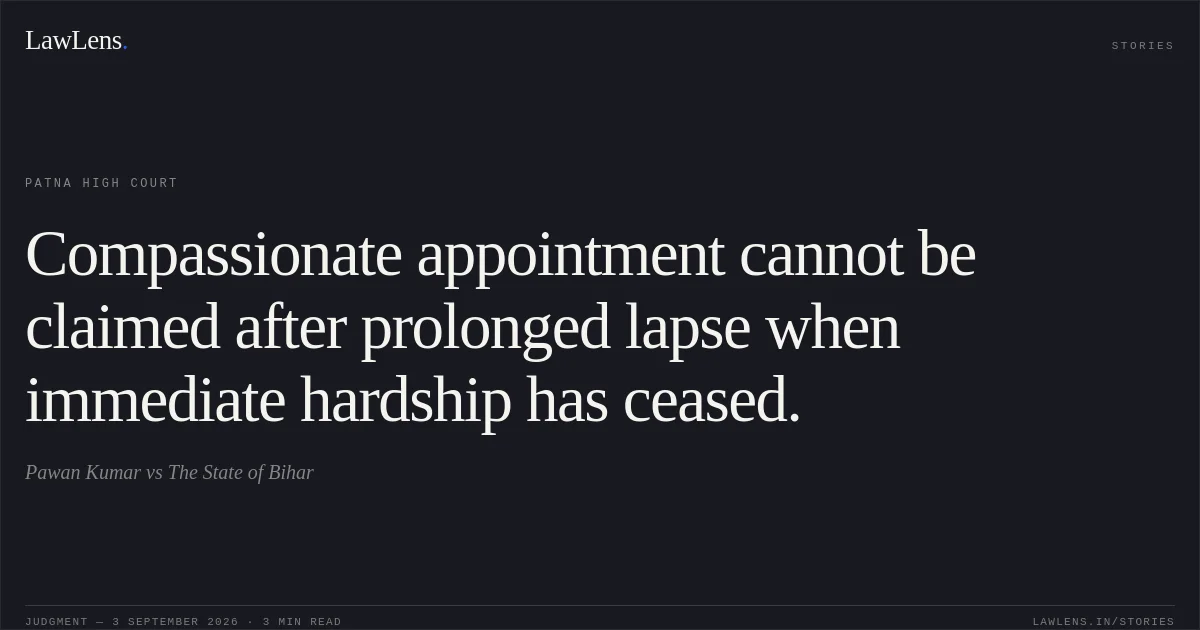
Whether the petitioner could claim compassionate appointment nearly ten years after the death of his father, notwithstanding the purpose of such appointment being to address immediate financial hardship.
Source reference: paras. 7–10; pp. 6–8Whether the subsequent marriage and separate residence of the petitioner’s employed sister entitled the petitioner to reopen and succeed in his claim for compassionate appointment.
Source reference: paras. 6–7; pp. 5–6Law Applied
Compassionate appointment is an exception to the ordinary recruitment process and is intended only to relieve the family of a deceased government employee from immediate hardship caused by the employee’s death; it is not a vested or inheritable right that may be claimed at any future time.
Source reference: no citationRelying on Umesh Kumar Nagpal v. State of Haryana, 1994 (4) SCC 138, the Court held that compassionate employment cannot be granted after a reasonable period or after the crisis has passed.
Source reference: para. 8; p. 6It further relied on Jagdish Prasad v. State of Bihar, 1996 (1) SCC 301, which held that delayed appointment would effectively create an alternative mode of recruitment outside the applicable recruitment rules.
Source reference: para. 9; p. 7The Court also applied the relevant State Government circular governing compassionate appointment, under which the existence of a gainfully employed family member was treated as relevant to the claim.
Source reference: para. 6; p. 5Reasoning
The Court accepted that the petitioner’s father had died in harness and that the petitioner had initially sought compassionate appointment.
Source reference: no citationHowever, at the relevant time, one of the deceased employee’s daughters, Priti Kumari, was employed in the CISF, and this fact formed the basis for rejection of the claim.
Source reference: paras. 6–7; pp. 5–6The Court held that her subsequent marriage and separate residence could not revive a claim whose purpose was to meet the immediate hardship arising in 2016.
Source reference: no citationSince nearly ten years had elapsed since the death, the Court concluded that the immediate crisis contemplated by the compassionate appointment scheme no longer survived.
Source reference: no citationGranting appointment at that stage would convert compassionate appointment into an alternative mode of public recruitment, contrary to the principles in Umesh Kumar Nagpal and Jagdish Prasad.
Source reference: paras. 7–9; pp. 6–7Holding
The Court answered the issues against the petitioner.
It held that the lapse of nearly ten years defeated the compassionate appointment claim and that the sister’s subsequent marriage and separate residence did not justify reopening the claim.
Source reference: paras. 10–11; p. 8Finding no merit in the writ petition, the Court dismissed it and also disposed of any pending applications.
Source reference: paras. 10–11; p. 8Original Court PDF
Pawan KumarvsThe State of Bihar
Click to open original judgment
Original judgment, available to read, download and summarize on LawLens.in