Facts
The applicant’s father, a Senior Accountant under the Accountant General (A)-II, U.P., died in harness on January 12, 2012
Source reference: p. 2The family received terminal benefits and a family pension
Source reference: p. 3The applicant applied for a compassionate appointment in 2012 and was interviewed five times between 2013 and 2017
Source reference: p. 3-5In each instance, the Departmental Selection Committee (DSC) deferred the case due to a "shortfall of vacancies"
Source reference: p. 4-5Following a 2018 review, the DSC rejected the applicant’s claim via an order dated March 11, 2019, noting that the daughter’s marriage in 2017 had reduced the family's financial liabilities
Source reference: p. 5The applicant challenged this rejection as arbitrary and illegal
Source reference: p. 3Issues
1. Whether the respondents’ decision to reject the application for compassionate appointment after multiple years of deferral due to vacancy shortfalls was legally sustainable
Source reference: p. 2, 92. Whether the reduction in family liability (due to the sister's marriage) and the receipt of terminal benefits justified the denial of appointment under the Dying in Harness Rules
Source reference: p. 5, 10Law Applied
The court applied the prevailing Government of India and Comptroller Auditor General guidelines regarding compassionate appointments, which limit such appointments to a maximum of 5% of direct recruitment vacancies in Group ‘C’ posts
Source reference: p. 10The Tribunal relied on the precedent set by the Hon'ble Supreme Court in Himachal Road Transport Corporation v. Dinesh Kumar [JT 1996 (5) S.C. 319], which held that compassionate appointments cannot be made in the absence of a vacancy
Source reference: p. 11It further cited Life Insurance Corporation of India v. Mrs. Asha Ramchandra Ambekar [JT 1994 (2) S.C. 183], establishing that Courts and Tribunals cannot direct an appointment on compassionate grounds but can only direct the consideration of such claims
Source reference: p. 11-12Reasoning
The Tribunal observed that the respondents had complied with procedural requirements by repeatedly considering the applicant's case over a six-year period (2013–2018)
Source reference: p. 9The court noted that the repeated deferrals were solely due to the non-availability of vacancies under the 5% quota prescribed by law
Source reference: p. 10The analysis emphasized that the primary objective of the scheme is to provide immediate financial relief to prevent penury, and the DSC is entitled to assess the family's evolving financial condition
Source reference: p. 10Since the family had received terminal benefits and the financial burden had decreased following the daughter's marriage in 2017, the court reasoned that the respondents' final rejection was neither arbitrary nor a violation of the rules
Source reference: p. 5, 10The court concluded that it lacked the jurisdiction to mandate a "supernumerary" appointment or override the factual absence of a vacancy
Source reference: p. 11Holding
The Tribunal held that there was no merit in the Original Application as the respondents had consistently evaluated the applicant's claim in accordance with the rules
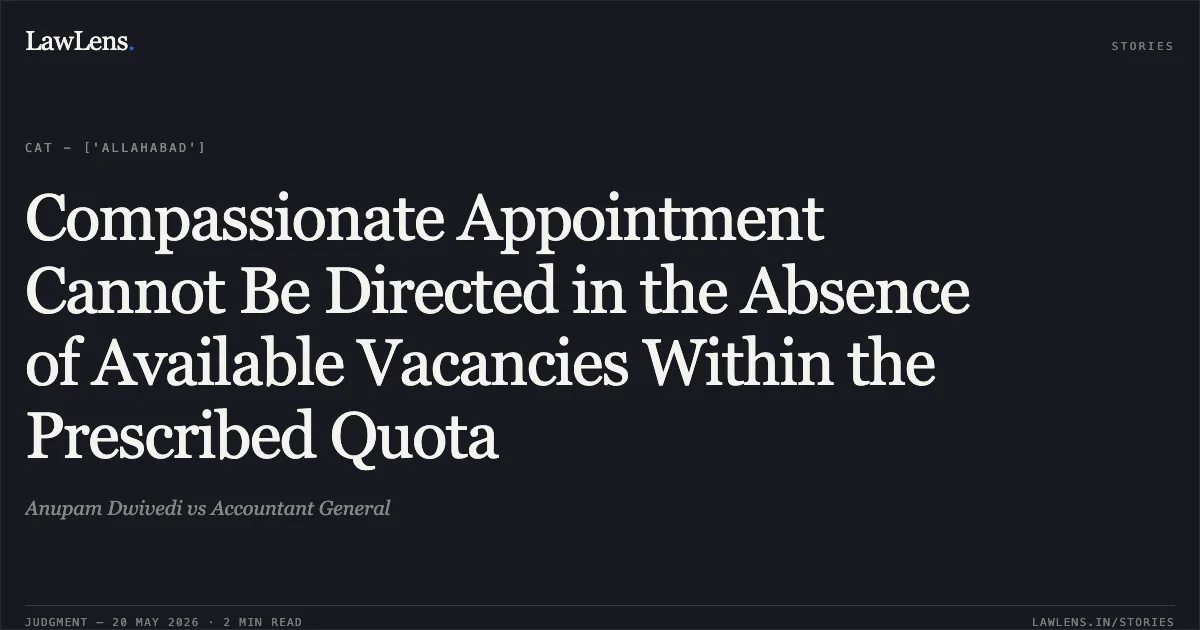
The court ruled that in the absence of available vacancies, no direction for appointment could be issued
Source reference: p. 12Consequently, the O.A. was dismissed, the impugned order dated March 11, 2019, was upheld, and no relief was granted
Source reference: p. 12Acts & Sections Cited
1 provisions across 1 statute referred to in this judgment. Each provision opens on LawLens.
Administrative Tribunals Act, 19851
Original Court PDF
Anupam DwivedivsAccountant General
Click to open original judgment
Original judgment, available to read, download and summarize on LawLens.in