Facts
The petitioner’s father, employed as a Grade IV Sweeper at R.D. & D.J. College, Munger, died in harness on 4 November 2010.
Source reference: para. 3; p. 2The petitioner claimed to have applied for compassionate appointment on 4 December 2012, and stated that his application was forwarded to Tilka Manjhi Bhagalpur University (“T.M.B.U.”).
Source reference: para. 4; p. 2T.M.B.U. issued a communication dated 9 December 2017 requiring him to appear with the necessary certificates, but the petitioner allegedly took no further steps and did not furnish the requisite documents.
Source reference: paras. 4, 7, 10; pp. 2–4R.D. & D.J. College subsequently came under Munger University following the bifurcation of T.M.B.U. and creation of Munger University on 18 March 2018.
Source reference: para. 5; p. 2The petitioner filed the writ petition in November 2025, seeking compassionate appointment approximately fifteen years after his father’s death.
Source reference: paras. 10–11; pp. 4–5The universities opposed the claim on the grounds of non-production of documents, delay and laches, and the absence of any application before Munger University.
Source reference: paras. 7–8; pp. 3–4Issues
Whether the petitioner was entitled to appointment on compassionate grounds despite the substantial delay following his father’s death and his failure to furnish the documents required by the University?
Source reference: paras. 10–14; pp. 4–5Whether compassionate appointment could be granted when the petitioner approached the Court approximately fifteen years after the death of the deceased employee, thereby undermining the object of such appointment?
Source reference: paras. 11–14; pp. 4–5Law Applied
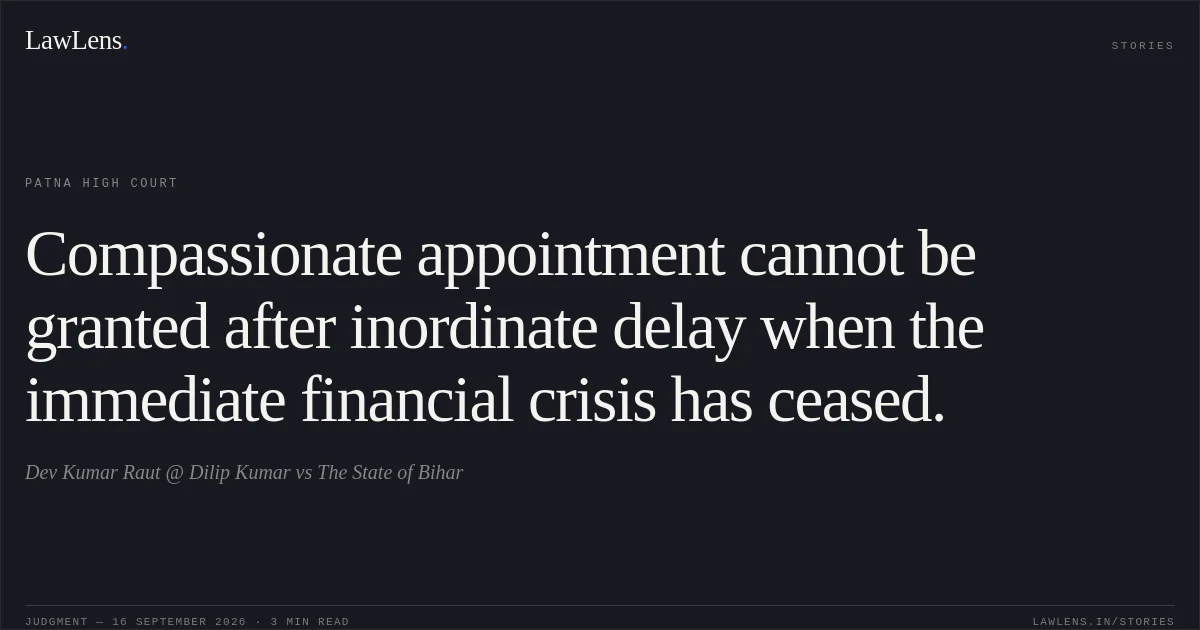
The Court applied the principle that compassionate appointment is not an alternative mode of regular recruitment and does not confer an inherent or vested right upon the legal heir of a deceased employee.
Source reference: no citationRelying on Indian Bank & Ors. v. Promila & Anr., (2020) 2 SCC 729, the Court held that compassionate appointment cannot be claimed as a matter of right.
Source reference: para. 12; p. 5It further relied on Umesh Kumar Nagpal v. State of Haryana & Ors., (1994) 4 SCC 138, which establishes that compassionate appointment is intended only to enable the financially distressed family of a deceased employee to overcome the sudden crisis caused by the employee’s death, and is not intended to provide employment irrespective of the passage of time.
Source reference: para. 12; p. 5The claim is also subject to promptness and cannot ordinarily be entertained after prolonged and unexplained delay.
Source reference: paras. 10–13; pp. 4–5Reasoning
The Court found that, even assuming the petitioner had submitted an application in December 2012, he failed to comply with the T.M.B.U.’s communication dated 9 December 2017 requiring production of relevant documents.
Source reference: para. 10; p. 4He thereafter waited until November 2025 to invoke the writ jurisdiction of the Court, nearly fifteen years after his father’s death.
Source reference: paras. 10–11; pp. 4–5Applying the principle that compassionate appointment exists to address an immediate financial crisis rather than to create a delayed avenue of employment, the Court reasoned that the family’s ability to sustain itself for such a prolonged period indicated that the urgent crisis contemplated by the doctrine no longer existed.
Source reference: para. 13; p. 5The petitioner’s inaction and the substantial delay therefore defeated the very object of compassionate appointment.
Source reference: paras. 10–14; pp. 4–5Holding
The Court held that the petitioner had not established any entitlement to compassionate appointment.
His failure to submit the required documents, coupled with the approximately fifteen-year delay in seeking relief, rendered the claim unsustainable in law.
Source reference: paras. 10–14; pp. 4–5The writ application was accordingly dismissed, with no direction for appointment or other relief.
Source reference: para. 15; p. 5Original Court PDF
Dev Kumar Raut @ Dilip KumarvsThe State of Bihar
Click to open original judgment
Original judgment, available to read, download and summarize on LawLens.in