01Facts
The first respondent's father, an employee of Damodar Valley Corporation (DVC), died in harness on 15.10.2012.
¶ 12DVC placed the respondent's name on its compassionate appointment panel on its own motion, so no formal application was required.
¶ 12The respondent's mother then sought appointment under the 1984 scheme.
¶ 13On 10.03.2017, DVC rejected the claim and offered Rs. 5 lakh in lieu of appointment.
¶ 13, 15In W.P.(S) No. 2561 of 2017, decided on 05.07.2018, the learned Single Judge quashed that order. It held that the dependant, not the employer, chooses between compensation and appointment, and that DVC had stated the respondent would remain on the panel.
¶ 14, 15DVC's LPA No. 446 of 2018 was withdrawn and dismissed as not pressed, so the order attained finality.
¶ 16, 17DVC did not comply with the order.
¶ 18In W.P.(S) No. 2037 of 2019, the Court on 15.10.2020 remitted the matter for fresh decision in light of Yasoda Mehra, within 12 weeks.
¶ 20, 21DVC passed a fresh order on 07.01.2021 again denying appointment.
¶ 22In Contempt Case (Civil) No. 77 of 2021, DVC stated on affidavit that the respondent was at Sl. No. 1 on the panel, and the contempt was disposed of.
¶ 23No appointment followed. The respondent filed W.P.(S) No. 1505 of 2024, and the learned Single Judge on 20.12.2024 directed DVC to offer compassionate appointment within six weeks, including creation of a supernumerary post.
¶ 2, 25DVC appealed. It contended that a 2020 policy replaced compassionate appointment with a Rs. 15 lakh lump sum, that the 2017 application was belated, and that a supernumerary post could not be directed.
¶ 3, 4, 6, 7No interim stay was granted, but DVC did not comply, and a further contempt petition was pending.
¶ 2602Issues
i.1. Whether the compassionate appointment claim is governed by the 1984 policy in force when the cause of action arose and the claim was adjudicated, or by the 2020 policy in force when the offer is made.
¶ 4, 5, 28, 34, 35ii.2. Whether the alleged belated application (about five years after the death) bars or justifies denial of compassionate appointment.
¶ 6, 13, 30iii.3. Whether the direction to create a supernumerary post is legally sustainable.
¶ 7, 32iv.4. Whether the Letters Patent Bench may interfere with the learned Single Judge's discretionary writ order.
¶ 36, 37, 3803Law Applied
The DVC Office Circular dated 17.07.1984, as modified by Office Memorandum dated 22.07.2008, under which the dependant chooses between a lump sum and compassionate appointment, and the employer cannot impose the choice.
¶ 11, 15The finality principle: an order that is not appealed, or whose appeal is withdrawn, binds the parties, and the employer cannot escape its obligations by a later policy change.
¶ 17, 29The governing scheme is the one in force when the cause of action arose and was adjudicated.
¶ 28The Supreme Court's reference of the conflicting lines of authority in State Bank of India v. Sheo Shankar Tewari, (2019) 5 SCC 600, to a Larger Bench does not displace existing precedent.
¶ 5, 34A Letters Patent Bench may interfere only where the writ court's findings are demonstrably erroneous or the mistake is glaring, and not where the decision is just and reasonable, as laid down in R. Saravanan v. Periyar University, (2026) INSC 1136.
¶ 36, 37The co-ordinate Bench decision in Yasoda Mehra on annual vacancy allocation.
¶ 2104Reasoning
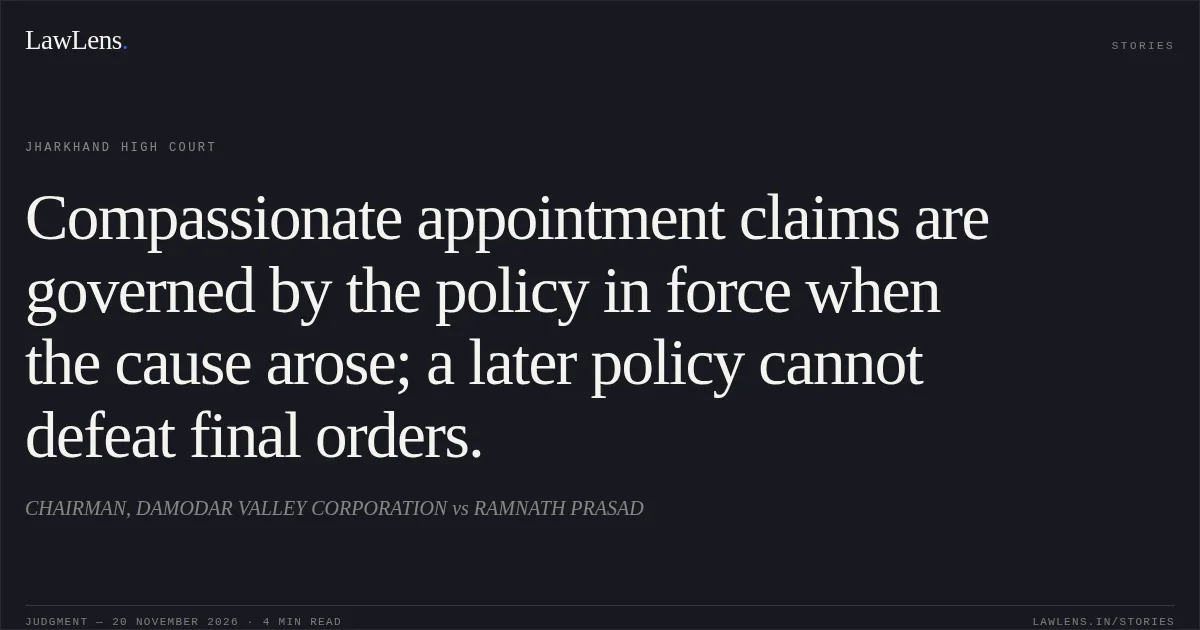
The cause of action arose in 2012 and was adjudicated in 2017–2018 under the 1984 scheme, which was admittedly in force and not replaced until 2020.
¶ 17, 28, 35Its 2018 order had attained finality after the LPA was withdrawn, and DVC's non-compliance and repeated deferrals meant it could not invoke a later policy to defeat that relief.
¶ 17, 18, 28, 29The Court found DVC's stated empanelment and undertakings in the contempt proceedings inconsistent with the later denial, and treated the 2020 argument as an attempt to avoid those undertakings.
¶ 23, 24, 31The Court found that the respondent's mother's representation was an urgent plea rather than a belated application. It also noted that DVC had itself empanelled the respondent, so no fresh application was needed, and that delay had never been accepted as a ground in earlier litigation.
¶ 13, 30The Court held that the extraordinary facts, including the harassment of a dependant by a public sector undertaking, justified the relief of a supernumerary post, and that interference would encourage disobedience of court orders.
¶ 32, 33The Court found the single judge's order just and reasonable, so no interference was warranted under R. Saravanan.
¶ 36, 37, 38The Court treated the Sheo Shankar Tewari reference as irrelevant, since the facts did not attract the conflicting precedents.
¶ 34, 3505Holding
The 1984 policy governs, because the claim arose and was adjudicated under it and the orders attained finality while it was in force.
¶ 28, 35The delay argument is misconceived.
¶ 30The supernumerary post direction does not warrant interference.
¶ 32The Letters Patent Bench cannot interfere with the single judge's just and reasonable order.
¶ 37, 38The appeal is dismissed. The directions in the impugned order must be complied with within two weeks, and a compliance report must be filed in the pending contempt proceedings after serving an advance copy on the respondent. The Court refrained from imposing costs, in the hope of compliance without further contempt proceedings.
¶ 39, 40Original Court PDF
CHAIRMAN, DAMODAR VALLEY CORPORATIONvsRAMNATH PRASAD
Click to open original judgment
Original judgment, available to read, download and summarize on LawLens.in