01Facts
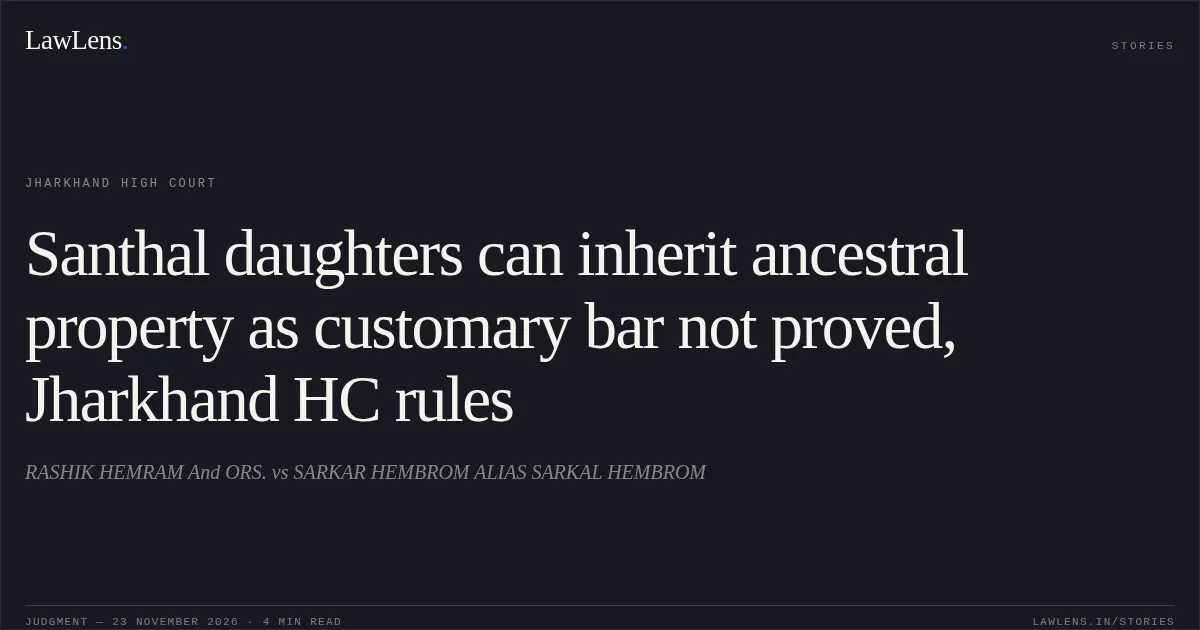
The plaintiff sued in Title Suit No. 45 of 1985 for a declaration of title, confirmation of possession, and delivery of possession of Schedules "A" and "B" properties, claiming by hereditary title through inheritance from her father.
¶ 10, 39The Trial Court, by judgment dated 05.10.1996, partly decreed the suit and declared the plaintiff owner of a 1/3rd share.
¶ 11The defendants (original defendants 7 to 13) did not challenge that decree.
¶ 11The plaintiff appealed against the denial of the remaining relief in Title Appeal No. 29 of 1996, renumbered 59 of 2002.
¶ 12The First Appellate Court, by judgment dated 04.03.2006, allowed the appeal and decreed the suit in its entirety.
¶ 13The defendants filed this second appeal under Section 100 CPC.
¶ 14The defendants' defence was that a Santhal custom in Turka village bars daughters and sonless Santhals from inheriting, save where a son-in-law is taken as a Gharjamai.
¶ 17-19On 05.03.2009, the Court admitted the appeal on whether the appellate finding required reconsideration in light of the conflicting single-judge decisions in Karan Murmu (2004) and Narayan Soren (2009).
¶ 3At the final hearing on 19.11.2026, the appellants belatedly proposed an additional substantial question alleging perversity in the First Appellate Court's findings, based on the plaintiff's alleged admissions regarding custom and her residence.
¶ 5-6The Court heard the parties on the additional question despite the delay.
¶ 7, 36-3702Issues
i.1. Whether the First Appellate Court's findings on the plaintiff's residence/possession and her deposition admissions regarding custom are perverse, warranting interference in second appeal.
¶ 5, 15-16, 36-38, 46ii.2. Whether the First Appellate Court's finding, that a female Santhal may inherit her father's property absent proof of an applicable custom, requires reconsideration in light of the conflicting decisions in Karan Murmu and Narayan Soren.
¶ 3, 47, 68-6903Law Applied
Section 100 CPC permits a second appeal only on substantial questions of law, and Section 100(5) permits formulation of additional questions.
¶ 2, 5Perversity means no evidence, findings contrary to the overwhelming evidence, or conclusions no reasonable tribunal could reach, and insufficiency of evidence is not perversity (Madamanchi Ramappa v. Muthaluru Bojappa, 1964).
¶ 40Evidence must be read in its entirety and in the context of the pleadings, not on stray statements.
¶ 39Sections 102 and 103 of the Indian Evidence Act place the onus on the party asserting a custom to prove it.
¶ 26, 42A custom displacing general law must be proved as ancient, certain, reasonable, and not unsatisfactory or conflicting, and cannot be established by analogy or a priori reasoning (Laxmibai v. Bhagwantbuva, (2013) 4 SCC 97).
¶ 30, 43The constitutional equality concern in female succession is relevant to the custom inquiry (Madhu Kishwar v. State of Bihar, (1996) 5 SCC 125).
¶ 31, 57, 63Karan Murmu, a single-judge decision in writ jurisdiction, was held not to be authoritative on the custom question.
¶ 48-53Narayan Soren, a second appeal decision, was preferred as correctly stating the law.
¶ 54-64A party relying on a custom excluding daughters must prove every element of a binding, uniform, continuous, and compulsory custom (Ismail Hansda v. Mathias Murmu, 2025 SCC OnLine Jhar 2952, SLP dismissed by the Supreme Court).
¶ 66-67Provisions in the judgment · 2 · Linked ones open on LawLens
Code of Civil Procedure, 1908 Section 100
Code of Criminal Procedure, 1973 Section 145
04Reasoning
The plaintiff's statements regarding residence and the Gharjamai route were torn from their context, since her suit rested on hereditary title, and her evidence had to be read as a whole and against her pleadings.
¶ 39Those statements could not amount to an admission of any custom debarring females.
¶ 41The defendants bore the onus of proving the alleged custom and adduced no cogent evidence to discharge it, while the plaintiff's oral and documentary evidence, including about 13 witnesses and revenue records, was sufficient to rebut it.
¶ 25, 42, 45Absent a perverse finding, the Court would not reappreciate evidence in second appeal.
¶ 40The additional question was answered against the appellants even on the assumption that it was a substantial question of law.
¶ 46Karan Murmu rested on a finding that the foundational fact of adoption was unproved, so its observation on female inheritance was unnecessary to the decision.
¶ 49Karan Murmu did not address statutory law, Madhu Kishwar, or onus, and arose in writ jurisdiction, where disputed custom findings cannot be conclusively decided.
¶ 50-51Narayan Soren was preferred as consistent with Madhu Kishwar and Laxmibai.
¶ 63-64The impugned finding was supported by evidence and consistent with Narayan Soren, and needed no reconsideration even if a conflict existed.
¶ 65, 6805Holding
Both the additional question on perversity and the original question on conflicting decisions were answered against the appellants.
¶ 46, 68-69The First Appellate Court's findings were not perverse. Karan Murmu is not an authoritative pronouncement on female inheritance under Santhal custom, and Narayan Soren correctly states the law and is preferred.
¶ 53, 64The second appeal is dismissed. The judgment and decree dated 04.03.2006 of the First Appellate Court in Title Appeal No. 29 of 1996 (renumbered 59 of 2002) are confirmed, without costs, and pending IAs are disposed of. The Court placed on record its appreciation for the Amicus Curiae, Mr Sumeet Gadodia.
¶ 70-72Original Court PDF
RASHIK HEMRAM And ORS.vsSARKAR HEMBROM ALIAS SARKAL HEMBROM
Click to open original judgment
Original judgment, available to read, download and summarize on LawLens.in