01Facts
The parties were members of the family of T.G. Vellaya Nadar.
¶ 3.1Under a 1956 partition, 25 grounds of property in Chennai were retained as J-Schedule property for Vellaya Nadar and six sons; by the time the suit was filed, 4 grounds and 7 square feet—calculated by the Court as 9,607 square feet—remained
¶ 3.1, 3.5, 10, 19.1Some children were born after the partition.
¶ 3.4, 3.6Vellaya Nadar executed a settlement deed in 2006 concerning his share, and his wife, Thanalakshmi, executed a settlement deed in 2005 covering 522 square feet inherited from a deceased son.
¶ 3.4, 3.6, 16–17The plaintiffs sought partition, claiming shares in the remaining property; other family members disputed their entitlement, and subsequent purchasers claimed under sale agreements made during the suit.
¶ 3.2, 3.7The Single Judge granted a preliminary decree, following which the plaintiffs, certain defendants and subsequent purchasers filed these connected appeals.
¶ 2, 502Issues
i.1. Whether the suit was properly valued and the plaintiffs could be treated as being in joint possession.
¶ 9(a)–(b)ii.2. Whether the children born after the 1956 partition could claim shares in the property without reopening that partition, and what shares the parties were entitled to.
¶ 9(c)–(d)iii.3. Whether the settlement deeds dated 28 November 2005 and 6 March 2006 were valid and binding.
¶ 9(e)iv.4. Whether the sale to the subsequent purchasers during the suit bound the plaintiffs.
¶ 9(e)–(f), 2103Law Applied
The Court applied the Hindu-law rule, stated in Bhagwat Ram v. Ramji Ram, AIR 1947 PC 140, and Mulla’s Hindu Law, that a son begotten and born after partition cannot reopen it where the father reserved a share, but may claim in the share reserved to the father.
¶ 13–14It applied Section 6 of the Hindu Succession Act, 1956, as amended by the Hindu Succession (Amendment) Act, 2005, in holding that daughters born after the partition became coparceners with their father in his reserved share.
¶ 15It applied Sections 8 and 15 of the Act to the devolution of the father’s and mother’s respective shares.
¶ 16–19The Court also applied the co-ownership principle that possession by one co-owner is, in law, possession by the others.
¶ 12It held that the father’s settlement could not bind the after-born coparceners insofar as it dealt with the joint-family share, while the mother’s settlement of 522 square feet was to be recognised.
¶ 16–17Provisions in the judgment · 4 · Linked ones open on LawLens
Hindu Succession Act, 1956 Section 6Section 8Section 14Section 15
04Reasoning
The Court treated the plaintiffs and defendants as co-owners and found that the defendants had not seriously pursued the court-fee objection or rebutted the pleaded joint possession with evidence; it therefore rejected the challenge to valuation and possession.
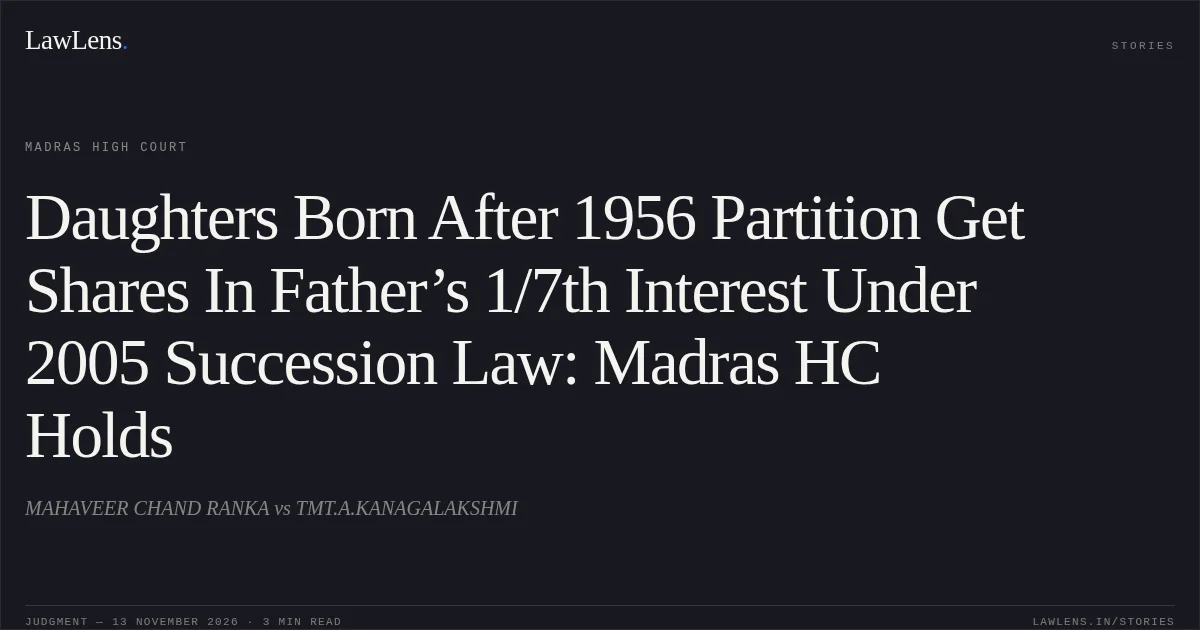
¶ 11–12Applying the after-born-child rule, it held that the children born after partition—including daughters, by virtue of amended Section 6—could claim in their father’s 1/7 share, but could not reopen the 1956 partition or claim coparcenary rights in the shares already allotted to the divided sons.
¶ 15–16The father’s settlement could not defeat those rights in his joint-family share.
¶ 15–16The Court separately accounted for the shares inherited by the parents under Sections 8 and 15, recognised the mother’s settlement of 522 square feet, and calculated the parties’ respective entitlements.
¶ 16–19Because the purchasers acquired the property during the pending suit, their purchase did not bind the plaintiffs’ shares.
¶ 2105Holding
The Court modified the preliminary decree.
¶ 19.8, 22It declared that plaintiffs 1 and 3 and defendants 2, 4, 5 and 9 were each entitled to 276.55 square feet; the second plaintiff and defendant 10 to 80.49 square feet each; defendants 1, 3, 6 and 7 to 1,452.924 square feet each; and defendants 14–17 collectively to 1,452.924 square feet.
¶ 19.8, 22It recognised the 522-square-foot settlement in favour of defendants 4 and 7.
¶ 19.8, 22O.S.A. Nos. 304 and 370 of 2018 were partly allowed, O.S.A. No. 390 of 2018 was disposed of, and there was no order as to costs.
¶ 23Original Court PDF
MAHAVEER CHAND RANKAvsTMT.A.KANAGALAKSHMI
Click to open original judgment
Original judgment, available to read, download and summarize on LawLens.in