01Facts
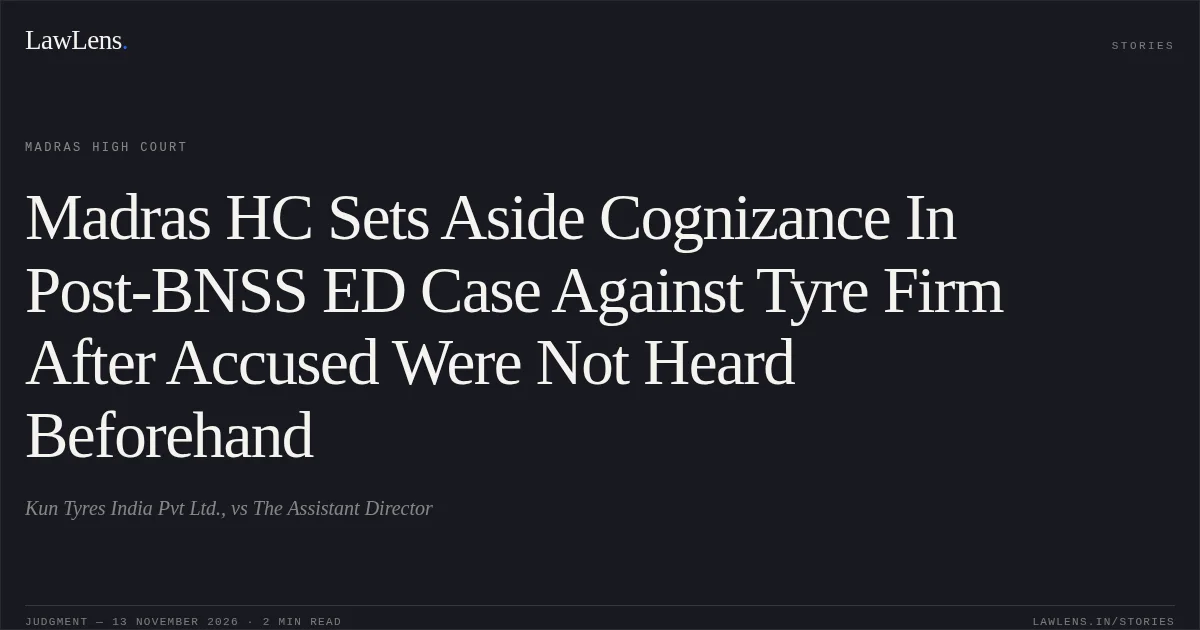
The petitioners sought to quash proceedings in Spl.C.C. No. 14 of 2025, challenging the Special Court’s order dated 7 October 2025 taking cognizance of the Enforcement Directorate’s complaint without first giving them an opportunity to be heard under the proviso to Section 223(1) of the Bharatiya Nagarik Suraksha Sanhita, 2023 (BNSS).
pp. 1–2, 6The Enforcement Directorate argued that, because the ECIR had been registered before the BNSS came into force on 1 July 2024, Section 531 of the BNSS preserved the application of the Code of Criminal Procedure, 1973 (CrPC).
p. 202Issues
i.1. Whether the proviso to Section 223(1) of the BNSS required the Special Court to give the accused an opportunity of being heard before taking cognizance of the Enforcement Directorate’s complaint.
pp. 2, 4–6ii.2. Whether the fact that the ECIR was registered before the BNSS came into force meant that the cognizance proceedings were governed by the CrPC under Section 531 of the BNSS.
p. 203Law Applied
Section 223(1) of the BNSS bars a Magistrate from taking cognizance of an offence on complaint without giving the accused an opportunity to be heard; this hearing requirement is distinct from the requirement to examine the complainant and witnesses, from which the statute provides exceptions.
pp. 3–5The Supreme Court in Kushal Kumar Agarwal v. Directorate of Enforcement, 2025 SCC OnLine SC 1221, held that complaints under Section 44 of the Prevention of Money Laundering Act, 2002 (PMLA) are governed by the complaint-procedure provisions in Sections 200–204 of the CrPC and, for complaints filed after 1 July 2024, by the corresponding provisions in Chapter XVI of the BNSS, including Section 223.
pp. 3–5The Court also referred to Yash Tuteja v. Union of India, 2024 SCC OnLine SC 533, and Tarsem Lal v. Enforcement Directorate, (2024) 7 SCC 61, as supporting the application of the complaint procedure to PMLA complaints.
p. 5Provisions in the judgment · 12 · Linked ones open on LawLens
Bharatiya Nagarik Suraksha Sanhita, 2023 Section 212Section 223Section 224Section 225Section 226Section 531
Prevention of Money-Laundering Act, 2002 Section 44
Code of Criminal Procedure, 1973 Section 200Section 201Section 202Section 203Section 204
04Reasoning
The Court treated the relevant date as the filing of the complaint, not the earlier registration of the ECIR.
pp. 4–6It relied on Kushal Kumar Agarwal for the proposition that Section 223 of the BNSS applied to a PMLA complaint filed after 1 July 2024 and that its hearing proviso restricted the court’s power to take cognizance without hearing the accused.
pp. 4–6The Court found the respondent’s authorities distinguishable; it noted that the Uttarakhand High Court decision in Parvinder Singh had been set aside by the Supreme Court and that the decision in G. Ganesan was under challenge.
p. 6Accordingly, the pre-BNSS registration of the ECIR did not justify taking cognizance without complying with Section 223(1).
p. 2, 605Holding
The Court held that the order taking cognizance without giving the petitioners an opportunity to be heard was illegal.
p. 6It set aside the 7 October 2025 cognizance order, restored the complaint to its original file, and directed the court concerned to proceed in accordance with law.
p. 6The Criminal Original Petition was partly allowed; the connected miscellaneous petitions were closed.
p. 6Original Court PDF
Kun Tyres India Pvt Ltd.,vsThe Assistant Director
Click to open original judgment
Original judgment, available to read, download and summarize on LawLens.in