01Facts
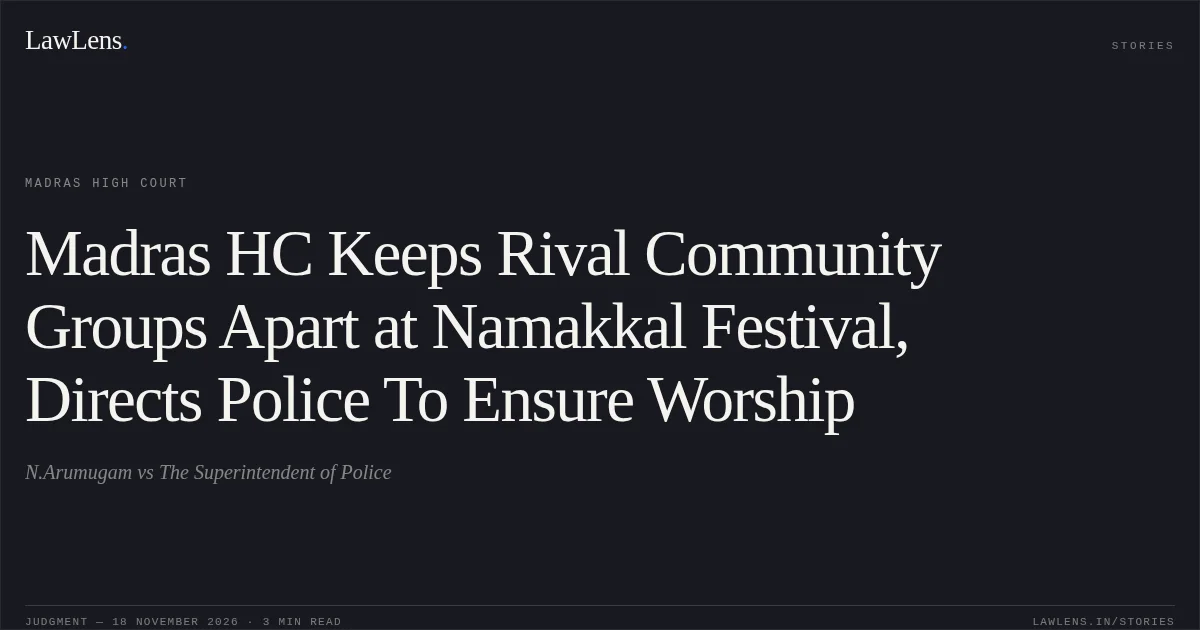
Two writ petitions were clubbed and disposed of by a common order concerning a festival (Periya Thevam / Perum Pongal Pooja, also described as a Periya Deva Mahotsavam) scheduled for 19 and 20.11.2026 at Mallasamuthiram, Namakkal District, performed by the Vasista Maharishi Gothra, Kongu Kual, Paruthipalli Naadu community.
¶ 2The festival is held once every 12 years and includes tonsuring, ear-piercing and related rites.
¶ 2The petitioner in W.P. 3042/2026 (N. Arumugam) states that the community proposed to hold the rites at a private premises (nrq;Fe;jh; jpUkz kz;lgk;) and that invitations were issued.
¶ 3A complaint filed by respondents 3 and 4 alleged black magic, after which the Inspector asked the petitioner not to proceed; he then made a representation dated 30.10.2026 and approached the Court when no action followed.
¶ 3The fourteen petitioners in W.P. 3117/2026 state that they are being socially boycotted and prevented from entering the temple and worshipping its deities; a police complaint (Crime No. 200 of 2016) was pending and the matter had been referred to the RDO without result.
¶ 4Counsel for the petitioners in W.P. 3117/2026 asserted that the other group would not permit them to worship in the temple.
¶ 7–8Counsel for the other side denied this and gave an undertaking that the festival would be held in a rented marriage hall, that no person would be prevented from entering the temple, and that idols would not be touched or removed.
¶ 7–8The RDO (R5) was impleaded suo motu by order dated 13.11.2026.
p. 202Issues
i.1. Whether the petitioner in W.P. 3042/2026 is entitled to police protection to conduct the proposed religious festival without obstruction.
¶ 1–3, 10ii.2. Whether the petitioners in W.P. 3117/2026 are entitled to enter the temple and offer worship, and whether they may be prevented from doing so by the other group.
¶ 4, 7, 9–10iii.3. Whether the public or private character of the temple can be determined in these writ proceedings.
¶ 603Law Applied
The order does not expressly cite any statute or precedent.
The petitioners in W.P. 3117/2026 are, "as a matter of right," entitled to enter the temple and offer worship.
¶ 9The right to conduct religious worship in a private premises must not be obstructed by others, and police must ensure such activities proceed unhindered.
¶ 10Whether a temple is public or private must be determined by filing an appropriate application before the jurisdictional Hindu Religious and Charitable Endowments authorities, not in writ proceedings.
¶ 6The petitioners' assertion that exclusion violates their "Constitutional rights" is recorded as a contention, but no constitutional provision is analysed in the order.
¶ 4 · no citation04Reasoning
The Court declined to decide whether the temple is public or private, holding that this question belonged to the statutory authorities under the HR&CE framework.
¶ 6The Court accepted the undertaking given on behalf of the W.P. 3042/2026 petitioner (festival held in a rented marriage hall; no obstruction of entry; no removal or touching of idols) and recorded it.
¶ 8The Court held that the W.P. 3117/2026 petitioners were entitled to enter the temple and worship, but should not go to the site of the proposed private celebration or disrupt worship there.
¶ 9To balance the competing claims, the Court placed a bilateral obligation on the Inspector of Police, Mallasamuthiram, to ensure that neither group's religious activity is obstructed.
¶ 10The reasoning separates the two spaces (temple versus private venue) and resolves the immediate dispute through restraint and supervision rather than adjudicating the underlying title or boycott allegations.
¶ 6, 9–1005Holding
The Court did not finally adjudicate the public/private status of the temple or the alleged social boycott, both of which are left to the appropriate authorities.
¶ 6The petitioners in W.P. 3117/2026 are entitled to enter the temple and worship, but must not proceed to the private venue or disrupt the W.P. 3042/2026 petitioner's worship there.
¶ 9The Inspector of Police, Mallasamuthiram Police Station, is directed to ensure that the W.P. 3042/2026 petitioner's religious activities are not obstructed by anyone, including the W.P. 3117/2026 petitioners, and that the latter are not prevented from entering the temple and worshipping.
¶ 10Both writ petitions are disposed of, and the connected miscellaneous petition (WPMP Crl. No. 1125 of 2026) is closed.
¶ 11Original Court PDF
N.ArumugamvsThe Superintendent of Police
Click to open original judgment
Original judgment, available to read, download and summarize on LawLens.in