01Facts
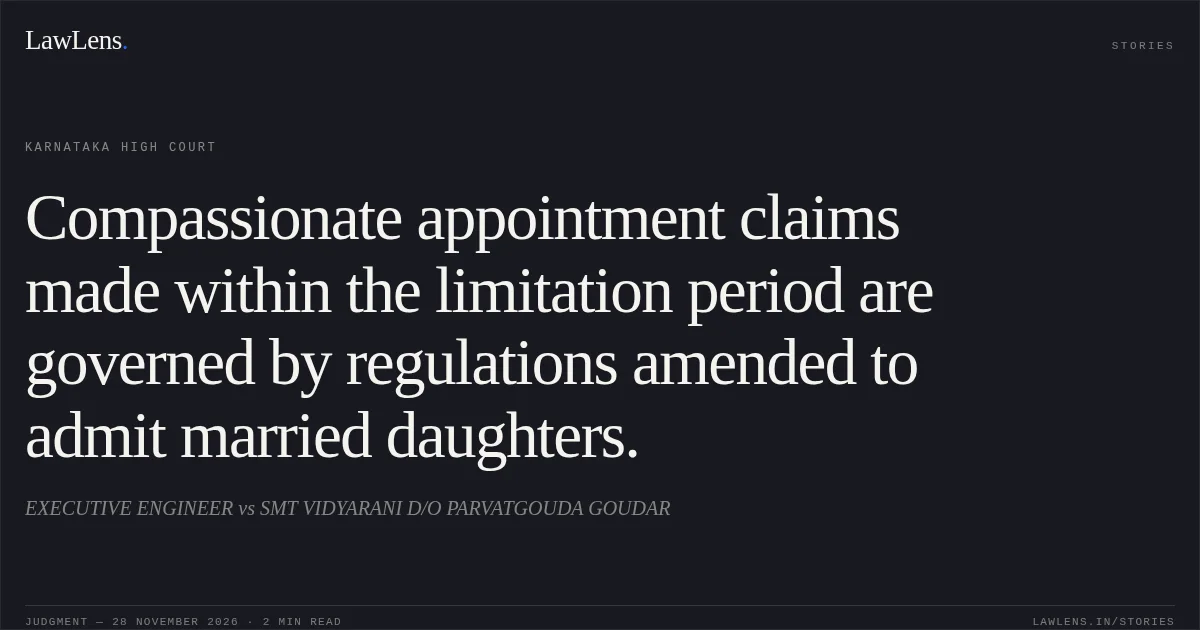
The respondent's father, an employee of HESCOM, died in harness on 27.01.2020, leaving a wife and three daughters.
¶ 2The respondent was already married at the time of his death.
¶ 2Under HESCOM's regulations then in force, a married daughter was not eligible for compassionate appointment, whereas a married son was.
¶ 2The respondent applied for compassionate appointment within the stipulated limitation period.
¶ 2Before her application was decided, the regulations were amended to make married daughters eligible.
¶ 2Her application was rejected on 20.11.2021 on the ground that she lacked eligibility on the date of her father's death.
¶ 2In W.P. No. 101510/2022, the learned Single Judge quashed the rejection order on 20.12.2023 and remitted the matter for fresh consideration within three months.
¶ 2HESCOM filed the present appeal with a delay of 783 days.
¶ 302Issues
i.1. Whether the appellants made out satisfactory grounds for condonation of the 783-day delay in filing the appeal.
¶ 4(i) · ¶ 8ii.2. Whether the learned Single Judge erred in holding that the amended regulations apply to the respondent's request for compassionate appointment.
¶ 4(ii) · ¶ 703Law Applied
The Court relied on Article 14 of the Constitution of India, holding that the erstwhile regulations' differentiation between married sons and married daughters for compassionate appointment was discriminatory, as it was not a reasonable classification with a rational nexus to the object of the scheme.
¶ 5The purpose of compassionate appointment is to prevent the family of a deceased employee from being pushed into destitution after the loss of its breadwinner, and the time limit for applying exists to serve that purpose.
¶ 6An appellant seeking condonation of delay must assign appropriate reasons that satisfactorily explain the delay.
¶ 8The judgment cites no precedents and does not name the governing statute, referring to it only as "the Act."
Provisions in the judgment · 1 · Linked ones open on LawLens
KARNATAKA HIGH COURT ACT, 1961 Section 4
04Reasoning
The erstwhile regulations were discriminatory and violative of Article 14, because sons and daughters share equal responsibility for their parental families and equal rights in inherited property.
¶ 5HESCOM's subsequent amendment placing married daughters at par with married sons was a correction of that discrimination.
¶ 5The respondent had applied within the limitation period, and the amendment took effect while her application was pending. This fact was undisputed, so she was entitled to be considered under the amended regulations.
¶ 6The Single Judge's reasoning was sound and HESCOM had shown no reason to disturb it.
¶ 7 · ¶ 8The appellants' explanation for the 783-day delay did not satisfactorily account for it, and the delay was inordinate.
¶ 805Holding
The appellants had not satisfactorily explained the inordinate delay of 783 days.
¶ 8The Single Judge did not err in applying the amended regulations, since the erstwhile differential treatment was discriminatory and the respondent applied within time.
¶ 5–7The writ appeal is dismissed, and the connected interlocutory applications are also dismissed.
¶ 9The Single Judge's order dated 20.12.2023 directing reconsideration of the respondent's application within three months stands affirmed.
¶ 2 · ¶ 9Original Court PDF
EXECUTIVE ENGINEERvsSMT VIDYARANI D/O PARVATGOUDA GOUDAR
Click to open original judgment
Original judgment, available to read, download and summarize on LawLens.in