01Facts
On March 2, 2007, a motorcycle carrying Nagendra Pratap Singh and Surendra Pratap Singh (pillion rider) was hit head-on by a Tata Sumo (offending vehicle) on the Patti-Pratapgarh Road
¶ 5Both victims succumbed to their injuries. Two claim petitions were filed under Section 166 of the Motor Vehicles Act, 1988
¶ 6The Tribunal awarded compensation of Rs. 8,42,224/- and Rs. 5,23,312/- respectively, holding the Tata Sumo driver solely negligent
¶ 8The Insurance Company appealed on grounds of contributory negligence and "double benefit" because the sons of the deceased received compassionate appointments
¶ 10.1–10.2The claimants cross-appealed for enhancement, seeking revised pay scale benefits, future prospects, and higher consortium
¶ 11.1–11.602Issues
i.1. Whether the driver of the offending vehicle was solely responsible for the accident or if it was a case of contributory negligence
¶ 13ii.2. Whether the revision of salary pursuant to the VIth Pay Commission (effective retrospectively from 01.01.2006) should be considered for compensation
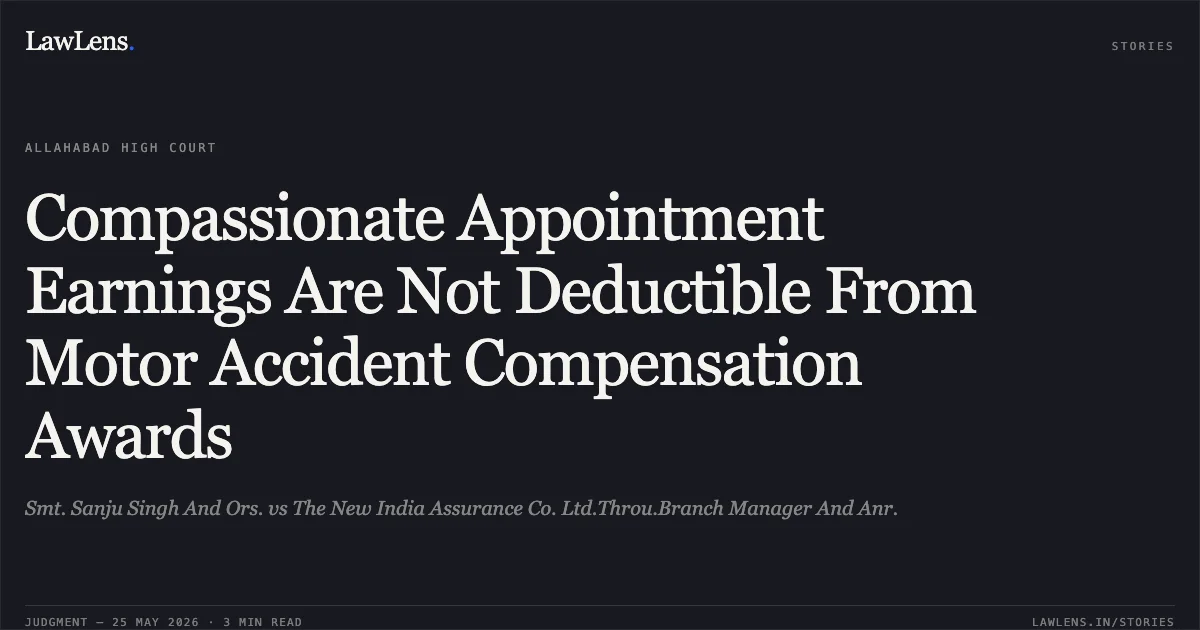
¶ 15iii.3. Whether income from compassionate appointments granted to the sons of the deceased is a "pecuniary advantage" deductible from the compensation
¶ 18iv.4. Whether the claimants are entitled to future prospects and re-evaluated conventional heads/multipliers
¶ 32, 35, 3803Law Applied
The Court applied Section 168 of the Motor Vehicles Act, 1988 regarding "just compensation"
¶ 25It followed Rajesh v. Rajbir Singh and Roshani Devi v. P.S. Malhotra to allow retrospective pay revision benefits
¶ 16Regarding compassionate appointments, it applied National Insurance Co. Ltd. v. Rekhaben and Vimal Kanwar v. Kishore Dan, establishing that such employment is not a deductible "pecuniary advantage" as it is earned through labor and is not a direct result of the tort
¶ 20–21For quantification, it applied Sarla Verma v. DTC for multipliers and deduction of personal expenses
¶ 33National Insurance Co. Ltd. v. Pranay Sethi for conventional heads/future prospects
¶ 35Magma General Insurance Co. Ltd. v. Nanu Ram regarding "parental consortium"
¶ 36Provisions in the judgment · 5 · Linked ones open on LawLens
Motor Vehicles Act, 1988 Section 140Section 162Section 166Section 168Section 173
04Reasoning
The Court affirmed sole negligence of the Jeep driver, noting the site plan showed the motorcycle was on the extreme left while the Jeep swerved into the wrong lane
¶ 14It held that since the VIth Pay Commission was implemented retrospectively from 2006, the revised salary must be the basis for calculation
¶ 17Crucially, the Court rejected the Insurance Company's "double benefit" argument, ruling that salary from compassionate appointment is not deductible because the source (employment/labor) is distinct from the tortfeasor's liability
¶ 23However, the Court uniquely denied "future prospects" because the sons had "stepped into the shoes" of the deceased by securing revised pay scale jobs, thus neutralizing the loss of future career progression in this specific factual matrix
¶ 31–32It corrected the personal expense deductions (from 1/3rd to 1/5th and 1/4th) based on the high number of dependents and updated the multipliers according to the Sarla Verma table
¶ 34, 3905Holding
The holding clarified that while compassionate appointment does not reduce base compensation, it may be considered when deciding the necessity of adding "future prospects" to be "just"
¶ 32The Court partly allowed the claimants' appeals and modified the awards. In FAFO No. 871 of 2014, compensation was enhanced to Rs. 15,75,190/-; in FAFO No. 24 of 2016, it was enhanced to Rs. 11,42,370/-
¶ 41, 43The Court ordered a simple interest rate of 7% per annum from the date of filing and upheld the "pay and recover" principle, allowing the Insurance Company to recover the enhanced amount from the vehicle owner
¶ 42, 43Original Court PDF
Smt. Sanju Singh And Ors.vsThe New India Assurance Co. Ltd.Throu.Branch Manager And Anr.
Click to open original judgment
Original judgment, available to read, download and summarize on LawLens.in