Facts
The petitioner’s husband died on 14.10.2015 while serving in the Department of Atomic Energy, Kalpakkam.
Source reference: p. 2The petitioner claimed to have applied for compassionate appointment on 29.12.2015, but failed to provide proof of receipt by the respondents until 2019.
Source reference: p. 2Following a direction from the Central Administrative Tribunal (CAT) in a previous application (OA.No.511/2023), the authorities rejected the claim on 11.10.2023.
Source reference: p. 3The rejection was based on the son’s overage, lack of educational qualifications (not passing 10th standard), and failure to meet the minimum merit points.
Source reference: p. 3-4The CAT upheld this rejection in OA/310/00966/2024 on 30.01.2026; the petitioner then moved the High Court to quash the CAT’s order.
Source reference: p. 1, 3Issues
1. Whether the delay in establishing the initial application and the subsequent rejection based on eligibility criteria under the DOPT Scheme justified the denial of compassionate appointment.
Source reference: p. 2-32. Whether the family of the deceased could be considered in "indigent circumstances" despite the receipt of substantial terminal benefits and family pension.
Source reference: p. 4Law Applied
Master Circular governing the Scheme of Compassionate Appointment issued via DoPT O.M. No. 14014/1/2022-Estt(D) dated 02.08.2022.
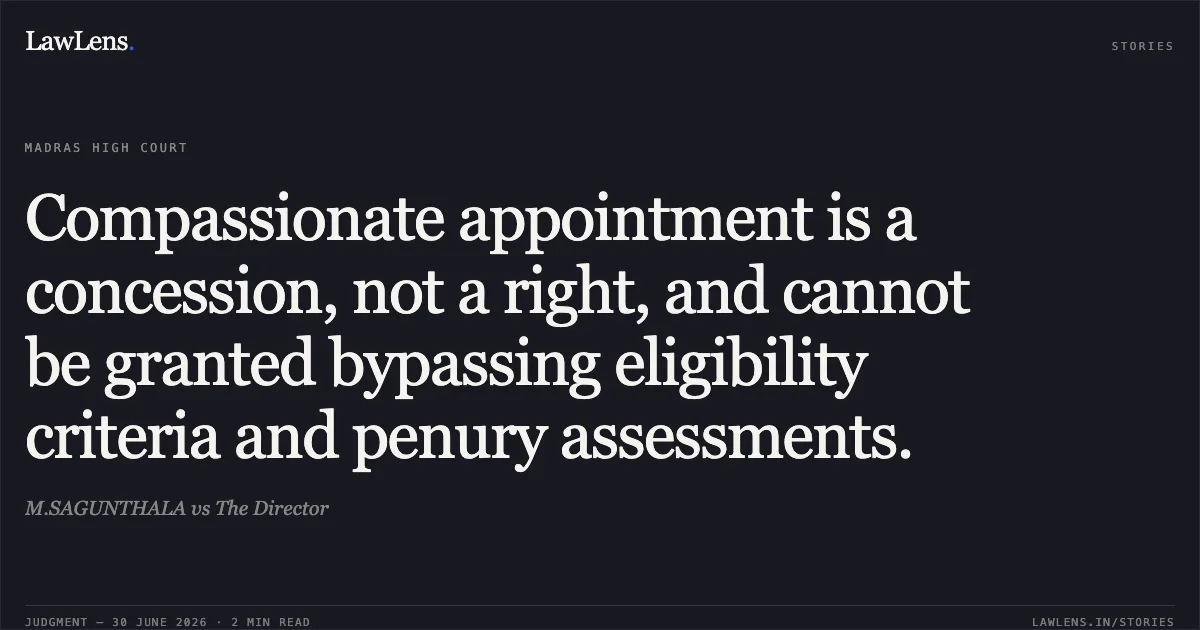
Source reference: para. 4-5Compassionate appointment is a "concession" and a "special scheme"—not a vested right—intended strictly to mitigate immediate penury.
Source reference: para. 6Article 16 of the Constitution mandates equal opportunity in public employment, meaning such appointments must be restricted to truly deserving cases to avoid infringing upon the rights of meritorious candidates in open competition.
Source reference: para. 6Reasoning
The court found no evidence that the petitioner submitted a timely application following the 2015 death, noting that the first reliable acknowledgment appeared only in 2019.
Source reference: p. 2Upon evaluating the merits, the court noted that the son, Shri. Jaiganesh, was 31 years old at the time of death and lacked the minimum educational qualification (10th standard).
Source reference: para. 5The court observed that the family was not in a state of "penury," as they had received a revised family pension of ₹16,000 per month, arrears of ₹3,27,861, and terminal benefits (DCRG, etc.) totaling ₹8,42,654.
Source reference: para. 5The court reasoned that since both children were married and lived independently at the time of the employee's death, they were not "dependents" as defined by the scheme.
Source reference: para. 5The court emphasized that providing large-scale compassionate appointments would lead to administrative inefficiency and violate the constitutional mandate of merit-based recruitment.
Source reference: para. 6Holding
The High Court answered both issues in the negative, finding no infirmity in the Tribunal's order.
The court held that compassionate appointment is an exception to the general rule of recruitment and cannot be granted when the family is not in indigent circumstances and the applicant fails to meet age and educational criteria.
Source reference: para. 5-6The Writ Petition was dismissed, and no costs were awarded.
Source reference: para. 8Acts & Sections Cited
1 provisions across 1 statute referred to in this judgment. Linked provisions open on LawLens.
Scheme for appointment of Arbitrators, 19961
Original Court PDF
M.SAGUNTHALAvsThe Director
Click to open original judgment
Original judgment, available to read, download and summarize on LawLens.in


