Facts
The petitioner’s father, an employee in the Work Charged Contingency Establishment, died in service on January 15, 2011.
Source reference: para. 3The petitioner applied for compassionate appointment, which was rejected via an impugned order in 2014.
Source reference: para. 2, 5The rejection was based on the policy dated September 29, 2014, which provided only a compensatory amount of Rs. 2 lakh for heirs of Work Charged employees rather than appointment.
Source reference: para. 2The petitioner challenged this rejection in 2019, arguing that a 2016 amendment to the policy now makes such dependents eligible for appointment.
Source reference: para. 3Issues
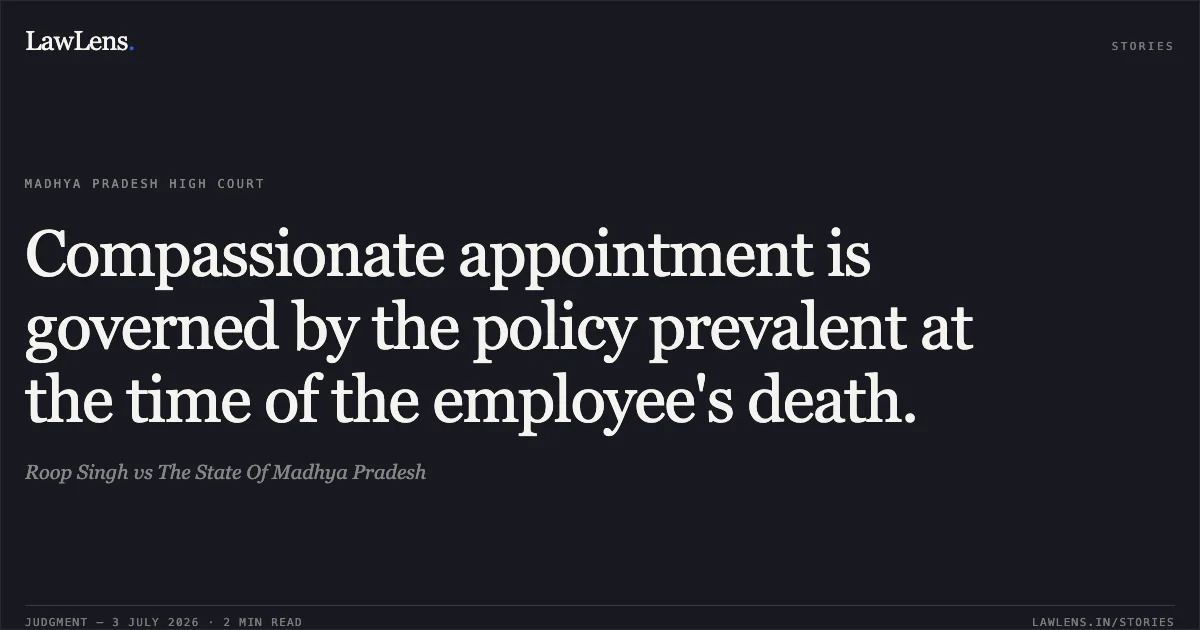
1. Whether the policy prevalent at the time of the employee's death or a subsequent amended policy governs the entitlement for compassionate appointment.
Source reference: para. 42. Whether the petitioner is entitled to compassionate appointment after a significant lapse of time since the death of the breadwinner.
Source reference: para. 6Law Applied
The court applied the principle that compassionate appointment must be governed by the scheme/policy in force on the date of the employee’s demise, as established in State of Madhya Pradesh v. Ashish Awasthi (2022) 2 SCC 157.
Source reference: para. 4It further relied on Indian Bank v. Promila (2020) 2 SCC 729 and State of M.P. v. Amit Shrivas (2020) 10 SCC 496 to affirm that subsequent schemes cannot be applied retrospectively.
Source reference: para. 4Additionally, the court applied the doctrine from Steel Authority of India Limited v. Gouri Devi (2022) 17 SCC 531, which stipulates that the objective of compassionate appointment is immediate amelioration; thus, a long delay in seeking relief suggests the family has survived the financial crunch and negates the right to such an appointment.
Source reference: para. 6Reasoning
The court reasoned that since the petitioner’s father died in 2011, the 2014 policy (which was in effect or similar to the terms at the time of death) correctly applied to his case, limiting relief to a compensatory payment of Rs. 2 lakh.
Source reference: para. 2-3The court rejected the petitioner's claim to the benefit of the 2016 amendment, citing settled Supreme Court precedents that prohibit applying subsequent policies to past deaths.
Source reference: para. 4-5Furthermore, the court observed a significant delay: the death occurred in 2011, the rejection happened in 2014, the petition was filed in 2019, and it reached a hearing in 2026.
Source reference: para. 3, 5The court concluded that because the petitioner had coped with the financial crisis for 12 to 15 years, the immediate necessity that justifies compassionate appointment as an exception to Article 14 no longer existed.
Source reference: para. 6-7Holding
The court answered the issues in the negative, holding that the petitioner was bound by the policy prevalent at the time of death and that the claim was stale due to laches.
The court found no illegality in the impugned order and dismissed the writ petition, affirming that compassionate appointment is not a vested right but a need-based exception that expires if the family survives the initial crisis.
Source reference: para. 6-7Original Court PDF
Roop SinghvsThe State Of Madhya Pradesh
Click to open original judgment
Original judgment, available to read, download and summarize on LawLens.in