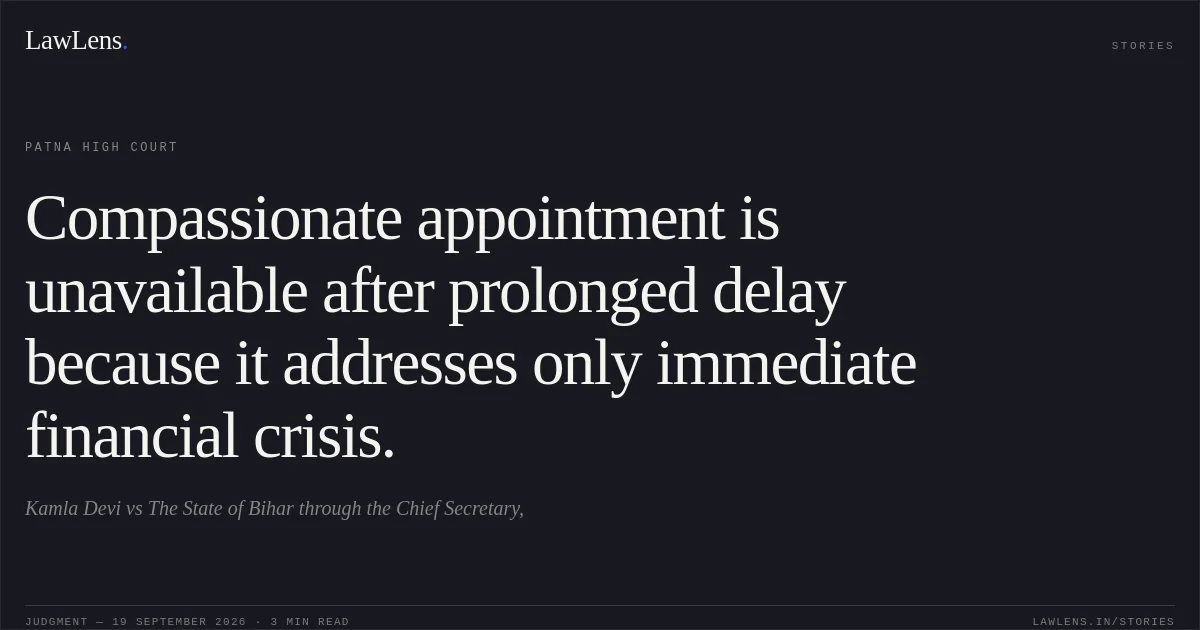
Facts
The appellant’s husband died in 1999.
Source reference: para. 2She claimed compassionate appointment and submitted a representation to the Patna Municipal Corporation on 14 July 2017.
Source reference: para. 2Earlier, she had filed CWJC No. 16397 of 2017 seeking the same or substantially similar relief; that petition was withdrawn on 1 May 2018, with the Court recording that no further writ petition would lie on the subject matter.
Source reference: para. 1, pp. 1–2Despite this, she filed CWJC No. 14792 of 2023.
Source reference: para. 1The learned Single Judge dismissed it on 1 April 2024, holding that it was barred by the principles governing successive writ petitions and constituted an abuse of process; the Court also held that compassionate appointment could not be granted approximately 24 years after the employee’s death.
Source reference: para. 1, pp. 1–4The appellant challenged that order in the present Letters Patent Appeal.
Source reference: no citationIssues
Whether the subsequent writ petition seeking compassionate appointment was maintainable after the appellant had withdrawn an earlier writ petition concerning the same or similar relief with an observation that no further writ would lie.
Source reference: para. 1, pp. 1–3Whether the appellant could claim compassionate appointment approximately 24 years after the death of her husband, notwithstanding her representation dated 14 July 2017.
Source reference: paras. 1–2, pp. 2–4Law Applied
The Court applied the principle that successive writ petitions seeking the same or substantially similar relief are impermissible and may constitute an abuse of the process of the Court, particularly where an earlier petition was withdrawn with an express bar against pursuing a fresh writ on the same subject matter.
Source reference: para. 1, pp. 1–3It relied on Sarguja Transport Service v. State Transport Appellate Tribunal, (1987) 1 SCC 5, and the other authorities cited by the learned Single Judge, including Hular Rai Baijnath Firm v. K.B. Das and Company, AIR 1968 SC 111; Upadhyay and Company v. State of U.P., AIR 1999 SC 509; Staff Association v. State Bank of India, (1996) 4 SCC 378; and Avinash Nagra v. Navodaya Vidyalaya Samiti, (1997) 2 SCC 534.
Source reference: para. 1, pp. 1–3The Court also applied the settled rule in Umesh Kumar Nagpal v. State of Haryana, (1994) 4 SCC 138, that compassionate appointment is an exception intended to relieve the family from the immediate financial crisis caused by the death of the breadwinner and cannot ordinarily be claimed after an inordinate delay.
Source reference: para. 1, pp. 3–4Reasoning
The Division Bench agreed with the learned Single Judge that the appellant’s second writ petition was substantially directed toward the same relief already pursued in the earlier proceeding.
Source reference: para. 1, pp. 1–3Since the earlier petition had been withdrawn with a specific observation that no further writ would lie on the subject matter, the subsequent petition was rightly treated as impermissible and an abuse of process.
Source reference: para. 1, pp. 1–3Independently, the appellant’s claim was defeated by the substantial lapse of time: her husband died in 1999, and the claim for compassionate appointment was being pursued nearly 24 years later.
Source reference: paras. 1–2, pp. 3–4The representation made in 2017 did not alter the underlying purpose of compassionate appointment, which is to provide immediate financial assistance rather than to reserve employment for a dependent indefinitely.
Source reference: paras. 1–2, pp. 3–4Holding
The Court held that the learned Single Judge’s dismissal of the writ petition was legally justified.
The appellant was not entitled to maintain a successive writ petition on the same subject matter and, in any event, was not entitled to compassionate appointment after such a long delay.
Source reference: para. 3The Letters Patent Appeal was accordingly dismissed, with no relief granted to the appellant.
Source reference: para. 3Original Court PDF
Kamla DevivsThe State of Bihar through the Chief Secretary,
Click to open original judgment
Original judgment, available to read, download and summarize on LawLens.in
![Caregiver exemption from routine transfer is discretionary, not an absolute right, where alternative care exists.. Gyanod Kumar vs MINISTRY OF STATISTICS & PROGRAMME IMPLEMANTATION. CAT - ['Allahabad']. LawLens](/stories/thumbnails/caregiver-exemption-from-routine-transfer-is-discretionary-not-an-absolute-right-where-alt-e82e11e068a44d2bb4a62626fc3758c8.webp)