Facts
The respondent was appointed as a Chargeman in the Naval Dock Yard, Visakhapatnam, in 2012 and was later transferred to the Naval Ship Repair Yard, Karwar.
Source reference: para. 3.1He contended that the establishment, being a registered factory employing more than 1,000 workers, was required to appoint a Safety Officer under the Factories Act, 1948 and Rule 88-A of the Karnataka Factories Rules, 1969.
Source reference: para. 3.1After obtaining an Advanced Diploma in Industrial Safety, he was assigned safety-related duties and redesignated as Foreman-in-Charge of the Yard Safety Department.
Source reference: para. 3.2The learned Single Judge quashed the rejection order and directed the appellants to extend Safety Officer service benefits to the respondent retrospectively from 23 May 2019.
Source reference: paras. 5–7Issues
Whether the learned Single Judge was justified in directing conferment of the status and service benefits of a Safety Officer in the absence of a sanctioned post in the relevant cadre?
Source reference: para. 13(i)Whether Rule 88-A of the Karnataka Factories Rules, 1969 could, by itself, compel the creation of a post and fixation of pay contrary to the applicable Central Government service and cadre rules?
Source reference: para. 13(ii)Whether the order of the learned Single Judge required interference in appellate jurisdiction?
Source reference: para. 13(iii)Law Applied
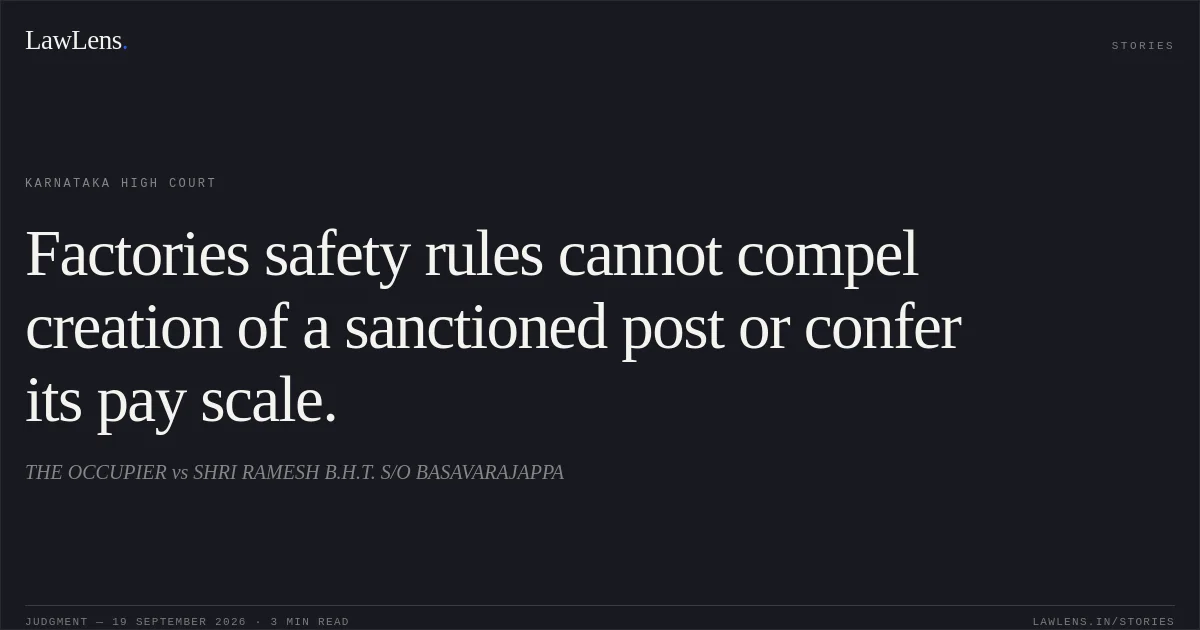
The Court applied the Factories Act, 1948 and Rule 88-A of the Karnataka Factories Rules, 1969, which impose statutory obligations concerning industrial safety and the appointment or deployment of qualified safety personnel, but do not by themselves create a substantive post or confer a particular cadre status or pay scale.
Source reference: paras. 19, 24–27Fundamental Rule 11 permits the assignment of additional duties to a Government servant without additional remuneration, subject to the governing service framework.
Source reference: paras. 4, 7, 11–12The Court further applied the principle that a writ of mandamus cannot compel the creation of a post, grant a pay scale not attached to the post held, or require action contrary to applicable service and cadre rules.
Source reference: para. 18Relying on State of West Bengal v. Subas Kumar Chatterjee, AIR 2010 SC 2927, the Court held that equation of posts and salaries, cadre strength and pay fixation are matters ordinarily entrusted to the executive and expert authorities.
Source reference: para. 21Reasoning
The respondent’s substantive service, cadre and pay were governed by Central Government and Ministry of Defence rules, and the record showed that no separate sanctioned post of Safety Officer existed in the relevant Naval cadre.
Source reference: paras. 9–10, 14Although the respondent performed safety-related functions, the Court distinguished between the assignment of additional duties and appointment to a sanctioned post.
Source reference: paras. 15–17The memorandum dated 5 August 2021 expressly assigned functional duties without financial implications and therefore could not be treated as a substantive appointment carrying the benefits of a separate post.
Source reference: paras. 15–17Rule 88-A could require the establishment to maintain appropriate safety arrangements, but it could not independently override the Navy’s cadre rules, create a post, or confer a particular pay scale retrospectively.
Source reference: paras. 18–22, 25–27The Court also held that “equal pay for equal work” could not be invoked mechanically without establishing legal equivalence of the posts, including their cadre position, recruitment method, qualifications and responsibilities.
Source reference: para. 29Holding
The writ appeal was allowed, and the Single Judge’s order dated 25 November 2025 was set aside.
The respondent’s writ petition was dismissed, and he was held not entitled, through a writ of mandamus, to retrospective conferment of the status, cadre or pay scale of a Safety Officer in the absence of a sanctioned post.
Source reference: paras. 32–34The Court clarified that the decision did not relieve the appellants or the establishment of their statutory obligations under the Factories Act, 1948 and the applicable safety rules.
Source reference: para. 35(iii)No order was made as to costs.
Source reference: para. 35(iv)Acts & Sections Cited
1 provisions across 1 statute referred to in this judgment. Each provision opens on LawLens.
KARNATAKA HIGH COURT ACT, 19611
Original Court PDF
THE OCCUPIERvsSHRI RAMESH B.H.T. S/O BASAVARAJAPPA
Click to open original judgment
Original judgment, available to read, download and summarize on LawLens.in