Facts
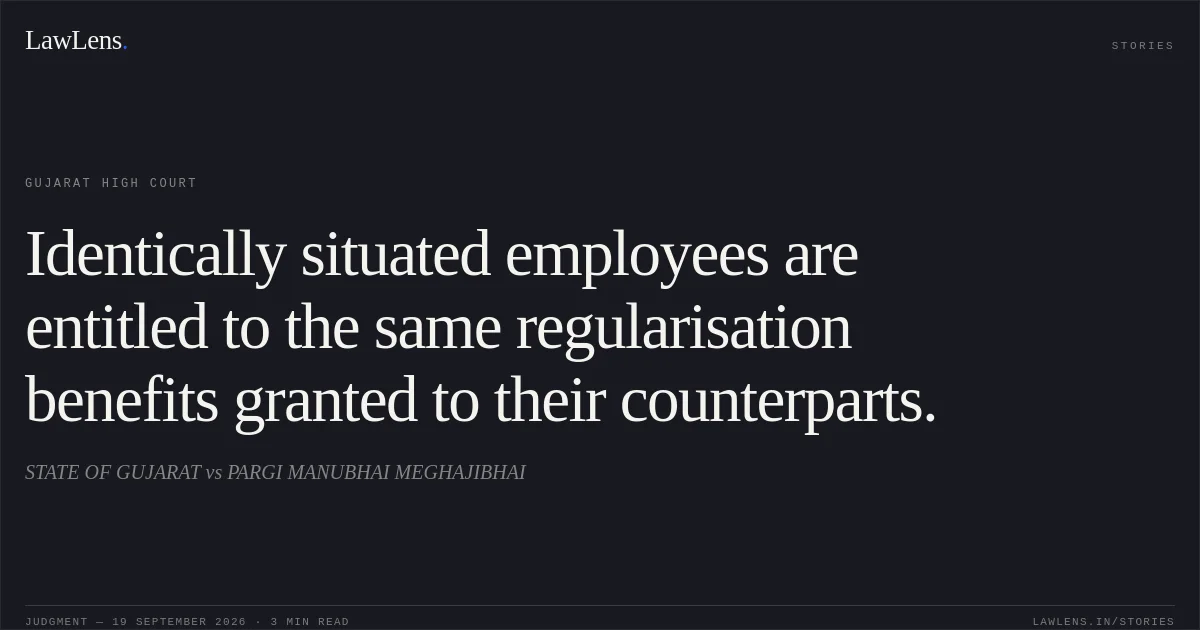
The respondents-original petitioners had approached the Gujarat High Court seeking benefits equivalent to those granted to similarly situated employees in Special Civil Application No. 6026 of 2015.
Source reference: para. 3The learned Single Judge held that the respondents were identically situated and directed the State to extend the same benefits granted in that earlier matter.
Source reference: para. 3The State did not dispute before the Single Judge that the respondents and the petitioners in Special Civil Application No. 6026 of 2015 were similarly situated.
Source reference: para. 4In the earlier proceedings, the Single Judge had directed the State to grant benefits under the applicable Government Resolutions by order dated 15 June 2015.
Source reference: para. 6That decision was affirmed in Letters Patent Appeal No. 2 of 2016 on 23 January 2023, and the Supreme Court declined to interfere on 15 March 2024, while keeping the question of law open.
Source reference: para. 6In the meantime, the employees covered by the earlier decision were regularized by the State on 23 August 2023.
Source reference: para. 6The State preferred the present Letters Patent Appeal against the order dated 23 March 2026 passed in Special Civil Application No. 7696 of 2017, contending that the respondents had specifically sought regularization whereas the earlier judgment referred to benefits under Government Resolutions.
Source reference: paras. 3, 5Issues
Whether the State could deny the respondents the same benefits granted to the petitioners in Special Civil Application No. 6026 of 2015 on the ground that the reliefs claimed in the two proceedings were differently worded, particularly in relation to regularization?
Source reference: paras. 5–9Whether the learned Single Judge was justified in directing the State to extend to the respondents the benefits granted in the earlier proceedings, when the State had not disputed that they were identically situated?
Source reference: paras. 4, 7–10Law Applied
The Court applied the principle that similarly situated persons must receive equal treatment and that a binding judicial determination, once affirmed by the appellate court and not disturbed by the Supreme Court, should ordinarily be followed in cases involving identical facts.
Source reference: paras. 6, 9The Court treated the decision in Special Civil Application No. 6026 of 2015, as affirmed in Letters Patent Appeal No. 2 of 2016 and left undisturbed by the Supreme Court, as binding precedent for the respondents’ case.
Source reference: paras. 6, 9It further applied the principle that the substance and implementation of the relief granted—not merely the wording of the prayer or judgment—must be considered, particularly where the State had implemented the earlier decision by regularizing the concerned employees.
Source reference: para. 9Reasoning
The Division Bench found that the State had failed to identify any factual or legal distinction between the respondents and the employees covered by Special Civil Application No. 6026 of 2015.
Source reference: para. 8Although the earlier judgment referred to benefits under Government Resolutions rather than expressly directing regularization in the terms relied upon by the State, the State had, in implementation of that judgment as affirmed in appeal, regularized the earlier petitioners.
Source reference: para. 9Since the respondents were admittedly identically situated, denying them the same consequential benefit would be inconsistent with the binding precedent and the State’s own implementation of it.
Source reference: para. 9The learned Single Judge had therefore correctly followed the earlier decision, and no ground for appellate interference was established.
Source reference: paras. 7–10Holding
The Gujarat High Court rejected Letters Patent Appeal No. 767 of 2026 as meritless and upheld the learned Single Judge’s order directing the State to extend to the respondents the same benefits granted to the petitioners in Special Civil Application No. 6026 of 2015.
The State was directed to comply with the learned Single Judge’s order on or before 7 November 2026.
Source reference: para. 10(B)In the event of non-compliance by that date, interest at 6% per annum on the arrears would be payable by the appellants from the date of filing of the original writ petition.
Source reference: para. 10(C)Original Court PDF
STATE OF GUJARATvsPARGI MANUBHAI MEGHAJIBHAI
Click to open original judgment
Original judgment, available to read, download and summarize on LawLens.in