Facts
The petitioner challenged, under Article 226 of the Constitution, the order dated 13.08.2021 passed by the Additional Commissioner, Bhopal Division, affirming the Sub-Divisional Officer’s order dated 16.03.2012 dismissing the petitioner’s appeal on the ground of delay.
Source reference: p.1The challenge concerned an alleged partition order dated 19.12.1995, purportedly passed by the Tahsildar, Kurwai, followed by mutation of the property in favour of the respondents.
Source reference: p.1The petitioner contended that he had neither applied for partition nor received notice of the proceedings, and that he became aware of the partition and mutation only in 2011 when the respondents allegedly informed him that the land no longer belonged to him.
Source reference: p.1–2He further alleged discrepancies in the partition documents, including the absence of the Tahsildar’s signature and the absence of seal or signature on mutation entry No. 18, and alleged that the respondents had procured the revenue entries by fraud.
Source reference: p.2The respondents opposed the petition on the grounds of inordinate delay, failure to provide a satisfactory explanation for the petitioner’s prolonged silence, and the existence of disputed questions of fact concerning the genuineness of the revenue documents and allegations of fraud.
Source reference: p.3Issues
Whether the High Court should interfere under Article 226 with the revenue authorities’ refusal to entertain the petitioner’s highly belated challenge to the alleged partition and consequential mutation?
Source reference: p.4–6Whether the allegations of want of notice, absence of signatures and seals, and fraud required adjudication by the High Court in writ jurisdiction?
Source reference: p.5–6Whether the orders dated 16.03.2012 and 13.08.2021 suffered from jurisdictional error, perversity, patent illegality, or violation of natural justice warranting interference?
Source reference: p.4–6Law Applied
The Court applied Article 226 of the Constitution, holding that writ jurisdiction is supervisory and is not intended to substitute the High Court’s view for that of a subordinate authority merely because another view is possible.
Source reference: p.4Interference is justified where the authority acts without jurisdiction, fails to exercise jurisdiction vested in it, or acts in a manner resulting in manifest injustice or patent perversity.
Source reference: p.4The Court further applied the principles governing delay and condonation, namely that a mere assertion of want of knowledge does not automatically justify entertaining a highly belated challenge.
Source reference: p.4–5It also held that allegations of fraud, authenticity of documents, and the circumstances surrounding preparation or issuance of revenue records generally involve disputed questions of fact requiring evidentiary examination and cannot be established merely by labelling an act as fraudulent.
Source reference: p.5Reasoning
The Court noted that the alleged partition took place in 1995, whereas the petitioner approached the revenue authorities only in 2011, after a substantial delay.
Source reference: p.4The petitioner’s explanation—that he lived in another village, had entrusted the land to relatives for cultivation, and lacked knowledge of the proceedings—was treated as a factual matter considered by the competent revenue authorities in relation to condonation of delay; the Court held that such an assertion, by itself, did not mandate acceptance of the belated challenge.
Source reference: p.4–5The petitioner’s objections regarding the absence of the Tahsildar’s signature, discrepancies between copies of the partition order, and missing seals or signatures on the mutation record required examination of the original revenue record and determination of disputed factual issues.
Source reference: p.5Similarly, the allegation of fraud lacked demonstrated foundational facts sufficient to establish a patent jurisdictional defect. Since the petitioner essentially sought reappraisal of the factual circumstances surrounding a 1995 partition and the genuineness of related documents, the Court found no ground for exercising its limited writ jurisdiction.
Source reference: p.5–6Holding
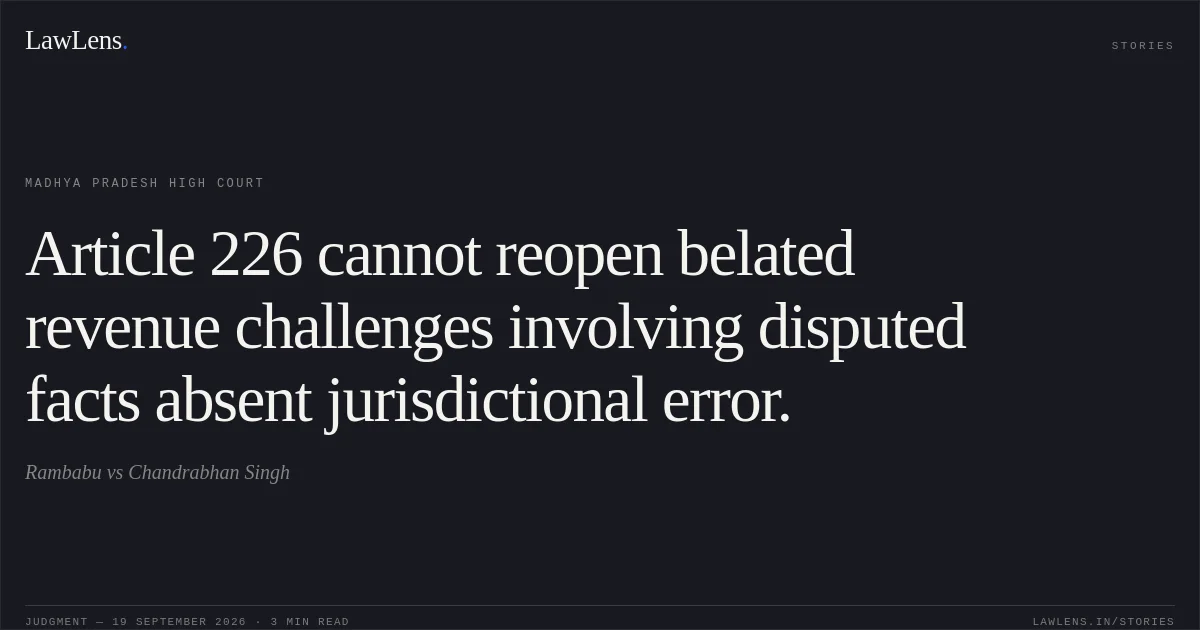
The Court held that the petitioner failed to establish any jurisdictional infirmity, perversity, patent illegality, or other ground warranting interference under Article 226.
It therefore declined to reopen the belated challenge to the alleged partition and mutation, upheld the order dated 13.08.2021 of the Additional Commissioner and the order dated 16.03.2012 of the SDO, and dismissed the writ petition as devoid of merit.
Source reference: p.6–7Original Court PDF
RambabuvsChandrabhan Singh
Click to open original judgment
Original judgment, available to read, download and summarize on LawLens.in