Facts
The petitioner/plaintiff instituted a suit for declaration and permanent injunction, including a prayer to declare the sale deed dated 22 June 1973 null and void.
Source reference: no citationIn the plaint, he disputed the genealogy claimed by respondent/defendant No. 1 and asserted that respondent No. 1 was not his son. Respondent No. 1 denied this position and claimed to be the petitioner’s son
Source reference: para. 2The petitioner filed an application under Section 45 of the Indian Evidence Act, 1872, read with Section 151 of the Code of Civil Procedure, 1908, seeking DNA examination of himself and respondent No. 1 to determine paternity.
Source reference: no citationThe First Civil Judge, Class-II, Bhind, rejected the application by order dated 23 September 2025, principally on the ground that the examination would adversely affect respondent No. 1’s privacy. The petitioner challenged that order under Article 227 of the Constitution of India.
Source reference: paras. 1–2Issues
Whether a DNA test should be directed where paternity is disputed but the principal controversy in the suit concerns title and the validity of a sale deed?
Source reference: paras. 5–6Whether the trial court’s refusal to order DNA examination constituted a palpable illegality or jurisdictional error warranting interference under Article 227 of the Constitution?
Source reference: paras. 7–8Whether the inherent power under Section 151 CPC, as recognised in Sharda v. Dharmpal, requires the court to order DNA testing whenever paternity is placed in issue?
Source reference: paras. 3 and 7Law Applied
The Court considered Section 45 of the Indian Evidence Act, 1872, concerning expert opinion, and Section 151 CPC, which preserves the civil court’s inherent power to pass orders necessary for the ends of justice.
Source reference: no citationRelying on Sharda v. Dharmpal, AIR 2003 SC 3450, the Court recognised that a civil court may, in an appropriate case, invoke Section 151 CPC to obtain relevant scientific evidence, but that the power is discretionary and not automatic.
Source reference: paras. 3 and 7The Court applied Aparna Ajinkya Firodia v. Ajinkya Arun Firodia, (2024) 7 SCC 773, which cautions against routinely directing DNA tests because of privacy, bodily autonomy, and the possible impact on a person’s identity; a DNA test should be ordered only where it is eminently necessary and is the only or substantially necessary route to the truth, subject to the statutory presumption under Section 112 of the Evidence Act.
Source reference: para. 5The Court also applied the supervisory-jurisdiction principle in Shalini Shyam Shetty v. Rajendra Shankar Patil, (2010) 8 SCC 329, that a possible view taken by a subordinate court ordinarily does not warrant interference under Article 227.
Source reference: para. 8Reasoning
The High Court held that the suit primarily concerned title and the validity of the 1973 sale deed, whereas the disputed paternity of respondent No. 1 was only incidental to that controversy.
Source reference: para. 6Since the petitioner had already pleaded a genealogical tree, the relationship between the parties could be examined through documentary and oral evidence.
Source reference: para. 6Consequently, DNA testing was not the only route to determining the relevant facts and was not shown to be eminently necessary for a just adjudication of the suit.
Source reference: para. 6Although Sharda recognised the court’s inherent power to direct scientific examination, it did not mandate DNA testing as a matter of course, particularly where such testing would implicate bodily autonomy and privacy.
Source reference: para. 7The trial court’s refusal was therefore a legally possible and discretionary view, not a jurisdictional error or palpable illegality warranting correction under Article 227.
Source reference: para. 8Holding
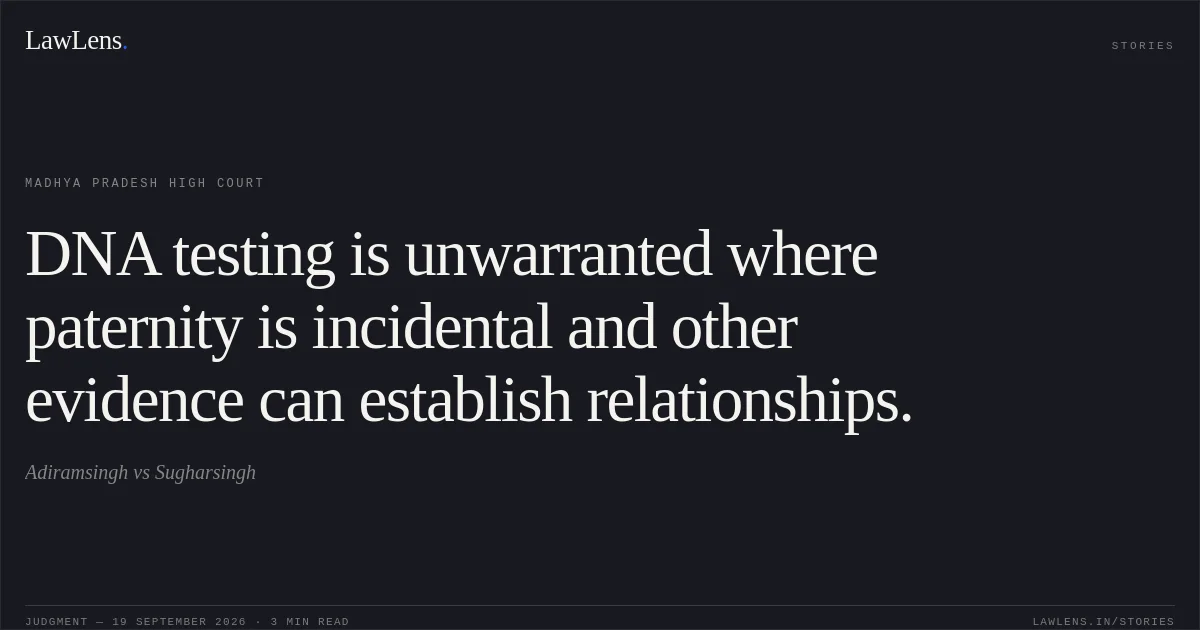
The Court answered the issues against the petitioner. It held that the disputed paternity did not justify a DNA examination because the principal issues—title and validity of the sale deed—could be adjudicated through oral and documentary evidence, and DNA testing was neither the only route to the truth nor eminently necessary.
Finding no palpable illegality or jurisdictional error in the trial court’s order, the High Court declined admission, dismissed Misc. Petition No. 6068 of 2025, and disposed of any pending applications.
Source reference: paras. 8–10Acts & Sections Cited
1 provisions across 1 statute referred to in this judgment. Each provision opens on LawLens.
Code of Civil Procedure, 19081
Original Court PDF
AdiramsinghvsSugharsingh
Click to open original judgment
Original judgment, available to read, download and summarize on LawLens.in