Facts
The petitioner’s father died while in service of the respondent electricity company.
Source reference: no citationThe petitioner sought compassionate appointment under the company’s Compassionate Appointment Policy, 2013 (Revised).
Source reference: no citationHis application was rejected by order dated 17 July 2015 on the ground that his father had died a natural death in the ordinary course, and not due to an accident or other specified contingency arising during employment.
Source reference: para. 2The petitioner challenged the rejection under Article 226 of the Constitution, contending that Clause 1.1 of the Policy permitted compassionate appointment upon the death of an eligible employee while in service.
Source reference: para. 2The respondent maintained that the Policy limited such appointment to cases involving death due to an accident, electrocution, assault by miscreants, or a motor-vehicle accident in the course of employment.
Source reference: para. 3Issues
Whether the petitioner was entitled to compassionate appointment merely because his father died while in service, notwithstanding that the death was a natural death and did not result from an accident or other specified employment-related contingency
Source reference: paras. 2–5Whether the rejection order dated 17 July 2015 was contrary to the respondent’s Compassionate Appointment Policy, 2013 (Revised), and liable to be quashed under Article 226 of the Constitution
Source reference: paras. 2, 5–6Law Applied
The Court applied Article 226 of the Constitution of India and the respondent’s Compassionate Appointment Policy, 2013 (Revised), particularly Clause 1.1 read with the eligibility conditions in Clauses 2 and 3.
Source reference: para. 2The governing principle was that compassionate appointment is available only in accordance with the applicable policy and its prescribed conditions; death during service, by itself, does not create an unconditional right to such appointment.
Source reference: no citationAs understood and applied by the Court, the Policy contemplated compassionate appointment in specified cases, including death resulting from an accident, electrocution, assault, or motor-vehicle accident in the course of employment.
Source reference: para. 3Reasoning
The Court found that the petitioner neither pleaded nor produced any material showing that his father’s death resulted from an accident, electrocution, assault, or any other employment-related contingency covered by the Policy.
Source reference: para. 5Since the impugned order recorded that the death was natural and occurred in the ordinary course, the petitioner’s case did not satisfy the Policy’s prescribed conditions.
Source reference: no citationThe Court declined to presume that the death resulted from an incident covered by the Policy in the absence of supporting evidence.
Source reference: para. 6Accordingly, the rejection was held to be consistent with the governing Policy and not arbitrary or illegal so as to warrant interference under Article 226.
Source reference: para. 6Holding
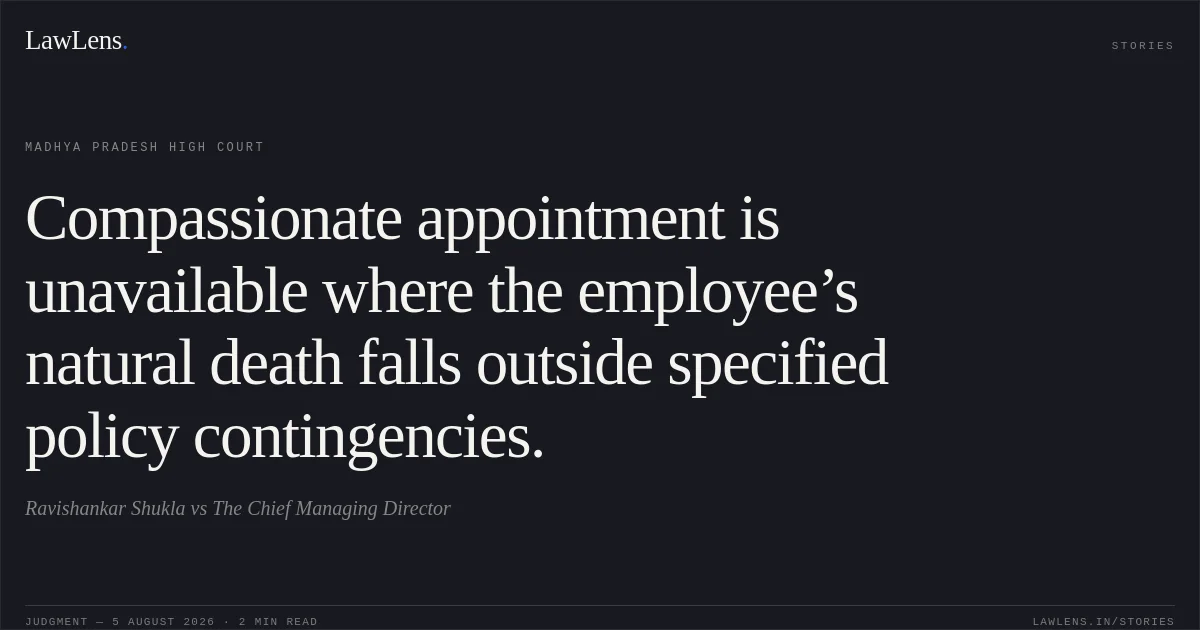
The Court held that the petitioner was not entitled to compassionate appointment because his father’s natural death did not fall within the contingencies contemplated by the respondent’s Policy.
The rejection order dated 17 July 2015 was upheld, and the writ petition was dismissed as meritless.
Source reference: para. 7Original Court PDF
Ravishankar ShuklavsThe Chief Managing Director
Click to open original judgment
Original judgment, available to read, download and summarize on LawLens.in