Facts
The deceased, who was the brother of Petitioner No. 1 and son of Petitioner No. 2, was serving as a Rural Health Officer (Male) and died in harness on 27 September 2025.
Source reference: para. 1–3Petitioner No. 1 applied for compassionate appointment. The competent authority rejected her claim by order dated 27 March 2026 on the ground that her husband, who was a member of the deceased employee’s family, was already employed in government service. The petitioners challenged the rejection under Article 226 of the Constitution, contending that the claim had been rejected arbitrarily and solely on the basis of the husband’s government employment.
Source reference: para. 1–3Issues
Whether the petitioner’s claim for compassionate appointment was rightly rejected under the applicable policy because her husband was already in government service?
Source reference: para. 5–7Whether the High Court could direct relaxation of the compassionate-appointment policy on equitable considerations under Article 226 of the Constitution?
Source reference: para. 6, 9Law Applied
Compassionate appointment is an exception to the normal rule of public recruitment and is intended to provide immediate financial assistance to the family of a deceased government employee facing financial crisis after the death of the breadwinner.
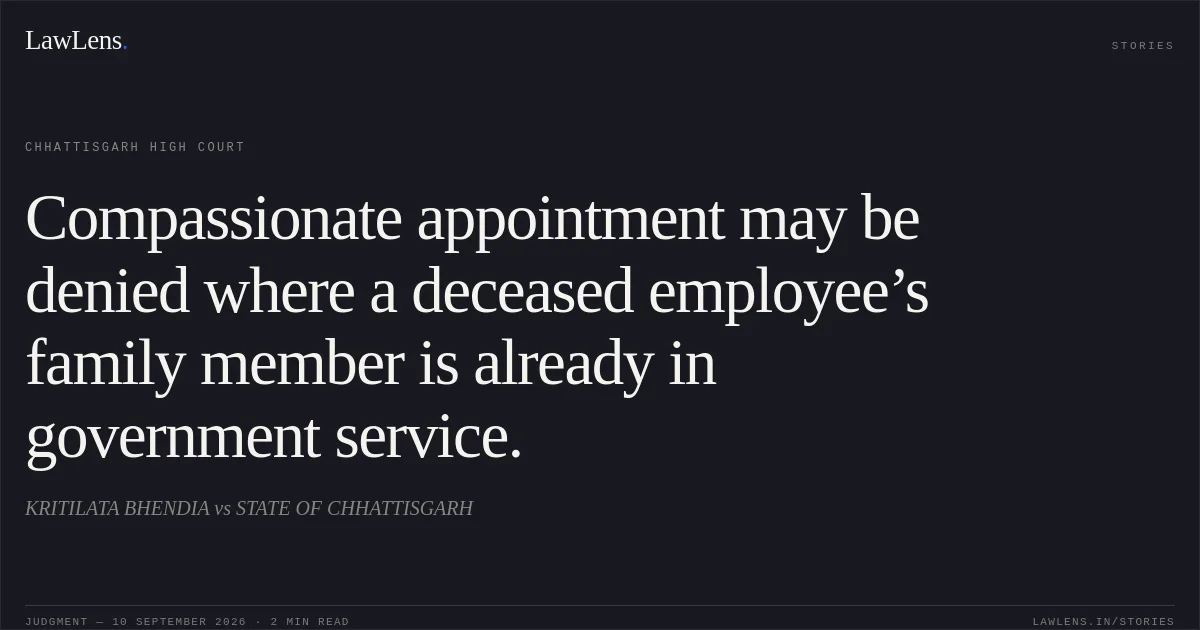
Source reference: para. 7The claim must be considered in accordance with the compassionate-appointment policy prevailing on the relevant date, and the competent authority is bound by the eligibility conditions and disqualifications prescribed therein. Where the applicable policy disqualifies a claimant because a member of the deceased employee’s family is already in government service, the Court cannot direct relaxation of that condition merely on equitable grounds while exercising jurisdiction under Article 226.
Source reference: para. 5–6The Court also relied on State of Chhattisgarh & Ors. v. Umesh Thakur, W.A. No. 236 of 2022, decided on 7 July 2023, which, following the Full Bench decision of the High Court, reiterated the applicable principles concerning dependency and government employment within the deceased employee’s family.
Source reference: para. 8Reasoning
The Court found that the competent authority had considered the petitioner’s application under the policy in force at the relevant time and had concluded that she was ineligible because her husband was already in government service.
Source reference: para. 5–6Since the policy itself prescribed this disqualification, the rejection could not be characterised as arbitrary or illegal. The Court further held that the existence of the husband’s government employment negated the immediate financial-crisis rationale underlying compassionate appointment, particularly because the husband was already serving when the deceased employee died.
Source reference: para. 7The Court declined to substitute equitable considerations for the express requirements of the policy and found no jurisdictional error warranting interference under Article 226.
Source reference: para. 6, 9Holding
The Court answered the issues against the petitioners. It held that the rejection of Petitioner No. 1’s claim was consistent with the applicable compassionate-appointment policy and that no arbitrariness, illegality, or jurisdictional error was established.
The writ petition was accordingly dismissed at the motion stage, with no direction for reconsideration or appointment.
Source reference: para. 10Original Court PDF
KRITILATA BHENDIAvsSTATE OF CHHATTISGARH
Click to open original judgment
Original judgment, available to read, download and summarize on LawLens.in