Facts
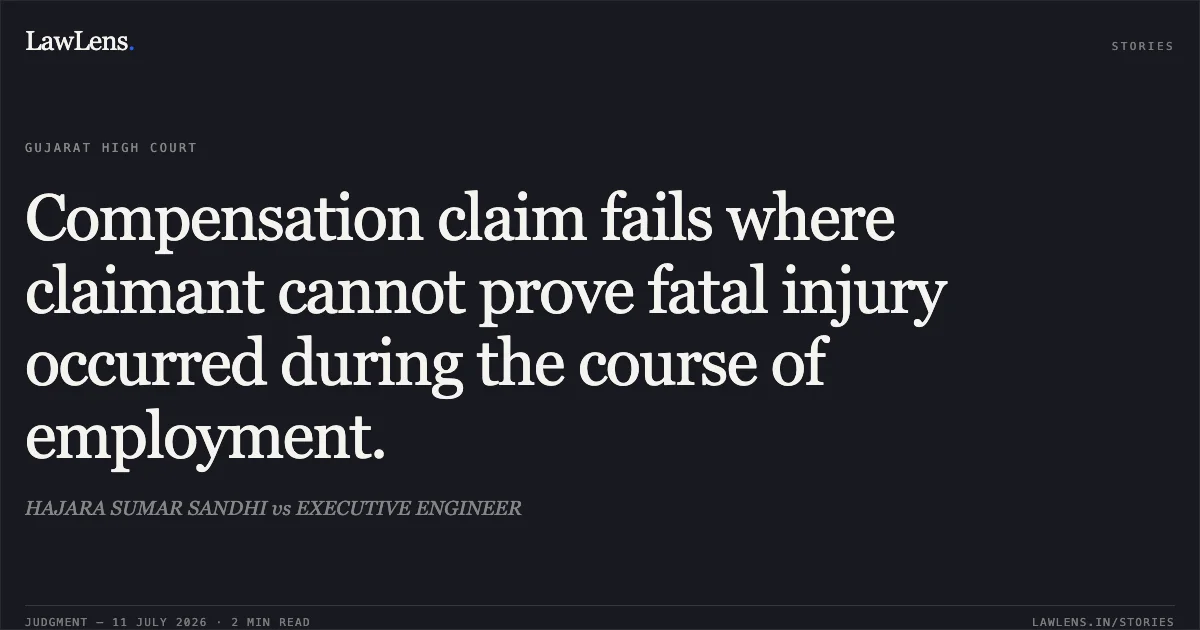
The appellants (widow and minor son of the deceased, Sumar Sandhi) challenged the dismissal of their claim petition by the Workman Commissioner, Jamnagar. The deceased was employed as a part-time Chowkidar at a PWD Store. On 04.12.1992, while on duty, he began vomiting and was hospitalized; he died the following day, 05.12.1992.
Source reference: p. 1-2The claimants alleged the death resulted from a heart attack or an insect/animal bite sustained during duty.
Source reference: p. 2medical evidence and the widow’s cross-examination revealed the deceased had been bitten by a dog two to three days prior to the incident, had sought private treatment, and subsequently developed rabies.
Source reference: p. 5-6The Commissioner dismissed the claim, finding the death did not occur "in the course of employment".
Source reference: p. 2Issues
1. Whether the death of the deceased due to rabies, resulting from a dog bite sustained days prior to the work shift, can be classified as an "employment injury" arising out of and in the course of employment.
Source reference: p. 52. Whether the claimant successfully established a causal relationship between the accident (dog bite) and the employment duties.
Source reference: p. 6Law Applied
The court applied Section 2(8) of the Employee State Insurance Act (referenced for the definition of "employment injury") and Section 3 of the Workman Compensation Act (now Employee’s Compensation Act), which require an injury to be caused by an accident arising "out of and in the course of employment".
Source reference: p. 4It relied on the Supreme Court precedent in Mackinnon Mackenzie and Co. Pvt. Ltd. v. Ibrahim Mahmmod Issak [1969 ACJ 422 (SC)], which established that there must be a "causal relationship" between the accident and the employment, meaning the risk must be incidental to the duties of the service.
Source reference: p. 6The court also referenced Halsbury’s Law of England to define an "accident" as an unexpected event happening without design.
Source reference: p. 7Reasoning
The court found that while the deceased was on duty when he fell ill (vomiting), the actual "accident" (the dog bite) did not occur during his employment hours or at his place of work.
Source reference: p. 5-6The widow’s admission in cross-examination proved that the deceased informed her of a dog bite sustained two to three days before 04.12.1992 and that he had been away from home for several days at a stretch.
Source reference: p. 5-6Applying the Mackinnon Mackenzie test, the court reasoned that the injury did not result from a risk incidental to his duties as a Chowkidar at the PWD Store.
Source reference: p. 6Although the court acknowledged the need for an "expansive meaning" of the Act’s remedial provisions, it concluded that the evidence "hopelessly failed" to connect the dog bite to the work environment or timing.
Source reference: p. 7Holding
The High Court held that since the dog bite occurred somewhere else and at a different time than his employment, it does not fall within the definition of an employment-related accident or mishap under the Act.
The High Court upheld the Trial Court's judgment, answering the issues in the negative. The appeal was dismissed, and the claim for compensation was denied.
Source reference: p. 7Acts & Sections Cited
4 provisions across 2 statutes referred to in this judgment. Linked provisions open on LawLens.
Employee3
Employees1
Original Court PDF
HAJARA SUMAR SANDHIvsEXECUTIVE ENGINEER
Click to open original judgment
Original judgment, available to read, download and summarize on LawLens.in