01Facts
The claimants' land was acquired and an award was passed.
p. 2The Reference Court (Addl. Civil Judge (Sr. Dn.), Gulbarga, LAC No. 133/1999, judgment dated 07.12.2000) enhanced compensation, from the claimed Rs. 48,000 per acre to the Rs. 60,000 per acre sought by the claimants.
p. 2 · ¶ 1–2The claimants appealed under Section 54(1) of the Land Acquisition Act, 1894 seeking further enhancement.
p. 2 · ¶ 1–2The matter was referred to mediation under retired Justice A.V. Chandrashekar, and the parties executed a Memorandum of Mediation Agreement, which was placed on record.
pp. 2–3 · ¶ 3Key terms include a recorded market value of Rs. 2,07,156 per acre for irrigated land, computed with reference to a 1991 notification rate of Rs. 1,72,630 per acre.
p. 4, cl. (a)Statutory benefits are payable except for the period of delay in filing the appeal, with no interest for that period.
pp. 4, cl. (b)–(c)The land losers waive statutory interest for three years.
p. 4, cl. (d)Interest is to be calculated up to 14.03.2026.
p. 5, cl. (e)Payment is to be made through the P.D. account of KNNL, Dharwad, under G.O. No. AE 13 TAR 2023 dated 27.09.2024.
pp. 5–6, cl. (g), (n)The agreement provides for full and final settlement with withdrawal of execution petitions.
p. 6, cl. (h), (j), (k)The Deputy Commissioner did not sign the agreement, whereas the authorised Land Acquisition Officer did.
p. 7 · ¶ 6–7The claimants raised concern about TDS and Form 16A on the compensation.
p. 8 · ¶ 802Issues
i.1. Whether the Mediation Agreement, executed without the signature of the Deputy Commissioner, is to be accepted as a valid compromise disposing of the appeal.
p. 7 · ¶ 6–7ii.2. Whether the compensation payable under the mediated settlement is subject to deduction of tax at source under the Income Tax Act, 1961.
p. 8 · ¶ 8iii.3. Whether the settlement, once accepted, can be given the effect of a decree under Section 89 CPC read with Order XXIII Rule 3 CPC.
pp. 8–9 · ¶ 903Law Applied
Section 54(1) of the Land Acquisition Act, 1894, under which the appeal was filed.
p. 2Section 89 CPC read with Order XXIII Rule 3 CPC, under which a lawful settlement in writing and signed by the parties is recognised and is to be treated as a decree.
pp. 8–9 · ¶ 9The Court's earlier order in W.P. No. 102884/2025 dated 20.08.2025, which held that compensation for compulsory acquisition of land is not subject to TDS under the Income Tax Act, 1961.
p. 8 · ¶ 8The mediation order dated 01.08.2025 referring the matters to mediation.
pp. 3–4The principle that the State's in-principle consent and the authorised officer's signature suffice where the dispute is between the beneficiary and the land loser.
p. 7 · ¶ 6Provisions in the judgment · 1 · Linked ones open on LawLens
Code of Civil Procedure, 1908 Section 89
04Reasoning
The Court accepted the mediation report because the dispute was essentially between the acquiring beneficiary (KNNL) and the land losers, and the State had consented in principle.
p. 7 · ¶ 6–7The Court dispensed with the Deputy Commissioner's signature, noting that the Land Acquisition Officer, who was authorised, had signed.
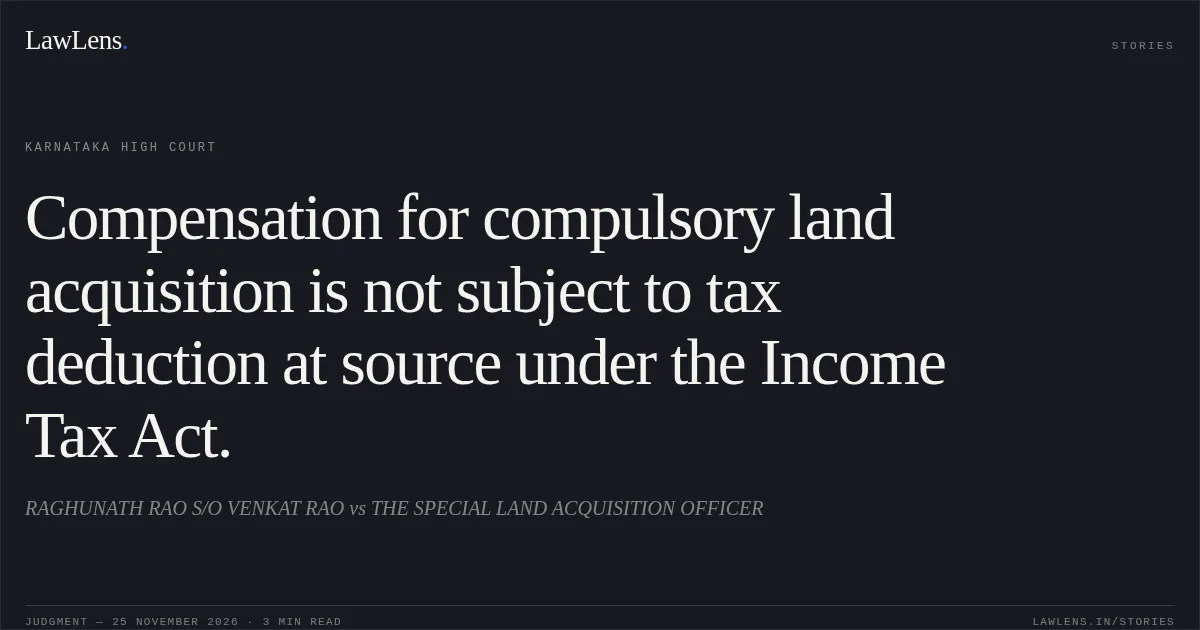
p. 7 · ¶ 6–7On the TDS apprehension, the Court held the issue settled by its earlier decision in W.P. No. 102884/2025 and directed that all payments under the agreement, whether to joint or individual accounts, be made without TDS.
p. 8 · ¶ 8The agreement was made part of the order and treated as a lawful settlement under Section 89 CPC and Order XXIII Rule 3 CPC, so that the settlement operates as a decree.
pp. 8–9 · ¶ 9The Court's reasoning rests on the voluntary nature of the compromise, which the agreement itself records as having been explained to the claimants in Kannada/English without coercion or misrepresentation.
p. 7The judgment does not separately analyse the valuation figure in cl. (a), which is recorded as stated.
p. 405Holding
The Court accepted the Memorandum of Mediation Agreement as a lawful settlement under Section 89 CPC read with Order XXIII Rule 3 CPC and held that it is to be treated as a decree for all purposes.
pp. 8–9 · ¶ 9The absence of the Deputy Commissioner's signature does not invalidate the agreement, given the State's in-principle consent and the authorised LAO's signature.
p. 7 · ¶ 6–7Compensation under the settlement is not subject to TDS, and all payments are to be made without deduction of tax at source.
p. 8 · ¶ 8The Registry is directed to draw the decree in accordance with the settlement, and the appeal is disposed of accordingly.
p. 9 · ¶ 9–10Original Court PDF
RAGHUNATH RAO S/O VENKAT RAOvsTHE SPECIAL LAND ACQUISITION OFFICER
Click to open original judgment
Original judgment, available to read, download and summarize on LawLens.in