01Facts
The petitioner, Karnataka Neeravari Nigama Ltd. (KNNL), is the beneficiary of a land acquisition for an irrigation project.
¶ 1It challenged the judgment and award dated 01.06.2019 passed by the Principal District Judge, Kalaburagi, in LACA No. 745/2017.
¶ 1 · prayer clauseIt is undisputed that KNNL was not arrayed as a party before the First Appellate Court when the award was passed.
¶ 2The matter was referred to mediation before Justice A.V. Chandrashekar (Retd.).
¶ 3The parties executed a Memorandum of Mediation Agreement, recording the market value of dry land at ₹1,57,381/- per acre.
¶ 4(a)The Mediation Agreement records entitlement to statutory benefits under the Land Acquisition Act, except for the period of delay in filing the appeal, for which no interest is payable.
¶ 4(b)–(c)The Mediation Agreement records a waiver of statutory interest for 2.5 years, with a proviso that the waiver lapses if payment is not made within four months.
¶ 4(d), (f)The Mediation Agreement provides for payment through the P.D. account of KNNL's Chief Accounts Officer, Dharwad.
¶ 4(g), (n)The Mediation Agreement records full and final settlement, withdrawal of execution petitions, and costs equal to court fee.
¶ 4(h)–(k), (m)The agreement recites State approval dated 25.02.2026.
¶ 4, preambleThe Deputy Commissioner, Kalaburagi, did not sign the agreement, while the authorised Land Acquisition Officer did.
¶ 6–7The claimants sought assurance against TDS and Form 16A issuance on compensation.
¶ 802Issues
i.1. Whether the Mediation Agreement, executed without the signature of the Deputy Commissioner but with the signature of the authorised Land Acquisition Officer, may be accepted as a lawful settlement and substituted for the Reference/Appellate Court award.
¶ 6, 7, 9ii.2. Whether compensation payable under the settlement is subject to deduction of tax at source and issuance of Form 16A.
¶ 8iii.3. Whether the writ petition may be disposed of in terms of the settlement, and what consequential directions should issue.
¶ 9, 1003Law Applied
Section 89 of the Code of Civil Procedure, 1908, read with Order XXIII Rule 3 CPC, under which a lawful settlement arrived at through mediation may be recorded and operate in substitution of a judgment or decree.
¶ 9The Court treated the mediation agreement's terms as binding once affirmed by its order.
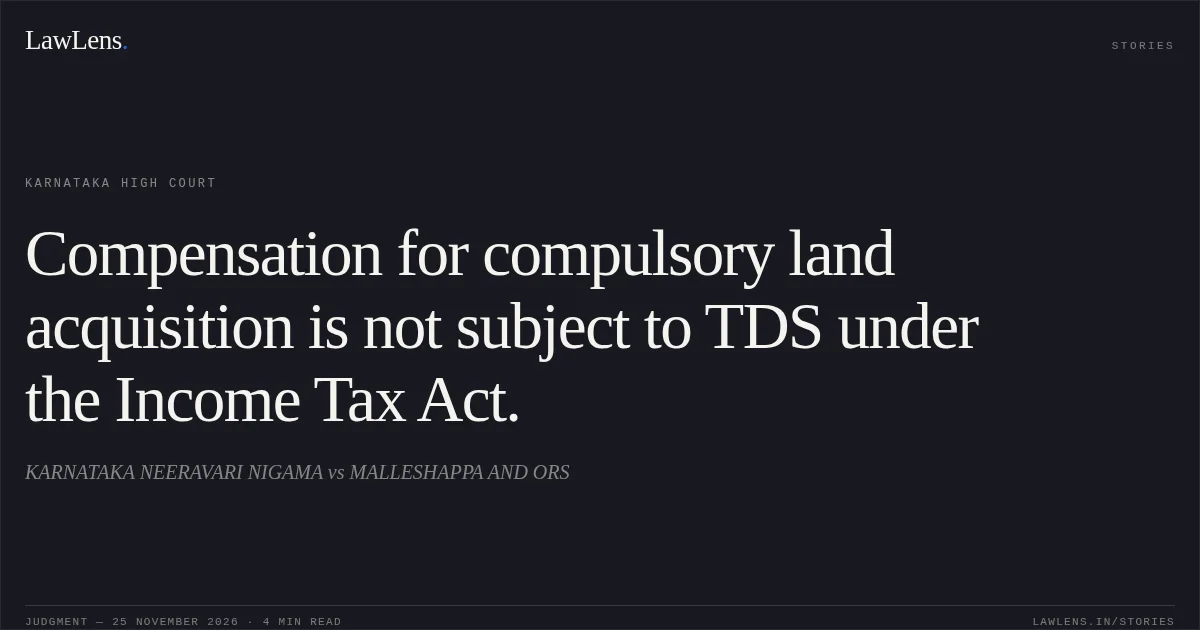
¶ 9The Court applied its earlier decision in W.P. No. 102884/2025 (order dated 20.08.2025), which held that compensation for compulsory acquisition of land is not subject to TDS under the Income Tax Act, 1961.
¶ 8The Court relied on the agreement's terms regarding statutory benefits under the Land Acquisition Act, which are referred to generally without specific section numbers.
¶ 4(b)The order references a Supreme Court decision in the agreement's recitals but does not identify it.
¶ 4, preambleProvisions in the judgment · 1 · Linked ones open on LawLens
Code of Civil Procedure, 1908 Section 89
04Reasoning
The Court first addressed the absence of the Deputy Commissioner's signature. It reasoned that the dispute was essentially between the beneficiary (KNNL) and the land loser, and that the State had consented in principle, so the Deputy Commissioner's signature was dispensed with.
¶ 6The Court accepted the Land Acquisition Officer's signature as sufficient authorisation and accepted the mediation report.
¶ 7Because the agreement was the product of detailed mediation, reflected State approval, and was voluntarily executed, the Court treated it as a settlement under Section 89 CPC and Order XXIII Rule 3 CPC, which could replace the existing award.
¶ 3, 4, 9On the TDS concern, the Court applied its prior ruling that acquisition compensation is not liable to TDS and directed that all payments under the agreement, whether to joint or individual accounts, be made without TDS deduction.
¶ 8The Court then disposed of the writ petition in terms of the settlement and directed the concerned courts to draw up a decree in accordance with the agreement within 60 days of receipt of a certified copy.
¶ 9–1005Holding
The Court accepted the Mediation Agreement and held that the absence of the Deputy Commissioner's signature did not invalidate it, given the State's in-principle consent and the authorised signature of the Land Acquisition Officer.
¶ 6–7The Court held that the agreement is a lawful settlement under Section 89 CPC read with Order XXIII Rule 3 CPC and operates in substitution of any award, judgment, or decree of the Reference and Appellate Courts.
¶ 9The Court held that compensation under the settlement is not subject to TDS and directed payments without deduction of tax at source.
¶ 8The writ petition was disposed of in terms of the memorandum of settlement, and the concerned courts were directed to draw up a decree within 60 days of receipt of a certified copy of the order.
¶ 9–10Original Court PDF
KARNATAKA NEERAVARI NIGAMAvsMALLESHAPPA AND ORS
Click to open original judgment
Original judgment, available to read, download and summarize on LawLens.in